If you sell apartments, plots, or commercial spaces in Bangladesh, you already know the math — a single closed deal can be worth tens of lakhs of taka in commission or millions in revenue. Which is why real estate is one of the most aggressively contested categories on Facebook and Google Ads in this country.
It’s also one of the most expensive places to advertise in Bangladesh. Cost per click for keywords like “apartment in Bashundhara” or “flat for sale in Gulshan” can run BDT 90–180 in 2026. Cost per qualified lead can hit BDT 2,000–5,000 in competitive Dhaka micro-markets. Developers regularly burn through BDT 5–10 lakh in monthly ad spend without seeing a single closed sale, then conclude that “digital doesn’t work for real estate.”
It does work. I’ve watched it work, repeatedly, across the real estate clients we’ve handled at Ngital over the past eight years. But it works only when the campaign architecture, targeting, creative, and lead handling are all aligned. Get any one of those wrong and you’ll burn money fast.
This post is a tactical playbook for generating real estate leads in Bangladesh through Facebook and Google Ads — what works, what doesn’t, and what most developers get wrong before they even start.
First: Real Estate Is a Fundamentally Different Game
Before we get into tactics, you have to understand why real estate marketing is different from almost every other category.
Most digital marketing optimizes for short consideration cycles — someone sees an ad, clicks, and buys within hours or days. Real estate doesn’t work that way. The journey from first ad impression to signed agreement is typically 60-180 days for an apartment purchase in Dhaka. Sometimes longer.
This means your campaigns need to do something different — not just generate clicks, but generate leads that you can nurture over weeks and months until they’re ready to make a decision. A lead is not a sale. The campaign that produces the most leads is not always the one that produces the most sales. The agencies and developers who understand this difference win the long game.
This single insight changes everything about how you should structure your Facebook and Google Ads.
The Three-Stage Funnel That Actually Works
Most real estate developers in Bangladesh run one type of campaign — usually a Facebook lead form ad or a Google Search ad pointing to a generic landing page. That’s not a campaign architecture. It’s one tactic, repeated.
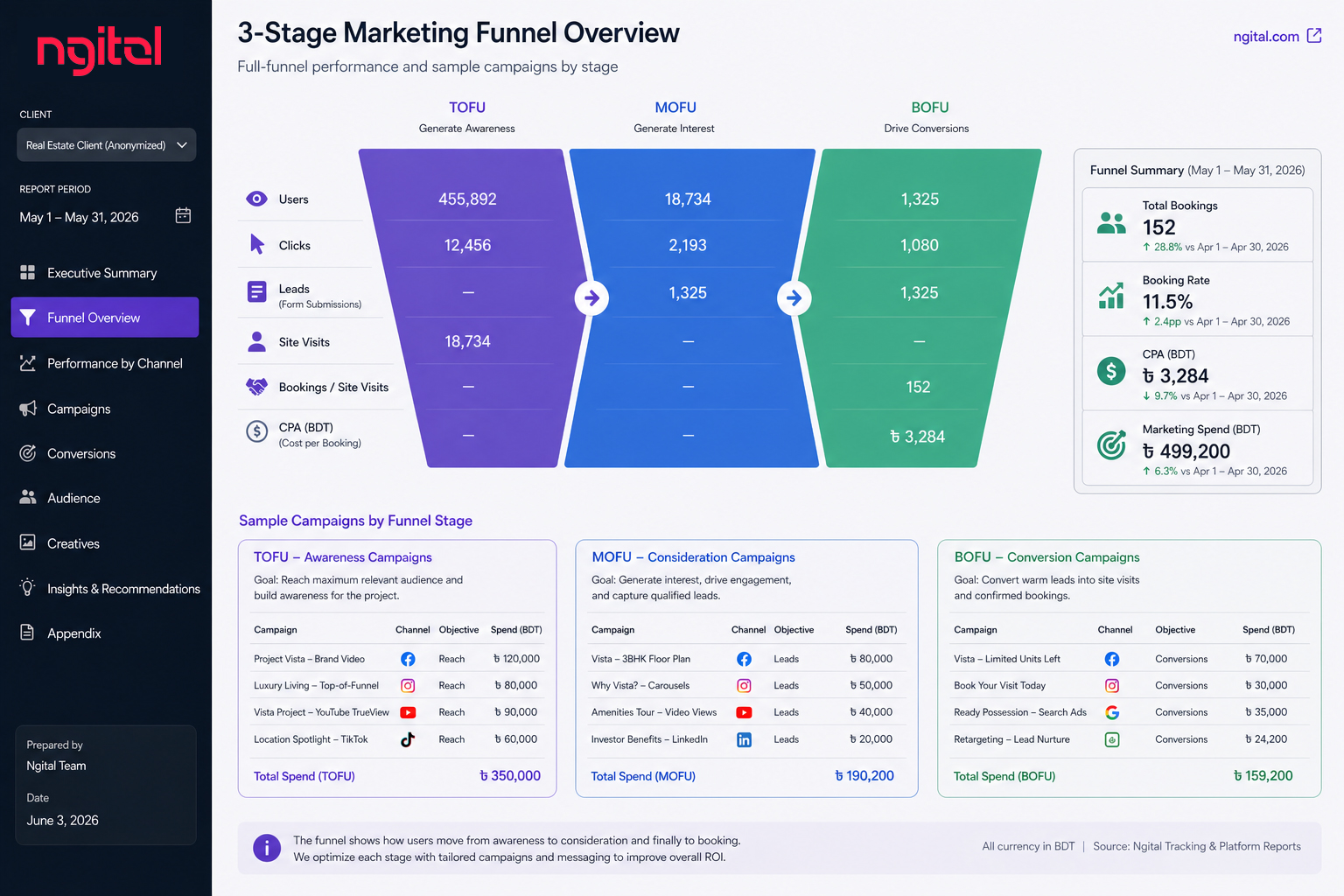
Real estate lead generation works when you build a three-stage funnel:
Stage 1 — Awareness (cold traffic, broad reach): People who don’t know your project yet but match your buyer profile. Goal: introduction and pixel data, not immediate leads.
Stage 2 — Consideration (warm retargeting): People who engaged with Stage 1 — watched a video, visited the website, clicked the ad. Goal: detailed information and lead capture.
Stage 3 — Conversion (hot retargeting + intent-based search): People who showed buying intent — submitted info, requested a callback, visited the project page multiple times — plus people actively searching on Google with high-intent keywords. Goal: book a site visit or schedule a call.
Each stage uses different platforms, different creatives, different messages, and different metrics. Most developers running BDT 5 lakh/month on Facebook are running Stage 1 logic with Stage 3 expectations. That’s why leads feel expensive and sales feel rare.
Facebook Ads for Real Estate: What Actually Works in Bangladesh
Facebook (and Instagram) are where most Bangladeshi real estate marketing budgets live, and for good reason — Meta’s targeting depth and creative formats are well-suited to long consideration purchases. But the specific tactics matter.
Use Lead Forms, But Build Better Ones
Instant Lead Forms on Facebook can deliver leads at half the CPL of website forms in Bangladesh because they auto-fill with the user’s Facebook information. The trade-off is lead quality — auto-filled forms produce more curious browsers and fewer serious buyers.
The fix is to add qualifying questions to your lead form. Don’t just ask for name and phone number. Ask:
- Budget range (BDT 80 lakh – 1.5 crore, 1.5 – 3 crore, 3 crore+)
- Timeline (within 3 months, 3-6 months, 6-12 months, just exploring)
- Preferred location (1-3 areas of interest)
- Apartment size needed (2BHK, 3BHK, 4BHK+)
Yes, adding questions reduces lead volume by 30-50%. But lead quality jumps dramatically, and your sales team stops wasting time on tire-kickers. Net result: more closed sales for the same ad spend.
Use Video, Not Just Images
In a feed dominated by Reels and short videos, static apartment photos struggle to stop the scroll. The real estate ads that perform best in Bangladesh in 2026 are short videos — 15-30 second walkthroughs of apartments, drone footage of project locations, founder/CEO videos talking about the project’s vision. Even a smartphone-quality video typically outperforms a polished still image.
Production quality matters less than authenticity. A genuine 30-second walkthrough by your project manager, shot on a phone, often outperforms a BDT 5 lakh produced ad film. The algorithm rewards engagement, and engagement comes from feeling real.
Target the Right Audience Layers
Real estate audiences in Bangladesh that consistently work for our clients:
Behavioral targeting: Frequent international travelers, premium credit card holders, business owners — these signals correlate with property purchase capacity better than income brackets do.
Demographic targeting: Age 32-55 for primary residential, 38-65 for second home or investment buyers. Skip the 18-30 bracket unless you’re selling small starter apartments.
Geographic targeting: Not just Dhaka. Bangladeshi diaspora in UAE, Saudi Arabia, Malaysia, UK, USA, and Canada are massive buyers of Dhaka real estate. Geo-targeted campaigns to these markets often deliver lower CPLs than domestic ones because competition is thinner.
Lookalike audiences: Build lookalikes from your existing customer database (anonymized and uploaded to Meta’s Custom Audience tool). Lookalikes from actual buyers consistently outperform interest-based targeting for real estate.
Avoid These Common Facebook Mistakes
I audit underperforming real estate accounts almost weekly. The same mistakes appear over and over:
- Running a single campaign objective (Engagement instead of Lead Generation)
- One creative running for 4+ months (audience fatigue is real)
- No retargeting layer for video viewers and website visitors
- Geographic targeting set to “all of Bangladesh” when 80% of buyers come from 5 specific upazillas
- Lead notifications going to a generic email that nobody checks for 3-5 days
- Sales team calling leads after 48+ hours, when research shows lead quality drops 80%+ after the first hour
Each one of these issues alone reduces real estate ad performance significantly. Stacked together, they explain why developers spend lakhs without closing deals.
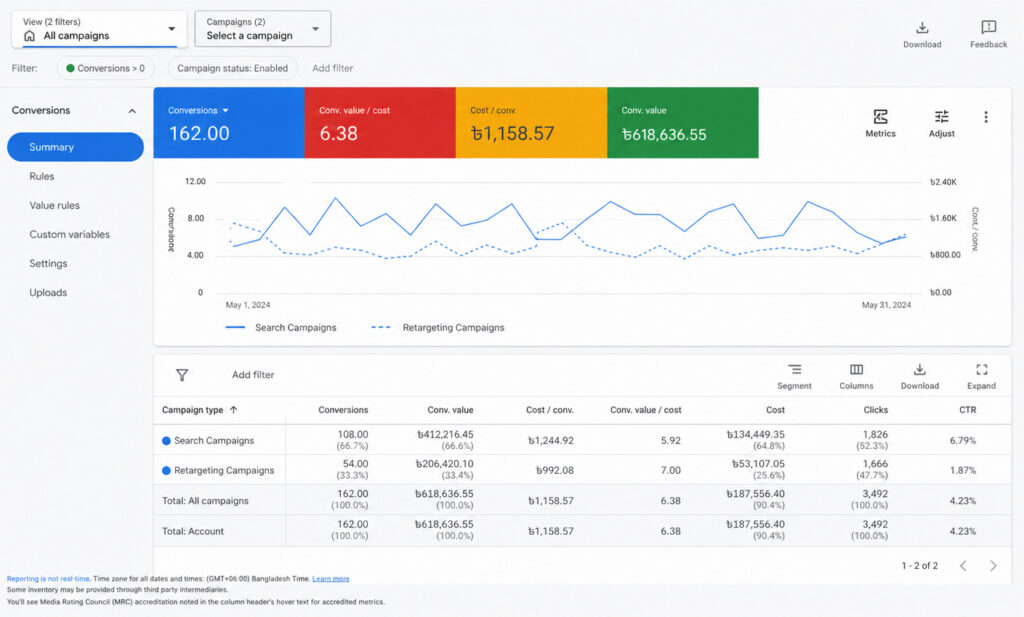
Google Ads for Real Estate: The High-Intent Channel
Google Ads plays a different role in real estate than Facebook does. People on Facebook see your ad while scrolling — they weren’t looking for an apartment. People on Google typed “3 bedroom apartment Banani” into the search box. That’s intent, not interest.
This makes Google Ads typically more expensive per click but more efficient per actual buyer. The leads convert at higher rates because they’re already in active research mode.
Search Campaigns: Where to Bid
The high-value keyword categories for Bangladesh real estate in 2026:
Location + property type: “apartment in Bashundhara,” “flat for sale Gulshan,” “duplex in Uttara,” “ready flat Dhanmondi.” These are pure intent keywords — expensive but high-converting.
Project name + variations: Bid on your own project name and competitor project names if your budget allows. People comparing options will see you in their search.
Buyer-stage keywords: “best real estate developer in Dhaka,” “ready apartments Dhaka,” “RAJUK approved apartment.” These show research intent.
Diaspora keywords: “apartment in Dhaka for NRBs,” “investment property Bangladesh,” “Bangladeshi property purchase from UAE.” Lower volume but very high-value buyers.
What to skip: generic terms like “real estate” or “property” without location modifiers. They’re expensive and attract too many irrelevant searches (job seekers, journalists, students researching for class).
Performance Max Campaigns: Use With Caution
Google’s Performance Max campaigns can work for real estate, but only if your conversion tracking is rock-solid. Without good conversion data feeding back to Google, Performance Max optimizes toward easy conversions (form fills from low-intent users) rather than high-quality leads.
For most Bangladeshi real estate developers, I’d recommend mastering Search and Display Remarketing campaigns first. Move to Performance Max only after you have 60+ days of clean conversion data showing what a quality lead looks like. Google’s official guidance on Performance Max best practices confirms this — it’s a tool that amplifies whatever signal you give it.
YouTube Ads for Project Awareness
For premium projects (BDT 2 crore+), YouTube Ads are dramatically underused in Bangladesh. A 30-second project showcase video, targeted to high-income demographics in Dhaka, Chittagong, and Bangladeshi expat geographies, can build awareness at CPMs significantly lower than Meta. The same audience that ignores yet another Facebook real estate ad will watch a well-produced YouTube ad.
Pair this with retargeting on Search — someone who watched 75%+ of your YouTube ad and then searched for your project is a high-intent lead, regardless of whether they immediately filled out a form.
Lead Handling: Where 80% of Real Estate Marketing Money Dies
Here’s the uncomfortable truth most agencies and developers don’t talk about. The biggest reason real estate ad budgets fail in Bangladesh isn’t the ads — it’s what happens after the lead comes in.
Pattern I see constantly in client audits:
- Lead submits form at 2:47 PM
- Notification goes to a generic Gmail account
- Sales coordinator sees it next morning at 11 AM
- Calls the lead at 3 PM the next day — 24+ hours after submission
- Lead doesn’t pick up (they were briefly interested yesterday, life moved on)
- Sales tries again two days later, then gives up
- Lead gets logged as “not interested”
That lead probably cost BDT 2,000+ to generate. It died not because the ad was bad, but because the response was slow.
The fix is operational, not advertising:
1. Calls within 5 minutes, not 24 hours. Industry research consistently shows that calling a lead within 5 minutes makes them 21x more likely to convert than calling after 30 minutes. In Bangladeshi real estate, where buyers are evaluating multiple developers simultaneously, this is even more critical.
2. CRM, not WhatsApp groups. Track every lead through a real CRM (HubSpot, Zoho, Salesforce) where conversations, callbacks, and stage progression are visible. WhatsApp groups for sales teams lose leads constantly.
3. Multi-touch nurturing for non-immediate buyers. Most real estate buyers aren’t ready to close in week one. Build email and WhatsApp nurture sequences that stay in front of them for 90-180 days. The leads you “lose” in week one often close in month four — but only if you stayed in touch.
4. Sales team training on digital leads. Walk-in customers and digital leads behave differently. Walk-ins are physically present and committed. Digital leads are casually exploring across multiple developers. Your sales script and approach need to reflect that.
What Realistic Real Estate Performance Looks Like in 2026
Here are the benchmarks I see across Ngital’s real estate client portfolio in Bangladesh’s 2026 market:
Cost per click (Search): BDT 90–180 for high-intent location keywords; BDT 30–80 for broader keywords.
Cost per click (Facebook): BDT 25–70 depending on creative quality and audience temperature.
Cost per lead: BDT 800–2,500 for unqualified leads; BDT 2,500–5,000 for pre-qualified leads with budget and timeline information.
Lead-to-site-visit conversion: 15-30% with strong follow-up; 5-10% without.
Site-visit-to-sale conversion: 8-15% for ready apartments; 4-10% for under-construction projects.
Total cost per closed sale: BDT 30,000–1,50,000 depending on price point, project type, and competition.
These ranges are wide because real estate spans a wide spectrum — a BDT 80 lakh apartment in Mirpur and a BDT 6 crore duplex in Gulshan have completely different unit economics. But the framework is the same. If your numbers are way outside these ranges, something specific is broken — either the campaign, the lead handling, or the product-market fit of the project itself.
Sample Budget Allocation for Real Estate
For a developer with BDT 5,00,000/month in digital ad spend in Bangladesh, here’s a starting allocation that typically works:
Facebook & Instagram (60% — BDT 3,00,000):
- Awareness campaigns (cold video): BDT 80,000
- Consideration (warm retargeting): BDT 1,00,000
- Lead generation campaigns: BDT 1,20,000
Google Search (25% — BDT 1,25,000):
- High-intent location keywords: BDT 80,000
- Project name and competitor terms: BDT 30,000
- Broader research keywords: BDT 15,000
YouTube and Display (10% — BDT 50,000):
- YouTube project showcase ads: BDT 30,000
- Display retargeting: BDT 20,000
Testing budget (5% — BDT 25,000):
- New audiences, new platforms (TikTok, LinkedIn for premium projects), new creative formats
This is a starting framework. After 60-90 days of data, you’ll see which channels are producing closed sales (not just leads) and rebalance accordingly.
When to DIY vs. Hire a Specialist
Real estate digital marketing is one of the categories where specialist agencies typically outperform in-house teams or generalist agencies. The reason is repetition — agencies that have run hundreds of real estate campaigns develop pattern recognition that takes years to build internally.
You can probably DIY if:
- You’re a single-project developer with one ready inventory
- Your monthly ad budget is under BDT 1,00,000
- You or your team has direct experience with Meta Ads Manager and Google Ads at meaningful scale
You should hire specialists if:
- You have multiple projects or large unit inventory
- Your monthly ad budget is BDT 2,00,000+
- You’re competing with established developers in Dhaka’s premium markets
- You don’t have internal expertise in conversion tracking, audience strategy, and creative testing
If you’d like to see how Ngital approaches real estate marketing, we’ve worked with developers on residential and commercial projects across Bangladesh. Request a free consultation and we’ll review your current campaigns and lead-handling process. We’ll tell you honestly what we’d change — whether you hire us or not.
Frequently Asked Questions
What’s a realistic monthly budget for real estate digital marketing in Bangladesh? For meaningful results, expect BDT 2,00,000–5,00,000 per month for established developers, and BDT 80,000–1,50,000 for smaller projects. Below BDT 80,000 you can run tests, but consistent lead flow is hard to maintain.
Should I run Facebook Ads or Google Ads first for real estate? For most projects, run both — but in different roles. Facebook drives awareness and lead volume. Google captures high-intent searchers ready to evaluate. The two work better together than either alone.
Why are my Facebook lead form leads low quality? Almost always because there are no qualifying questions on the form. Add 3-5 qualifier questions (budget, timeline, location preference) and lead quality typically improves dramatically, even though volume drops.
How long does it take to see real results from real estate digital marketing? Lead flow stabilizes in 30-60 days. Sales attribution takes longer because the customer journey is 60-180 days. Don’t judge campaign performance in the first 90 days — judge it on closed sales attributable to leads from months 2-5.
Should I target Bangladeshi expats or just domestic buyers? For premium projects (BDT 1.5 crore+), expat targeting is often more cost-efficient than domestic targeting and produces higher-budget buyers. Run both, but don’t overlook the diaspora — UAE, Saudi Arabia, USA, and UK buyers are significant in Dhaka real estate.
What’s the single biggest mistake real estate developers make in digital marketing? Treating leads as sales. Generating leads is the easy part. Closing them requires fast response, structured CRM, multi-touch nurturing, and trained sales people. Most developers underinvest in everything that happens after the lead comes in.
The Bottom Line
Real estate lead generation through Facebook and Google Ads in Bangladesh works — but only if you treat it as a system, not a single campaign.
Build a three-stage funnel. Use video, not just photos. Add qualifying questions to your lead forms. Master Search keywords by intent level. Use retargeting aggressively. Most importantly, fix your lead handling before you spend another taka on ads — because a fast-responding sales team with a slow campaign will outperform a fast campaign with a slow sales team every single time.
Real estate is one of the most rewarding categories for digital marketing when it’s done right, because the lifetime value of a single buyer can fund years of marketing. It’s also one of the most punishing categories when done wrong, because the budgets required to compete are large enough to seriously hurt a project’s overall economics.
Whether you build this in-house, hire specialists, or work with a full-service agency like Ngital, the principles in this post apply. Get them right and digital marketing becomes the most predictable lead source you have. Get them wrong and you’ll be the next developer telling everyone that “digital doesn’t work for real estate” — when really, you just didn’t work it right.