Every week, a founder or CMO reaches out to me with some version of the same question: “How do I actually hire a digital marketing agency in Bangladesh? They all say the same things on their websites.”
It’s a fair complaint. Walk through the top 20 agency websites in Dhaka and you’ll see the same claims — “data-driven,” “ROI-focused,” “creative thinking,” “360-degree solutions.” The websites are interchangeable. The results, I can tell you from years of watching the market, are not.
I’m writing this from an unusual position. I run Ngital, a digital marketing agency in Banani with 65+ people, 60+ clients, and a Manifest Awards 2025 win as Bangladesh’s Leading Digital Company. So yes, I have a vested interest in you choosing an agency. But I also watch brands get burned regularly by agencies that over-promised and under-delivered — and when that happens, the whole industry loses credibility, including mine.
So this guide is my honest attempt to help you evaluate digital marketing agencies in Bangladesh in 2026. Not just to pick Ngital, but to pick the right agency for your specific situation — which may or may not be us.
Before You Start Looking: Answer These Three Questions
Most bad agency selections happen because the brand didn’t know what it needed before it started shopping. Before you send a single inquiry, answer these:
1. What business outcome are you actually hiring an agency to deliver? Not “more followers.” Not “better branding.” A specific, measurable outcome — qualified leads at a target cost, e-commerce revenue at a target ROAS, reduced customer acquisition cost, or a defined increase in market share. If you can’t articulate this, no agency can deliver it.
2. What’s your actual budget — total, including ad spend? Agencies need to know this upfront to tell you honestly whether they can help. A brand with BDT 30,000/month total needs different partners than one with BDT 3,00,000/month. Hiding the number wastes everyone’s time.
3. Who on your side owns the relationship? Agencies work best with one clear point of contact who can make decisions. If every approval has to go through a committee, engagements move slowly and performance suffers. Decide this before you start.
Get these three answers down on paper. Any good agency will ask you these questions in the first meeting anyway — coming prepared speeds things up and signals you’re a serious buyer.
![[INSERT: photo of a client strategy meeting or your team in a working session]](https://ngital.com/wp-content/uploads/2026/04/Photo-of-a-client-strategy-meeting-or-your-team-in-a-working-session.jpg)
The 5 Types of Digital Marketing Agencies in Bangladesh (And Which One You Actually Need)
Not all agencies are the same, even when their websites look identical. There are roughly five types operating in Bangladesh in 2026:
Type 1: The Full-Service Agency. 40-100+ people, multiple service lines, works with medium to large brands. Ngital fits here, as do a handful of others. Best for: brands that need integrated strategy across multiple channels and have budgets above BDT 1,00,000/month.
Type 2: The Specialist Boutique. 5-20 people, deeply expert in one or two things (just SEO, or just Meta Ads, or just video production). Best for: brands that have one specific problem to solve and already have other marketing capabilities in-house.
Type 3: The Creative Shop. Strong on branding, design, and storytelling — weaker on performance marketing and paid media execution. Best for: brands building their visual identity or running awareness campaigns.
Type 4: The Freelancer Collective. A coordinator plus a rotating bench of freelancers. Cheap, flexible, but often inconsistent in quality and accountability. Best for: very early-stage startups with tiny budgets.
Type 5: The Ad Agency Pretending to Be Digital. Traditional agencies that bolted on a digital department but still think in TV-commercial frameworks. Best for: nobody, honestly — unless you specifically need integrated traditional + digital and are willing to manage the gaps.
Before you start meeting agencies, figure out which type fits your needs. Meeting a full-service agency when you actually need a specialist boutique is a waste of both sides’ time — and vice versa.
The 10 Questions to Ask Every Agency You Shortlist
When you’re evaluating agencies, most first meetings go something like this: the agency pitches their case studies, shows their logos, talks about their process, and asks you about your business. You leave with a proposal and no way to tell one agency from another.
Here’s a better way. Ask these 10 questions in every pitch meeting. The answers will separate good agencies from average ones faster than any proposal review.
1. Which industries do you specialize in, and which would you turn away? Good agencies say no. If an agency claims they can do great work in every industry, they’re probably average in all of them. Specialization compounds — an agency that’s run 20 real estate campaigns knows things a generalist never will.
2. Who specifically will work on my account, and what’s their experience? You want names and backgrounds. Many agencies pitch with senior leadership but deliver with juniors who just graduated. Ask for the specific team, their specializations, and how many accounts each person manages. Spread too thin is a red flag.
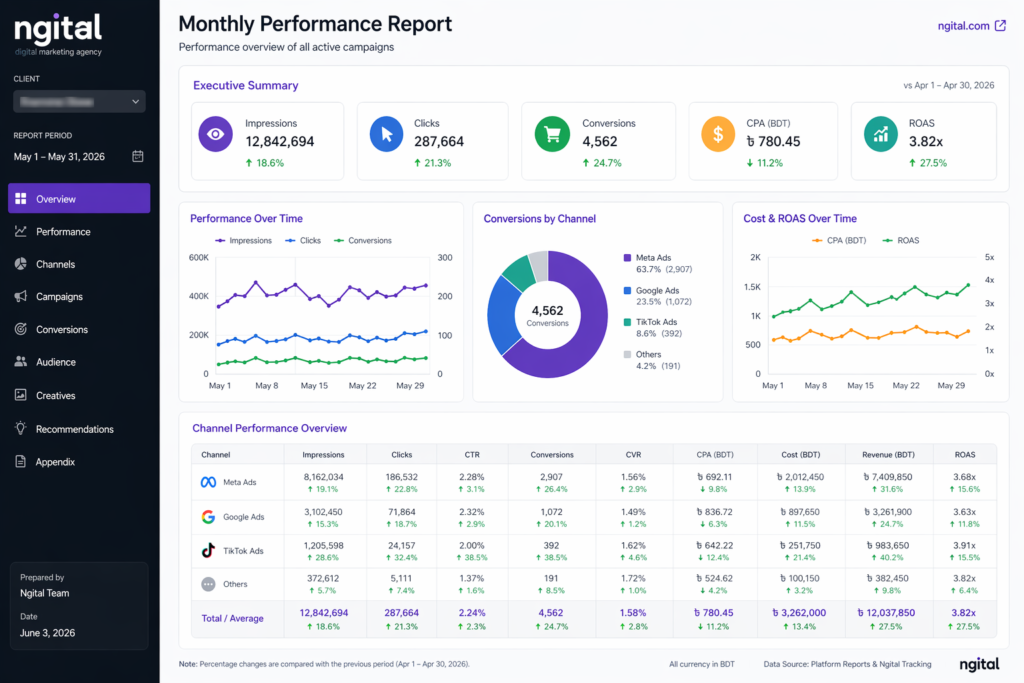
3. Can I see a recent monthly report you send to a client in my industry? Not a case study — a real, unvarnished monthly report (anonymized is fine). This tells you how they actually communicate progress, what metrics they track, and whether they report on business outcomes or just vanity metrics.
4. What’s your client retention rate over 12 months? Good agencies keep clients. Average ones have high churn because clients figure out they’re not getting value. Ask directly — and if they dodge the question, that’s your answer.
5. What’s your approach when a campaign isn’t working? Average agencies blame the market, the product, or the brand. Good agencies take ownership, diagnose systematically, and communicate proactively. Listen carefully to how they describe failure — it tells you what working with them will actually feel like.
6. How do you handle reporting, and how often will we talk? Weekly check-ins for active campaigns, monthly strategic reviews, and 24-48 hour response times on urgent issues are table stakes in 2026. Anything less is a warning sign.
7. What does onboarding look like, and how long until we see meaningful results? Real answer: 30-45 days for initial setup and Learning Phase, 60-90 days for meaningful optimization, 6+ months for compounding results. Anyone promising results in week two is either lying or about to under-deliver.
8. What are your platform partnerships, and are they active? Official badges from Google Partners, Meta Business Partners, TikTok, and HubSpot signal real platform relationships — but only if the agency actually uses those relationships. Ask when they last engaged their platform reps on a client account.
9. How do you price, and what’s included? Fixed retainer vs. percentage of ad spend vs. performance-based — all have trade-offs. Transparency here matters more than the specific model. Watch for agencies that can’t clearly explain what you’re paying for.
10. Why would I not hire you? This is the question that separates great agencies from everyone else. Great agencies have clear answers — “we’re too expensive for budgets under X,” or “we don’t do well with clients who need daily hand-holding,” or “if you need 24-hour turnaround on creative, we’re not the right fit.” Agencies that claim to be right for everyone are right for nobody.
Red Flags That Should End the Conversation Immediately
Some warning signs are bad enough that you should walk away regardless of what else the agency says. In my experience:
“We guarantee first-page Google rankings in 30 days.” Nobody can guarantee this. Google’s own guidelines explicitly warn against agencies making this promise. Agencies claiming it are either lying or using black-hat tactics that will get your site penalized.
They won’t give you admin access to your own ad accounts. Your Google Ads, Meta Ads, and analytics accounts should be owned by you, with the agency added as a user. If the agency owns the accounts and won’t transfer them, you’re a hostage — the day you stop paying, you lose everything.
Their case studies are vague, with no client names or real numbers. “We helped a major brand increase sales by 300%” means nothing. Good case studies have named clients (with permission), specific metrics, and honest context about what was achieved and what wasn’t.
They over-promise on timelines. Anyone claiming results in the first two weeks is either lucky on the occasional account or is setting you up for disappointment.
They can’t explain their own reports. In pitch meetings, ask them to walk through a live client dashboard. If the explanation is hand-wavy, if metrics are “reach” and “engagement” without ties to business outcomes, if they can’t tell you what a specific number means — walk away.
The proposal is dramatically cheaper than everyone else’s. This sounds counterintuitive coming from an agency owner, but it’s true. In Bangladesh’s 2026 market, digital talent costs what it costs. An agency quoting 40-60% less than the market average is either under-staffing the account, using inexperienced people, or planning to make up the difference by cutting corners. You’ll pay for it eventually, usually in lost opportunity cost.
No written contract or unclear scope. “We’ll figure it out as we go” is a recipe for disagreements about deliverables, timelines, and payments. A clear written contract protects both sides.
Pricing Expectations in Bangladesh in 2026
Pricing varies widely by agency type and scope, but here’s roughly what to expect from competent agencies in Bangladesh’s 2026 market:
Social Media Management: BDT 25,000–80,000/month for content + community management, depending on post volume and platforms.
Meta Ads / Google Ads Management: BDT 20,000–60,000/month retainer OR 10-20% of ad spend (whichever is higher), plus the actual ad budget.
SEO Services: BDT 30,000–1,50,000/month depending on competitiveness of keywords and scope of technical work.
Full-Service Digital Marketing: BDT 80,000–3,00,000+/month for integrated campaigns across multiple channels.
Influencer Marketing Campaigns: Project-based, typically BDT 50,000–5,00,000+ per campaign depending on influencer tier and scope.
Video Production: BDT 30,000–5,00,000+ per project depending on format, complexity, and talent.
These ranges reflect what serious agencies charge in 2026. If you’re being quoted significantly below these, ask what’s being cut. If you’re being quoted significantly above, ask what’s being added that justifies the premium — it might be genuine senior-level expertise, or it might just be inflated branding.
How to Structure the Evaluation Process
Here’s a practical framework for actually running an agency selection process:
Week 1-2: Shortlist. Research 8-12 agencies that match your type-of-agency criteria. Review their websites, case studies, team pages, and any third-party recognition. Cut down to 4-5 for initial meetings.
Week 3-4: First meetings. 45-60 minute meetings with each shortlisted agency. Use the 10 questions above. Take notes immediately after each meeting — impressions fade fast.
Week 5: Requests for proposals. Ask your top 2-3 candidates for written proposals with specific scopes, deliverables, timelines, and pricing. A good proposal is 8-15 pages, specific to your business, not a generic template.
Week 6: Final interviews and reference checks. Meet the actual team that would work on your account — not just sales leadership. Ask for 2-3 current client references you can call. Actually call them.
Week 7: Decision and contract. Negotiate scope, pricing, and KPIs. Sign a 3-6 month initial engagement with clear review points. Don’t commit to 12 months on the first contract with any agency — both sides need to earn long-term trust.
[INSERT: your own data point — e.g., “At Ngital, our average client engagement lasts X years, because we front-load the diagnostic work so we only take on clients we can genuinely help”]
When You Shouldn’t Hire an Agency at All
Honest advice from someone who runs one: sometimes you shouldn’t hire an agency.
You shouldn’t hire an agency if:
- Your total marketing budget is under BDT 40,000/month — the economics don’t work for either side
- You’re testing a product that hasn’t achieved product-market fit yet — an agency can’t fix a broken product
- You need one specific tactical execution (like a single landing page build) that a freelancer can handle faster
- You don’t have the internal capacity to provide brand assets, approvals, or strategic input — agencies amplify your team, they don’t replace it
- You’re looking for an agency to “magic wand” a struggling business — the underlying fundamentals matter more than any marketing
Good agencies will tell you these things in the first meeting. If you describe one of the situations above and an agency still tries to close the deal, they’re prioritizing their revenue over your success. Walk away.
A Framework for Red Teaming Your Own Decision
Before you sign any contract, run your final decision through these three tests:
The “six months from now” test: Imagine it’s six months into the engagement and things aren’t going well. Who would you blame — the agency, your own team, or the market? If you can’t clearly answer this, your success metrics aren’t clear enough yet. Define them before you sign.
The “two better options” test: Can you articulate why this agency is better than the next two options on your list? If your answer is “I just had a good feeling about them,” slow down. Good feelings matter, but they should be backed by specific reasons the other options fell short.
The “walk away” test: Would you still hire them if they removed 20% from the proposal scope? If yes, they might have padded the scope. If no, you might be signing up for something larger than you actually need.
Frequently Asked Questions
What should a digital marketing agency in Bangladesh cost? For most SMEs, expect BDT 80,000–3,00,000/month for full-service engagements, depending on scope and industry. Specialist services (just SEO, just Meta Ads) start lower, around BDT 25,000–60,000/month.
How do I know if an agency is legitimate? Check for official partnerships (Google, Meta, TikTok, HubSpot), third-party recognition (industry awards, memberships like e-CAB or BASIS), named case studies with real clients, and a working office you can visit. Avoid agencies that operate purely remotely with no verifiable team or location.
Should I hire an agency or build an in-house team? For most SMEs under BDT 5,00,000/month total marketing spend, agencies deliver better economics than in-house teams — you get access to specialists across multiple channels without paying full salaries for each. Above that spend level, hybrid models (small in-house team + specialist agencies) often work best.
How long should my first contract be with a new agency? 3-6 months for an initial engagement with clear review points. Anything longer on a first contract is a red flag — good agencies earn long-term commitments through performance, not locked-in contracts.
What if I want to change agencies mid-contract? Every contract should have a termination clause with 30-60 days’ notice. Ensure from day one that you own your accounts, data, and assets so switching is operationally possible.
Can I just use AI tools instead of hiring an agency? AI tools can replace certain tactical work — basic copywriting, first-draft creative, data analysis. They cannot yet replace strategic thinking, platform expertise, or relationship-based execution (like influencer negotiations). The smart move in 2026 is using AI tools alongside good agencies, not instead of them.
The Bottom Line
Choosing a digital marketing agency in Bangladesh in 2026 is harder than it should be because the surface-level information (websites, case studies, pitch decks) looks the same across agencies. The real differences show up in specialization, team quality, reporting honesty, and willingness to say no.
The best way to cut through the noise is to go in prepared — know your budget, your outcomes, and the type of agency you actually need. Ask the 10 questions. Watch for red flags. Check references. Don’t let urgency push you into a bad decision — a wrong agency costs more than a delayed one.
And remember: the goal isn’t to find the “best” agency in Bangladesh. It’s to find the right agency for your specific business, at your specific stage, with your specific budget. Those are very different questions.
If you’d like to see whether Ngital is the right fit for your business, request a free consultation. We’ll look at your situation and give you an honest read — including telling you if we think another type of partner would serve you better. That honesty is, in the end, the first thing you should look for in any agency.