I’m going to say something that won’t make me popular with other agency owners in Dhaka. Most influencer marketing campaigns running in Bangladesh don’t work. They generate impressive-looking reports, satisfy brand managers’ KPIs, and produce almost no measurable business outcome.
I’d estimate that 90% of influencer marketing campaigns in Bangladesh fail to deliver positive ROI when measured honestly. Not because influencer marketing doesn’t work — it does, when structured correctly. Because the way most brands and agencies execute it is fundamentally broken.
This post is going to make some agencies uncomfortable. It might make some influencers uncomfortable. It might even make some of our own past campaigns at Ngital look uncomfortable in retrospect — we’ve made several of these mistakes ourselves over the years and learned the hard way.
But every brand manager and CMO in Bangladesh deserves to know what’s actually happening inside their influencer marketing investments before they sign another quarterly contract. Here’s the honest breakdown.
The Failure Mode Most People Don’t See
Influencer marketing in Bangladesh has become an industry built on metrics that don’t predict outcomes. Reach, impressions, likes, comments, story views — every report shows them. Almost none of them correlate with actual sales lift.
The standard campaign post-mortem looks like this:
- Influencer X posted about our product
- Reached 800,000 people
- Got 45,000 likes
- Got 1,200 comments
- “Great campaign — let’s do it again next quarter”
Notice what’s missing? Sales attribution. Incremental revenue. Actual change in brand consideration measured against a control group. The campaign got reported on what it produced (reach), not what it was supposed to produce (business outcomes).
This is the failure mode at the heart of most Bangladesh influencer marketing. Not bad creative. Not wrong influencer choice. Not poor brand fit. The fundamental problem is that the entire industry has agreed to measure inputs (reach, engagement) instead of outputs (sales, brand lift), and as a result, everyone’s optimizing for the wrong things.
The Nine Reasons Influencer Campaigns Actually Fail
When we audit underperforming influencer campaigns at Ngital — both campaigns we’ve inherited from other agencies and our own past mistakes — we see the same patterns repeatedly. Here are the nine most common reasons these campaigns fail.
1. The Audience Match Was Wrong From the Start
The most common failure happens before anyone signs anything. Brands choose influencers based on follower count, perceived “vibe match,” or because the influencer is currently popular — not based on whether the influencer’s audience demographically and behaviorally matches the brand’s target customer.
A beauty brand targeting affluent Dhaka women aged 28-45 hires a lifestyle influencer whose audience is primarily 16-22 year old students. The campaign produces high engagement (young audiences engage more) but no sales (the audience can’t afford the product).
What we do at Ngital: Before any influencer recommendation, we audit their audience demographics through platform analytics, ask for screenshot proof from the influencer’s account, and run actual audience analysis tools. Follower count is the last thing we look at, not the first.
2. The Creative Was Brand-Mandated Rather Than Influencer-Owned
Brand managers want control. Marketing teams want approval workflows. Legal wants liability protection. The result is influencer content that’s been edited, scripted, and approved into something that no longer feels like the influencer — it feels like a TVC delivered through a different mouth.
The influencer’s audience can spot this immediately. Engagement crashes. The trust transfer that made influencer marketing work in the first place doesn’t happen because the content reads as advertisement, not endorsement.
What works instead: Heavy-handed brand control destroys the value of influencer marketing. The right approach gives clear brand parameters (don’t make claims X, Y, Z; do mention key benefits A, B, C; deadline is this date) but leaves creative execution to the influencer. Trust the people you’re paying to know their audience.
3. The Campaign Was a One-Off Instead of a Sustained Series
Most Bangladesh influencer campaigns run as single-post deals. Brand pays influencer for one post. Influencer posts. Brand reports on results. Both sides move on.
This structure almost guarantees failure. A creator’s audience needs to see them use a product 3-4 times before the recommendation feels genuine. One post reads as paid placement. Four posts over six weeks reads as “this person actually uses this.”
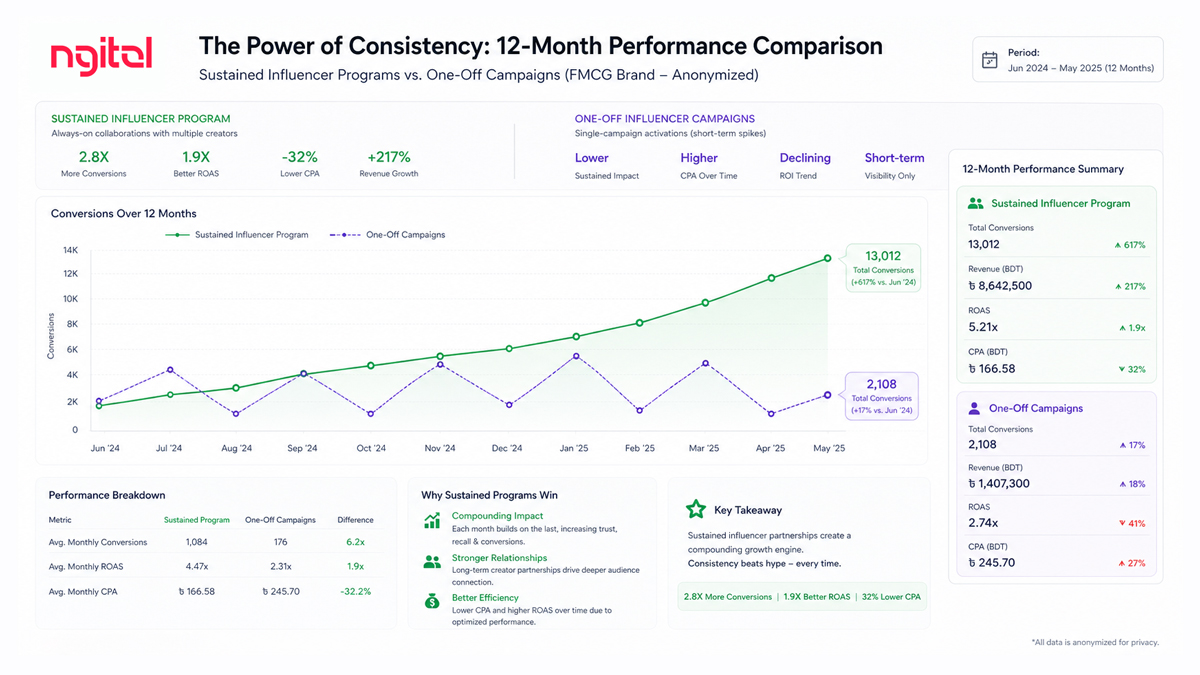
The data supports this consistently. Sustained campaigns (multiple posts from the same creator over 4-12 weeks) outperform one-off posts at the same total spend by significant margins. Yet most brand managers continue to default to the one-post model because it’s easier to budget and execute.
4. The Wrong Tier of Influencer Was Selected
Bangladesh’s influencer ecosystem has clear tiers, and brands consistently pick the wrong one for their goals.
| Tier | Followers | Best For |
|---|---|---|
| Mega-influencers | 1M+ | Mass awareness for major launches only |
| Macro-influencers | 300K–1M | Broad awareness with some engagement quality |
| Mid-tier creators | 50K–300K | The sweet spot — engaged audiences, lower costs, higher trust |
| Micro-influencers | 10K–50K | Niche audiences, high trust, very low cost |
| Nano-influencers | Under 10K | Hyperlocal or hyper-niche only |
The pattern across thousands of influencer campaigns we’ve analyzed: mid-tier creators (50K–300K followers) consistently produce the best ROI for most categories. Mega and macro influencers cost dramatically more per engagement and convert at lower rates because their audiences are more diverse and less personally connected to them.
Yet brands keep over-investing in big-name influencers because:
- It feels safer to pay someone “famous”
- Marketing teams can show leadership recognizable names
- Agencies make more money from larger deals
None of those reasons help the campaign actually work.
5. The Performance Wasn’t Tracked With Attribution
Most influencer campaigns in Bangladesh don’t have proper attribution infrastructure. There’s no unique tracking link, no influencer-specific coupon code, no UTM parameters, no separate landing page. The campaign runs, “results” get reported in vanity metrics, and nobody actually knows whether sales happened because of the influencer or in spite of them.
The fix is straightforward but rarely implemented:
- Unique tracking URLs for each influencer (UTM-tagged)
- Influencer-specific discount codes for e-commerce brands
- Influencer-specific landing pages where ROI matters most
- Survey questions on conversion forms (“How did you hear about us?”)
- Cohort analysis comparing sales spikes to influencer post timing
Without this infrastructure, you’re not running performance marketing. You’re running PR with extra steps.
6. The Brand Asked for the Wrong Type of Content
Different content types serve different purposes. A “honest review” post doesn’t work the same way a “lifestyle integration” post does, which doesn’t work the same way a “tutorial” post does.
Most brands ask for whatever they think looks polished — typically a clean product placement post with the creator looking happy with the product. This is exactly the format that performs worst because it reads most clearly as advertising.
What actually works:
- Honest reviews with both positives and small criticisms — builds trust
- Demonstration content showing the product solving a real problem
- Tutorials and how-tos that teach something useful with the product as a tool
- Day-in-the-life content integrating the product naturally into a routine
- Side-by-side comparisons with alternatives (only if your product genuinely wins)
The brand-mandated “happy person holding product” format produces low engagement, no trust transfer, and minimal sales lift. Stop asking for it.
7. The Campaign Optimized for Wrong Platform
Different platforms serve different influencer marketing goals. Bangladesh brands often pick the wrong one.
Instagram in Bangladesh still drives the highest perceived prestige but produces lower commerce conversion than other platforms. Best for premium positioning and aspirational categories.
Facebook has broader demographic reach but suffers from lower influencer engagement rates. Best for awareness in mass categories.
TikTok has become the highest-converting platform for many categories, especially FMCG, beauty, and youth-oriented brands. The algorithm favors engaging content over follower count, so mid-tier creators often produce massive reach. Best for genuine product discovery moments.
YouTube is criminally underused for long-form influencer content. A 10-minute YouTube review by a trusted creator often outperforms 50 Instagram posts because it allows depth that other platforms don’t. Best for considered purchases and high-ticket items.
Most brands run all their influencer budget on Instagram because that’s where their team feels most comfortable. The brands that diversify across platforms based on category fit consistently outperform.
8. The Sales Team Wasn’t Aligned With the Campaign
This is the operational failure most agencies don’t talk about. Influencer marketing creates demand. Sales infrastructure is supposed to capture it. But most campaigns launch without coordinating with the sales team about expected inquiry volume, lead routing, or follow-up SLAs.
The result: Influencer post drives a spike of inquiries. Sales team isn’t ready. Inquiries go unanswered for 24-48 hours. Interested prospects move on. Campaign reports “high engagement” but actual conversion is terrible — and nobody understands why.
What we set up at Ngital before any influencer campaign launches:
- Sales team briefed on expected inquiry timing and volume
- Lead routing set up to handle sudden volume increases
- Response time SLAs established (under 30 minutes ideally)
- Specific scripts or talking points if the campaign requires them
- Daily syncs during active campaign weeks to catch issues fast
Without this, even a perfect influencer campaign produces mediocre business results.
9. The Brand Stopped Too Early to See Compounding Effects
Influencer marketing produces immediate results (the post-week spike in engagement and inquiries) but its largest value is often compounding effects over 6-12 months — the cumulative trust building, the search volume increase, the word-of-mouth amplification, the audience overlap effects from multiple creator partnerships.
Most Bangladesh brands kill influencer programs after one or two underwhelming quarters because the immediate ROI looked weak. They miss the compound returns that would have arrived if they’d stayed disciplined.
The brands that win at influencer marketing in Bangladesh are the ones that commit to programs measured in years, not campaigns measured in weeks. This is hard for performance-marketing-trained CMOs to accept because it doesn’t fit their dashboard cadence. But the data is clear — influencer marketing rewards patience.
What 10% Success Actually Looks Like
The 10% of influencer campaigns that succeed in Bangladesh share patterns. After working on dozens of campaigns at Ngital and watching many more, here’s what successful campaigns consistently include:
They start with a measurable business objective, not a content brief. “Drive 15% increase in product trial among Dhaka women 28-45 over the next quarter” is an objective. “Run an influencer campaign for Q3” is not.
They invest in mid-tier creator volume rather than big-name singles. 12-20 mid-tier partnerships running concurrently produce more total business value than 2-3 mega-influencer deals at the same budget.
They give creators genuine creative latitude. Brand parameters set the boundaries; creators control execution within those boundaries.
They run sustained programs, not one-off posts. Same creators, multiple posts over weeks. Trust requires repetition.
They have proper attribution. UTM links, codes, dedicated landing pages, survey questions. The campaign measures what it produces, not just what it shows.
They align with sales operations. Sales teams know what’s coming, when, and how to handle the inbound volume.
They commit to multi-quarter programs. Compound returns require patience.
They measure the right metrics — incremental sales lift, branded search volume changes, brand consideration shifts in surveys, repeat purchase rates from influencer-attributed customers — not reach and engagement.
This isn’t complicated. It’s just not how most campaigns are run.
What Brands Should Do Differently in 2026
If you’re a brand manager or CMO planning your 2026 influencer marketing budget in Bangladesh, here are the changes I’d recommend based on what actually works.
Restructure your KPIs first. Before signing another influencer contract, decide what business metric you’ll measure success against. If you can’t measure it, don’t run the campaign. Vanity metrics produce vanity outcomes.
Shift budget from mega to mid-tier. Take 70% of what you’d typically spend on one big-name influencer and redistribute it across 8-12 mid-tier creators. The math will improve dramatically.
Move from one-off to sustained. Replace your “one post per quarter from a big name” model with “four posts over six weeks from the same mid-tier creator” model.
Demand attribution infrastructure. If your agency can’t set up unique tracking links, dedicated landing pages, and UTM-tagged URLs for every influencer partnership, find a different agency.
Plan operational alignment. Brief your sales team. Set response time SLAs. Test your lead capture infrastructure. Coordinate timing.
Commit to multi-quarter programs. One-quarter influencer programs almost always disappoint. Three to four quarter programs typically deliver the compound returns.
Audit your current influencer relationships. How many are producing measurable business outcomes vs. just producing content? Cut what isn’t working. Double down on what is.
When to Hire Specialist Help
Influencer marketing in Bangladesh requires specific operational capabilities that many in-house teams and generalist agencies lack:
You should consider specialist help if:
- You have BDT 5,00,000+/month influencer marketing budget where attribution and ROI matter
- Your past campaigns measured “engagement” without sales attribution
- You’re running across multiple platforms and lack platform-specific expertise
- You need to coordinate influencer marketing with paid media, SEO, and CRM systems
- Your sales team isn’t currently aligned with your marketing operations
At Ngital, we approach influencer marketing as a measured, attribution-rigorous discipline — not as a content production exercise. We work with brands across FMCG, beauty, healthcare, real estate, and education on integrated influencer programs that include creator selection, content strategy, attribution infrastructure, sales alignment, and outcome measurement.
If your current influencer marketing isn’t producing measurable business results — or if you suspect it isn’t but can’t tell from your current reporting — request a free audit. We’ll review your last 3-6 months of campaigns and tell you honestly what we see, including whether we’d recommend changes you can make in-house without hiring an agency at all.
Frequently Asked Questions
Is influencer marketing dead in Bangladesh? Not at all. Influencer marketing works extremely well when structured correctly. What’s failing is the way most brands execute it — vanity metrics, one-off posts, big-name singles, no attribution. Restructure those elements and influencer marketing becomes one of the highest-ROI channels available.
How much should we pay a Bangladeshi influencer? Pricing varies enormously by tier and platform. Rough ranges in 2026:
- Nano-influencers (under 10K): BDT 3,000-15,000 per post
- Micro-influencers (10K-50K): BDT 10,000-40,000 per post
- Mid-tier (50K-300K): BDT 25,000-1,50,000 per post
- Macro (300K-1M): BDT 1,00,000-5,00,000 per post
- Mega (1M+): BDT 3,00,000-25,00,000+ per post
These are starting points, not fixed rates. Performance bonuses, exclusivity terms, content rights, and platform requirements all affect final pricing.
Should we work directly with influencers or through an agency? Direct relationships work for brands with internal capacity to handle creator outreach, contracting, content review, attribution setup, and reporting. Most brands underestimate this operational load. Agencies add value when they bring established creator relationships, attribution infrastructure, and the ability to run multi-creator campaigns at scale.
How do we know if an influencer’s audience is real? Multiple checks: audience demographics in platform analytics, engagement rate vs. follower count (suspiciously low engagement signals fake followers), comment quality (generic comments are bot signs), follower growth pattern (sudden spikes are suspicious), and cross-platform consistency. Reputable agencies vet for this before recommending creators.
Can influencer marketing work for B2B brands in Bangladesh? Yes, but differently. B2B influencer marketing focuses on industry experts, thought leaders, and professionals with credibility in specific business categories — not entertainment-style creators. LinkedIn-native partnerships often outperform Instagram or TikTok for B2B objectives.
What’s the single biggest improvement most brands could make to their influencer marketing? Adding proper attribution infrastructure. Without unique tracking links, codes, or dedicated landing pages, you can’t tell which influencer partnerships are actually working. Adding this single capability transforms influencer marketing from a guessing exercise into a measurable discipline.
Summary:
The 90% failure rate in Bangladesh influencer marketing isn’t because influencer marketing is broken. It’s because the way most brands and agencies execute it is broken. The campaigns are measuring the wrong things, optimizing for the wrong outcomes, picking the wrong creators, mandating the wrong creative, and ending too quickly to see compound effects.
The brands that will win at influencer marketing in Bangladesh in 2026 won’t be the ones spending the most. They’ll be the ones executing with discipline — clear business objectives, mid-tier creator volume, sustained programs, real attribution, sales alignment, and patience for compound returns.
If you’re currently running influencer marketing that “looks good in reports but doesn’t seem to move the business,” you’re not alone. Most brands are in the same situation. The good news is the fix isn’t expensive — it’s a structural shift in how you think about and measure these campaigns.
If you’d like to talk through your current influencer marketing setup, our team at Ngital would be glad to review what you’re running and tell you honestly what we’d change. Most agencies won’t audit your current spending because they want to replace it. We’ll often recommend changes you can make without hiring us at all — because that’s what builds long-term trust, which is exactly the same principle that should drive your influencer marketing.