How Facebook Became a Marketplace in Bangladesh: The Complete F-Commerce Story
Facebook became Bangladesh's biggest marketplace because it was the internet for most new users. Here is the full F-commerce story: the timeline, the COVID boom, the rules, the latest data and a playbook for sellers.

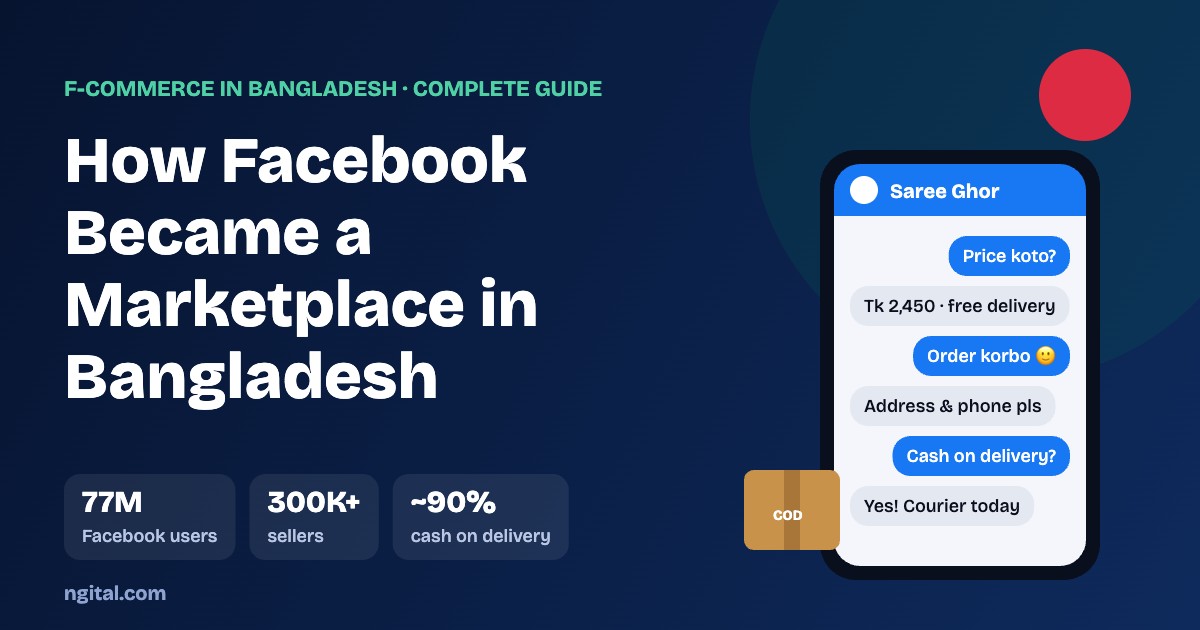
Walk through any Dhaka neighbourhood in the evening and you will see the same scene. A delivery rider stops his motorbike, hands over a polybag parcel, and collects cash at the door. That order almost certainly never touched a website. It began as a Facebook post, moved into a Messenger chat, was confirmed by a phone call, and was delivered by a courier booked through an app.
Bangladesh did not adopt e-commerce the way Europe or America did. It skipped the website stage and built a national retail market inside a social network. This guide explains exactly how Facebook became a marketplace in Bangladesh, why it happened here more than almost anywhere else, what went wrong along the way, and what every seller and brand should do about it now.
I have spent 20 years in marketing and business, and since 2020 I have run Ngital, a digital marketing agency in Dhaka that manages Facebook advertising for banks, real estate developers, fashion and beauty brands, NGOs and many small online sellers. What follows combines published data from credible sources with what we see every day inside real ad accounts.
The short answer
Facebook became Bangladesh’s largest marketplace because, for most new internet users, Facebook was the internet. When affordable smartphones and cheap mobile data arrived in the 2010s, Facebook was the first app people opened and the one they used most. Sellers simply followed the audience. Four local systems then made the model work: Messenger for negotiation, mobile money such as bKash and Nagad for payment, app-based couriers for cash-on-delivery, and Facebook groups for trust. The COVID-19 lockdowns of 2020 turned a fast-growing habit into a mass movement.
Key takeaways
- Audience: Bangladesh had about 77.1 million Facebook users in October 2026, roughly 42.5% of the population (NapoleonCat).
- Sellers: Estimates put the number of businesses selling through Facebook between 300,000 and 500,000, compared with only around 2,000 dedicated e-commerce websites (UNB, Future Startup).
- The turning point: COVID-19. The Women and e-Commerce Forum (WE), a Facebook group, grew from about 30,000 to 300,000 members in roughly four months of 2020 (bdnews24).
- Payments: Cash-on-delivery still dominates. Industry leaders estimate it at about 90% of online orders (The Financial Express).
- Regulation: The Digital Commerce Operation Guidelines (July 2021) and the Digital Business Identification (DBID) system (February 2022) brought Facebook sellers into the legal framework for the first time.
- What comes next: Storefront tools, interoperable payments and AI-driven search are pushing serious F-commerce sellers toward a hybrid model: Facebook for discovery, their own website for trust and repeat sales.
What is F-commerce?
F-commerce (Facebook commerce) means buying and selling goods or services through Facebook and its connected apps, mainly business Pages, Groups, Messenger, Facebook Live, Marketplace and paid ads, instead of through a standalone online store.
In Bangladesh the term has a wider, more local meaning. It describes a complete informal retail system that sits on top of Facebook:
- A seller creates a Facebook Page, often named after a product category or a family brand.
- Products are shown in photo posts, albums, Reels and live videos.
- Buyers comment “price?” or “inbox please” and continue the conversation in Messenger.
- The seller confirms size, colour and address, often by phone.
- A courier such as Pathao, Steadfast, RedX or Paperfly picks up the parcel and collects cash on delivery.
- The courier transfers the collected money to the seller’s bKash, Nagad or bank account.
No shopping cart, no checkout page and often no website at all. That is the defining feature of Bangladeshi F-commerce: the store is a conversation.
F-commerce vs e-commerce vs s-commerce
| Term | Where the sale happens | Typical Bangladeshi example |
|---|---|---|
| E-commerce | A dedicated website or app with a cart and checkout | Daraz, Chaldal, Rokomari, brand websites |
| F-commerce | Facebook Pages, Groups, Messenger, Live and Marketplace | A home-based saree, cosmetics or food page |
| S-commerce (social commerce) | Any social platform: Facebook, Instagram, TikTok, WhatsApp, YouTube | A TikTok seller closing orders on WhatsApp |
In Bangladesh, F-commerce is by far the largest part of social commerce, which is why most people use the two terms interchangeably.
How Facebook became a marketplace in Bangladesh: the timeline
The shift did not happen in one year. It happened in overlapping phases, each removing one barrier to buying online.
| Period | Phase | What changed |
|---|---|---|
| 2008 – 2012 | Social network arrives | Facebook spreads among urban students and young professionals. Buy-and-sell groups appear for used phones, books and gadgets. bKash launches in 2011. |
| 2013 – 2016 | Pages become shops | 3G rolls out and cheap Android phones spread. Clothing, cosmetics and gadget sellers open Facebook Pages and start boosting posts. |
| 2017 – 2019 | Infrastructure catches up | 4G launches in 2018. App-based couriers offer doorstep pickup and cash collection for small merchants. The WE group starts in 2017. e-CAB counts about 50,000 F-commerce pages by the end of 2019. |
| 2020 – 2021 | The COVID explosion | Lockdowns close shops and cut jobs. Hundreds of thousands start selling on Facebook. Facebook launches Shops globally in May 2020. Live selling goes mainstream. |
| 2021 – 2023 | Crisis and regulation | Evaly and other Ponzi-style platforms collapse. The government issues the Digital Commerce Operation Guidelines, Bangladesh Bank introduces escrow, and the DBID system launches. |
| 2024 – present | Professionalisation | Sellers adopt storefront tools, WhatsApp, TikTok and their own websites. Pathao, Zatiq and others build commerce software for F-commerce merchants. Facebook passes 77 million users in Bangladesh. |
Phase 1: Facebook becomes “the internet” (2008 – 2012)
For millions of Bangladeshis, the first meaningful online experience was not a search engine or an email account. It was Facebook. Many first-time users could not comfortably type English web addresses, but they could scroll a feed, recognise faces and press “Like”. Bangla language support and lightweight versions of the app made Facebook the default online space.
Commerce began quietly in buy-and-sell groups. Students resold phones and textbooks. Families of expatriates sold imported chocolates and cosmetics. Nobody called it e-commerce; it was simply people trading with people they could see.
Phase 2: Pages turn into shopfronts (2013 – 2016)
Three changes arrived together. Mobile data got cheaper, entry-level Android phones became affordable, and Facebook’s advertising tools became simple enough for a small seller to boost a post. Suddenly, a woman selling block-printed kurtis from her home in Mirpur could reach buyers in Chattogram and Sylhet.
Facebook launched Marketplace in 2016, first in the US, UK, Australia and New Zealand, as a section for local buying and selling. It later expanded to many more countries, including Bangladesh (Future Startup). Interestingly, Marketplace never became the centre of Bangladeshi F-commerce. Pages, Groups and Messenger did. Bangladeshi sellers built their own marketplace on top of Facebook’s social tools before Facebook built one for them.
Phase 3: The infrastructure catches up (2017 – 2019)
The biggest obstacles to online selling in Bangladesh were never technical. They were trust, payment and delivery. This phase solved two of them.
- Delivery: Traditional couriers were built for documents and corporate parcels. New app-based couriers offered doorstep pickup, same-day delivery inside Dhaka, returns handling and, most importantly, cash collection on the seller’s behalf.
- Payment: Mobile financial services (MFS) put a wallet on the phones of millions of unbanked people. Even when buyers paid cash, couriers could settle with sellers through bKash or Nagad within a day or two.
By the end of 2019, the e-Commerce Association of Bangladesh (e-CAB) estimated that around 50,000 F-commerce pages were operating (The Financial Express).
Phase 4: COVID-19 turns a habit into a movement (2020 – 2021)
The nationwide general holiday that began on 26 March 2020 closed shops, markets and offices. Many people lost jobs or saw their income cut. Buyers were stuck at home and wary of crowded markets. Facebook was the obvious place where both problems met.
Three groups flooded into F-commerce during this period:
- People who lost jobs, especially in services, garments and the informal sector.
- Women and homemakers, who began selling homemade food, pickles, handicrafts, sarees and local fish from home.
- Traditional shop owners, who moved their stock onto Facebook Pages and live videos while their physical shops were shut.
The numbers moved fast. According to e-CAB, online sales rose by 70–80% in the July–September 2020 quarter (MicroSave Consulting). e-CAB also estimated that of about Tk 7,000 crore in e-commerce sales in 2020, around Tk 1,000 crore came through F-commerce, and that more than 400,000 new entrepreneurs had joined (Apparel Resources). By 2021, Facebook-based businesses were making more than 90,000 deliveries a day (The Business Standard).
Phase 5: Crisis, regulation and professionalisation (2021 – present)
Rapid growth brought fraud. That story has its own section below. In short, the collapse of Evaly and similar platforms in 2021 forced the government to regulate digital commerce, and those rules covered Facebook sellers too. Since then, the most successful F-commerce businesses have been formalising: registering, adding websites, using order-management software and building real brands.
Seven reasons Facebook won in Bangladesh
Many countries have Facebook. Few turned it into their main retail channel. These seven forces explain why Bangladesh did.
1. Mobile-first, Facebook-first internet users
Most Bangladeshis came online through a phone, not a computer. In January 2026 the country had about 129 million internet subscriptions, around 114 million of them mobile (Digital Watch, citing BTRC). For a phone-first user, an app with a feed is easier than a website with menus. Facebook became the home screen of Bangladeshi digital life.
2. A massive, young audience
Facebook had about 77.1 million users in Bangladesh in October 2026. People aged 18–24 form the largest group at around 39% (NapoleonCat). A young, phone-native audience is exactly who adopts new ways of shopping first.
3. Shopping as a conversation
Bangladeshi retail has always been personal. Buyers bargain, ask questions and want to “see” the product before paying. Messenger recreated the shopkeeper’s counter. A buyer can ask for a close-up of the fabric, request a video, negotiate the delivery charge and confirm the order, all in a familiar chat window. A standard website checkout removes that conversation; Facebook keeps it.
4. Almost zero start-up cost
A Facebook Page is free. There is no rent, no developer, no hosting, no payment-gateway setup and, until 2021, no paperwork. A seller with a few thousand taka of stock and a smartphone could start the same day. In a country with millions of underemployed young people, and women with limited access to formal jobs, that low barrier mattered enormously.
5. Social proof and community trust
Buyers trusted Facebook sellers because they could see real people: comments from friends, Page reviews, live videos showing the seller’s face, and recommendations inside groups. Communities such as WE created shared norms and peer accountability. In a market where trust in strangers was low, visible social proof was more persuasive than any website badge.
6. Mobile money and cash-on-delivery couriers
bKash alone reported more than 83 million registered customers by April 2026 (bKash), and the MFS industry had about 239 million registered accounts by January 2025 (bdnews24, citing Bangladesh Bank). Couriers built cash-on-delivery into a service: one large courier has handled more than 250,000 orders a day with a delivery success rate above 95% (The Daily Star). Together they solved the payment and logistics problems that once made online selling impossible for small businesses.
7. Powerful, affordable targeting
Facebook’s ad system lets a small seller target women aged 22–35 in Dhaka interested in sarees, or parents in Chattogram interested in school supplies, for a few hundred taka a day. No newspaper, TV channel or billboard offered that precision at that price. For many Bangladeshi brands, Facebook Ads became the entire marketing department.
The F-commerce infrastructure stack
It helps to see F-commerce as a stack of layers. Facebook is only the top layer. Without the layers below it, Facebook would be a place to look at products, not buy them.
| Layer | Role | Main players |
|---|---|---|
| Discovery | Where buyers find products | Facebook feed, Reels, Groups, Live, Facebook Ads, Instagram, TikTok |
| Conversation | Questions, bargaining, order confirmation | Messenger, WhatsApp, phone calls |
| Order management | Recording orders, stock and customers | Notebooks and spreadsheets at first; now tools such as Zatiq and Pathao Commerce |
| Logistics | Pickup, delivery, returns | Pathao, Steadfast, RedX, Paperfly, Sundarban and others |
| Payment | Collecting and settling money | Cash-on-delivery, bKash, Nagad, Rocket, cards, bank transfer |
| Trust and regulation | Legitimacy and consumer protection | DBID registration, e-CAB membership, Digital Commerce Operation Guidelines |
Notice where the money is made. Facebook earns from ads, couriers earn per parcel, and MFS providers earn on transfers and cash-out. The seller carries the inventory risk and the return risk. Understanding this stack is essential for anyone trying to make F-commerce profitable rather than simply busy.
Women, COVID and the WE phenomenon
No account of how Facebook became a marketplace in Bangladesh is complete without the women who built much of it.
The Women and e-Commerce Forum (WE), led by Nasima Akter Nisha, began as a small Facebook group in 2017. It had about 30,000 members before the pandemic. During the first months of COVID-19 it grew to around 300,000, and later passed 1.3 million members (bdnews24, The Business Standard).
WE worked differently from a normal marketplace. Members told stories about their products and their journeys instead of posting hard sales. The group focused on deshi (local) products: homemade food, Padma hilsa, jamdani and handloom sarees, nakshi kantha, honey, spices and handicrafts. Buying and selling happened between members, outside the group itself. The group reported average sales of about Tk 15 lakh a day at one point, with a peak of about Tk 1.5 crore on the day before Eid-ul-Fitr (The Business Standard).
Why this matters: F-commerce gave many Bangladeshi women a way to earn without needing a shop, a trade licence, permission to travel to a market, or a bank loan. It changed household economics in thousands of families. It also showed that community, not technology, was the real engine of Bangladeshi online selling.
The trust crisis and how regulation caught up
Rapid growth with no rules created room for abuse. The worst damage came not from small Facebook sellers but from large platforms that used Facebook heavily for promotion.
The Evaly collapse
Between 2019 and 2021, platforms such as Evaly, e-orange, Dhamaka and Alesha Mart attracted customers with extreme discounts on motorbikes, phones and appliances, paid in advance, with delivery promised weeks or months later. They promoted these offers aggressively on Facebook.
According to a Bangladesh Bank report to the Ministry of Commerce, such platforms collected more than Tk 6,000 crore from customers between March and June 2021 alone. More than two dozen Ponzi-like platforms collapsed in the second half of 2021, leaving several hundred thousand consumers out of pocket (The Business Standard). Evaly’s founder and its chairman were arrested in September 2021.
Honest sellers paid a price too. Buyers who had lost money became suspicious of any advance payment, which pushed the market even further toward cash-on-delivery.
The rules that followed
| Date | Measure | What it means for Facebook sellers |
|---|---|---|
| June – July 2021 | Bangladesh Bank payment guidelines and escrow | From 1 July 2021, gateways hold advance payments until the buyer receives the product. |
| 4 July 2021 | Digital Commerce Operation Guidelines 2021 (Ministry of Commerce) | Applies to all digital businesses, including Facebook pages. Sellers must show product details, prices, delivery time and return conditions clearly, and advance payments for long delivery cycles are restricted. |
| 6 February 2022 | DBID system launched | A Digital Business Identification number for online businesses. |
| 2022 | DBID Registration Guideline 2022 | A Facebook seller can register without a trade licence if it has an official page or website, using the owner’s National ID. The DBID number must be displayed on the page or website. |
Sources: The Daily Star, The Daily Star (DBID), The Financial Express.
Adoption has been slow. The Financial Express reported that only 1,458 digital businesses had registered under DBID in its first three years, a tiny share of the hundreds of thousands of Facebook sellers. In practice, most small F-commerce businesses still operate informally. That gap between policy and practice remains one of the biggest open issues in Bangladeshi digital commerce.
Anatomy of a typical F-commerce sale
Here is how a typical order flows for a mid-sized fashion page in Dhaka today. Every step is a point where a sale can be won or lost.
- Discovery: A buyer sees a Reel or a boosted carousel ad for a new Eid collection.
- Engagement: She comments “price?” The page replies publicly and sends details in Messenger.
- Conversation: She asks for measurements and a real photo in daylight. An agent sends a short video.
- Order capture: She shares her name, phone number and address. The agent records it in a sheet or an order tool.
- Confirmation call: The page calls to confirm. This step exists mainly to reduce fake and impulsive orders.
- Dispatch: The order is booked with a courier through an app or API, and a tracking link is sent.
- Delivery and payment: The rider delivers. She pays cash, or has already paid the delivery charge by bKash.
- Settlement: The courier deducts its fee and COD charge and transfers the rest to the seller.
- Return or repeat: If she refuses the parcel, the seller pays for the return trip and loses margin. If she is happy, the seller retargets her with the next collection.
The weak points are clear: slow replies at step 3, fake orders at step 5 and returns at step 9. In our experience at Ngital, fast Messenger response times and an advance delivery charge for new customers are two of the simplest ways to cut losses.
Bangladesh F-commerce by the numbers
| Metric | Figure | Source |
|---|---|---|
| Facebook users in Bangladesh | ~77.1 million (October 2026), 42.5% of population | NapoleonCat |
| Messenger users | ~72.5 million (June 2026) | NapoleonCat |
| Largest Facebook age group | 18–24 years, about 39% of users | NapoleonCat |
| Gender split of Facebook users | About 62.5% men, 37.5% women | NapoleonCat |
| Internet subscriptions | ~129 million (January 2026), ~114 million mobile | BTRC via Digital Watch |
| Businesses selling on Facebook | 300,000+ (some estimates up to 500,000) | Future Startup |
| Role of F-commerce merchants | ~200,000 merchants account for over 80% of digital commerce | Future Startup |
| Online market size | About US$3–3.5 billion (2025–26) | Dhaka Tribune, citing Statista and e-CAB |
| Cash-on-delivery share | Around 90% of online orders | The Financial Express |
| Card-based e-commerce payments | About Tk 20.35 billion in February 2025, up 23.6% year on year | The Daily Star, citing Bangladesh Bank |
| bKash registered customers | 83 million+ (April 2026) | bKash |
Note: Facebook user figures are advertising-audience estimates and change month to month. Seller counts are industry estimates, because most F-commerce businesses are unregistered.
Facebook page vs marketplace app vs your own website
Every Bangladeshi seller eventually asks where to focus. Each channel does a different job.
| Factor | Facebook Page (F-commerce) | Marketplace (e.g. Daraz) | Own website |
|---|---|---|---|
| Start-up cost | Almost zero | Low, plus commission per sale | Medium (design, hosting, payment gateway) |
| Reach | Huge, but mostly paid | Built-in shoppers searching the app | Depends on SEO, ads and brand |
| Customer relationship | Strong conversations, but Meta controls the audience | The marketplace owns the customer | You own the customer and the data |
| Trust signals | Reviews, comments, live videos | Platform ratings and buyer protection | Brand, policies, secure checkout, registration details |
| Payments | Mostly cash-on-delivery | COD plus digital options | COD, bKash, Nagad, cards via a gateway |
| Visibility in Google and AI search | Weak | Product pages sometimes rank | Strong, if built and optimised well |
| Main risk | Account bans, algorithm changes, rising ad costs | Price wars and commission | Needs steady investment to attract traffic |
Our recommendation for most growing brands: use Facebook for discovery and conversation, and your own website for trust, repeat purchases and search visibility. Marketplaces are a useful extra channel, not the foundation of a brand.
The problems holding F-commerce back
F-commerce is remarkable, but it is also fragile. These are the problems we see most often.
- Platform dependency. A disabled ad account, a hacked page or a policy strike can stop a business overnight. The July–August 2024 internet shutdown, which lasted roughly three weeks (Digital Watch, citing OONI), showed how quickly Facebook-only businesses can lose all sales.
- Rising ad costs. As more sellers compete for the same audience, the cost of reaching a buyer keeps climbing, especially before Eid and Pohela Boishakh.
- Returns and fake orders. With cash-on-delivery, a buyer can simply refuse the parcel, and the seller pays courier charges both ways.
- Counterfeit and low-quality products. A minority of sellers post stock photos and deliver something different, which damages trust for everyone.
- Informality. Without registration, many sellers cannot access bank loans, card gateways or corporate customers.
- Manual operations. Orders tracked in notebooks and chats break down as volume grows, causing missed orders and stock errors.
- Weak brand building. Many pages compete only on price, so they never build a brand customers search for by name.
What comes next: the future of F-commerce in Bangladesh
Based on market data and what we see across client accounts, six shifts will shape the next five years.
- From pages to storefronts. Local platforms such as Pathao Commerce and Zatiq build online stores, order management and courier integration specifically for Facebook sellers. Zatiq says it served more than 150,000 sellers in 2025 (Future Startup). Expect most serious F-commerce brands to run a simple website alongside their Page.
- Digital payments slowly replace cash. Interoperability between banks and mobile wallets through the National Payment Switch, plus steady growth in card payments, will make prepaid orders more common, especially from repeat customers.
- Multi-platform selling. TikTok, Instagram and WhatsApp are taking a growing share of attention, particularly among under-25s. Sellers who repurpose content across platforms will reach more buyers with the same creative effort.
- Automation in Messenger and WhatsApp. AI chat assistants will answer price, size and delivery questions instantly, capture orders and pass them to couriers, closing the reply-speed gap that loses so many sales today.
- AI search changes discovery. Buyers increasingly ask Google’s AI Overviews, ChatGPT and other assistants for recommendations. Those systems mostly read websites, not Facebook posts. Brands without a website risk being invisible in this new layer of search.
- Formalisation. As payment gateways, banks and corporate buyers ask for DBID and trade licences, registration will become a growth requirement, not just a compliance cost.
A practical playbook for F-commerce sellers
If you sell on Facebook in Bangladesh, these steps will make your business more profitable and more resilient.
Protect the business
- Run your Page and ads through Meta Business Manager, with at least two admins and two-factor authentication.
- Keep a backup customer list (phone numbers, collected with consent) outside Facebook.
- Register for a DBID and display the number on your Page and website.
Sell more from the same traffic
- Reply to Messenger enquiries within five minutes during peak hours. Use saved replies and automation for common questions.
- Show real photos and short videos of the actual product, not stock images.
- Publish clear prices, delivery charges and return policies. “Inbox for price” reduces trust and goes against the spirit of the 2021 guidelines.
Cut losses
- Ask new customers to pay the delivery charge in advance by bKash or Nagad. It sharply reduces fake orders.
- Track return rates by area, product and courier, and adjust.
- Move to an order-management tool once you pass a few dozen orders a day.
Advertise smarter
- Install the Meta Pixel and Conversions API on your website so ads optimise for real purchases, not just messages.
- Build retargeting audiences from video viewers, Page engagers and past buyers.
- Test new creative every week; creative fatigue is one of the most common reasons Bangladeshi campaigns stop working.
Build a brand you own
- Launch a fast, mobile-friendly website with product pages that can rank on Google through SEO.
- Collect reviews and customer photos and publish them on your site.
- Expand to Instagram, TikTok and WhatsApp, but keep your website as the home base.
If you want help with any of this, Ngital’s performance marketing and e-commerce marketing teams work with F-commerce sellers and established brands every day.
Frequently asked questions
What is F-commerce in Bangladesh?
F-commerce (Facebook commerce) is selling products or services through Facebook Pages, Groups, Messenger, Live and Marketplace instead of a standalone online store. In Bangladesh it usually works with Messenger for orders, couriers for delivery and cash-on-delivery for payment.
How did Facebook become a marketplace in Bangladesh?
Facebook became Bangladesh’s main online marketplace because it was the first and most-used app for millions of new mobile internet users. Sellers followed that audience, mobile money and cash-on-delivery couriers solved payment and delivery, and the COVID-19 lockdowns of 2020 pushed hundreds of thousands of new sellers online.
How many people sell on Facebook in Bangladesh?
There is no official count because most sellers are unregistered. Industry estimates range from about 300,000 to 500,000 Facebook-based businesses, compared with roughly 2,000 dedicated e-commerce websites.
How many Facebook users are there in Bangladesh?
NapoleonCat estimated about 77.1 million Facebook users in Bangladesh in October 2026, around 42.5% of the population. The largest age group is 18 to 24.
Is Facebook Marketplace available in Bangladesh?
Yes, Facebook Marketplace is available in Bangladesh. However, most Bangladeshi F-commerce happens through business Pages, Groups, Messenger and Facebook Live rather than through Marketplace itself.
Do I need a trade licence to sell on Facebook in Bangladesh?
Under the Digital Commerce Operation Guidelines 2021 and the DBID Registration Guideline 2022, online businesses including Facebook sellers should register for a Digital Business Identification (DBID) number. A DBID can be obtained with the owner’s National ID even without a trade licence, if the business has an official Facebook page or website.
Why is cash-on-delivery so common in Bangladesh?
Cash-on-delivery accounts for around 90% of online orders because many buyers distrust advance payment, especially after the 2021 e-commerce scams, and card use remains limited. Mobile wallets such as bKash and Nagad are slowly increasing prepaid orders.
Is F-commerce better than having a website?
They do different jobs. Facebook is best for discovery, conversation and fast sales. A website gives you ownership of customers and data, more trust, more payment options and visibility in Google and AI search. Most growing Bangladeshi brands do best with both.
What is the future of F-commerce in Bangladesh?
F-commerce is moving toward storefront tools, automated Messenger and WhatsApp selling, more digital payments, multi-platform selling on TikTok and Instagram, and hybrid models where Facebook drives discovery and a brand website handles trust and repeat sales.
Conclusion: Bangladesh built its own kind of e-commerce
Facebook did not plan to become Bangladesh’s biggest shopping centre. Bangladeshi sellers and buyers made it one. They took a social network, added Messenger conversations, mobile money, cash-on-delivery couriers and community trust, and created a retail system that fits how Bangladesh actually shops: personal, mobile and cash-friendly.
That system now supports hundreds of thousands of small businesses, many run by women and young people who had no other route into business. It also has real weaknesses: dependence on one platform, rising ad costs, returns and informality. The next winners will be sellers who keep Facebook’s strengths while building brands, websites and customer relationships they own.
Want to grow your F-commerce business or turn your Facebook page into a full brand?
Ngital is a Meta Business Partner and Google Partner agency in Banani, Dhaka, serving 200+ brands. Talk to our team: enquiry@ngital.com · +880 1601-654800 · Message us on Messenger
Sources and further reading
- NapoleonCat – Facebook users in Bangladesh
- The Daily Star – Overview of the Digital Commerce Operation Guidelines 2021
- The Daily Star – NID sufficient for securing digital business ID
- The Financial Express – DBID registration figures
- The Business Standard – Weak laws or lax enforcement
- bdnews24 – A pandemic boost for women entrepreneurs
- MicroSave Consulting – How COVID-19 is transforming online commerce in Bangladesh
- Future Startup – Pathao launches Pathao Commerce
- The Daily Star – How couriers are powering e-commerce
- bKash – About