
Marie Stopes Bangladesh: 86,868 leads and 4,563 bookings a month for sensitive health services
How Ngital ran Marie Stopes Bangladesh's Meta and Google advertising as one always-on system: 86,868 leads, 3,760 clinic calls and direction requests, and an average of 4,563 bookings a month from online campaigns.
- Client
- Marie Stopes Bangladesh
- Industry
- Healthcare · Reproductive health NGO
- Market
- Bangladesh (nationwide)
- Channels
- Facebook Ads, Messenger lead campaigns, Google Search & Maps, Video, Hyper-local clinic campaigns
- Timeline
- Nov 2025 – Oct 2026
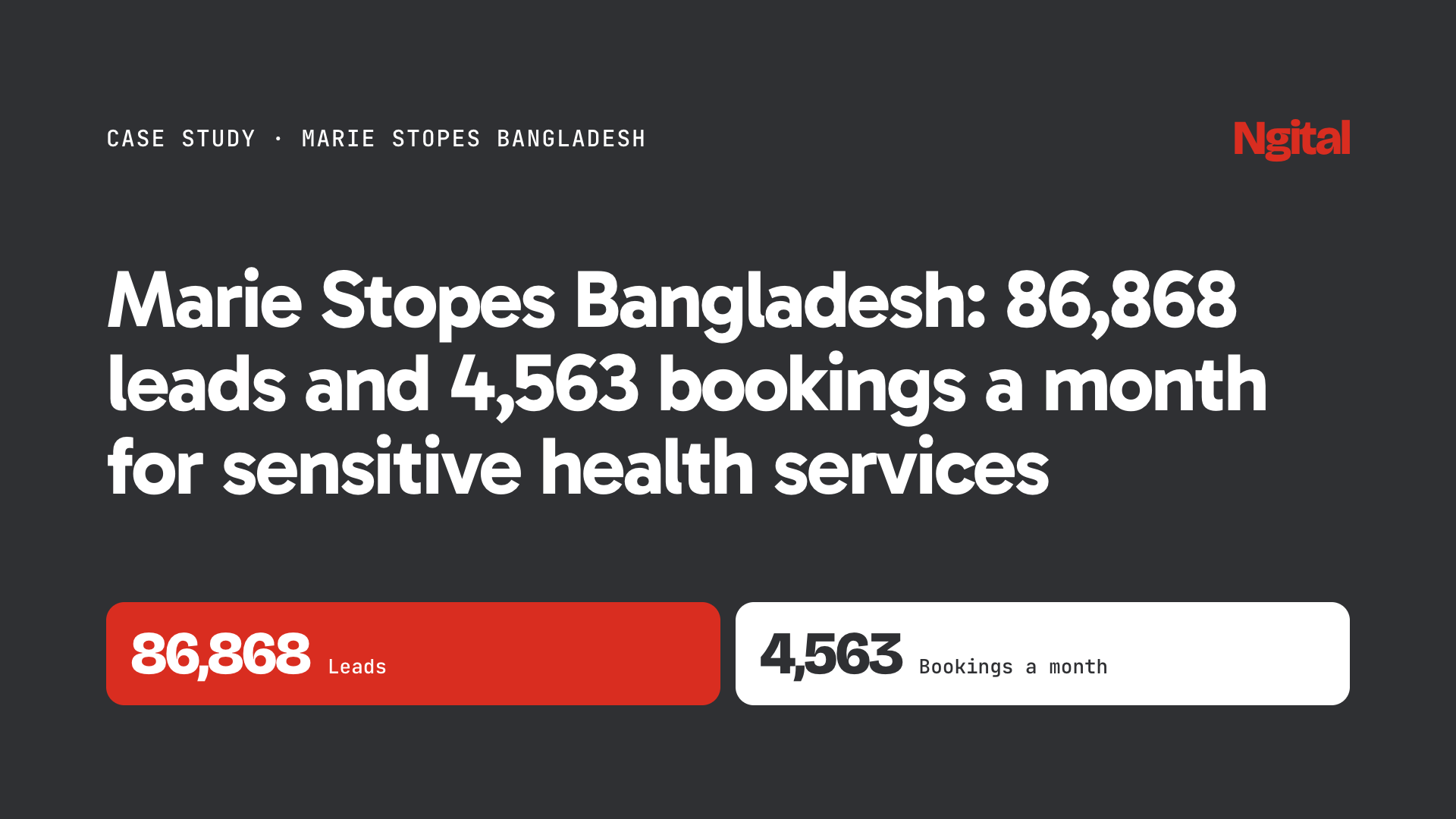
In 12 months, Ngital ran Marie Stopes Bangladesh's Meta and Google advertising as one always-on system. It captured 86,868 leads, including 3,760 clinic calls and direction requests, and delivered an average of 4,563 bookings a month from online campaigns for sensitive health services.
Objective & Challenges
Marie Stopes Bangladesh (MSB) is one of the country's leading providers of family planning, maternal and reproductive healthcare, and part of the global MSI Reproductive Choices partnership working in 37 countries.
Marketing these services is hard. The topics are private and often stigmatised, so many people will not ask in public, call a clinic, or comment on a post. The audience is spread across all divisions, from Dhaka to district towns, and many are young people seeking information for the first time.
The pressure to rebuild was real. In 2020, MSI's annual report shows MSB's couple years of protection fell from 1.06 million to 626,000 as COVID-19 disrupted services, while globally, social messaging interactions with MSI rose 87%. MSB needed a partner that could reach millions nationwide on a non-profit budget, turn awareness into confidential one-to-one conversations, drive footfall to specific clinics and camps, and stay compliant with Meta's strict health ad policies.
Our Strategy
Ngital built a layered, always-on system across Meta and Google in which every campaign has one job and each layer feeds the next: awareness, engagement and video, traffic, messaging and leads, search and Maps intent, service verticals such as maternity, and hyper-local clinic camps.
Messaging sits at the centre because it gives clients privacy. Calls to action point to Messenger, not public comments, so people can ask sensitive questions safely, and counsellors answer and capture details in a private chat.
On Google, Search and Maps campaigns reach people already looking for reproductive health services and point them to the nearest MSB clinic, turning searches into calls and direction requests.
Budgets shift every month towards the campaigns and districts producing the cheapest results, and each clinic camp runs as its own campaign with its own radius, budget and reporting, so MSB can see results location by location.
Private Messenger enquiries
58,000+ private enquiries from the core messaging campaign.
Explore service →The 12-month numbers
Every figure below covers 1 November 2025 to 31 October 2026.
| Result (12 months) | Channel | Volume |
|---|---|---|
| Leads captured (Messenger conversations, lead forms and clinic calls, deduplicated) | Meta + Google | 86,868 |
| Average leads per month | Meta + Google | 7,239 |
| Bookings from online campaigns | Meta + Google | 54,756 (4,563 a month on average) |
| Lead-to-booking rate | Meta + Google | 63% |
| Clinic calls and direction requests | 3,760 | |
| People reached | Meta | 22.7 million |
| Website / link clicks | Meta + Google | 823,091 |
| Video ThruPlays | Meta | 1.23 million |
Around six in ten leads became a booking, and Meta delivered about 96% of all leads, with Google Search and Maps adding the remaining 4% as calls and directions to clinics.
How we did it: a layered, always-on system
Every campaign has one job, and each layer feeds the next. Messaging sits at the centre because it gives clients privacy.
| Layer | What it does | Channel | 12-month result |
|---|---|---|---|
| 1. Awareness | Builds national recall of MSB services at the lowest possible cost | Meta | 16.3M people reached |
| 2. Engagement and video | Educates and builds trust with short videos and posts | Meta, including district video | 7.4M engagements, 6.2M video views |
| 3. Traffic | Sends interested people to MSB’s website and service pages | Meta and Google | Around 323,000 link clicks |
| 4. Messaging and leads | Opens a private Messenger chat where counsellors answer questions and capture details | Meta Messenger | 58,000+ enquiries |
| 5. Search and Maps intent | Reaches people actively searching for services and points them to the nearest clinic | Google Search and Maps | 3,059 direction requests, 701 calls |
| 6. Service verticals | Promotes specific services with their own audiences and creative | Meta, maternity services | 8,800+ enquiries |
| 7. Hyper-local clinic camps | Geo-targets people around a single clinic or camp to drive walk-ins | Meta, district by district | 8,200+ enquiries across districts |
Three working principles made this system run:
- Privacy first. Calls to action point to Messenger, not public comments, so people can ask sensitive questions safely.
- Always on, tuned monthly. Budgets shift every month towards the campaigns and districts producing the cheapest conversations.
- Local by design. Each clinic camp runs as its own campaign with its own radius, budget and reporting, so MSB can see results by location.
Results over time
From March 2026 the system scaled sharply. Monthly lead-form volume on Meta grew more than 6x and held at that level for eight straight months, while cost per lead fell by 69%.
The account also scaled efficiently. Between November 2025 and October 2026, monthly media investment roughly doubled, but impressions grew 3.8x as the cost of reaching people nearly halved.
Private Messenger conversations peaked in August 2026 at 11,132 in a single month.
Campaign spotlights
The core messaging campaign was the largest and most cost-efficient part of the programme, while local clinic campaigns showed the model works district by district.
| Campaign focus | Objective | Key result | What it shows |
|---|---|---|---|
| Core Messenger enquiries | Private one-to-one enquiries | 58,000+ enquiries | The main engine for sensitive questions |
| Maternity services | Maternity service enquiries | 8,800+ enquiries | A single service can run as its own lead engine |
| District maternity camp (Sylhet) | Local camp turnout | 2,300+ enquiries | One local camp can drive thousands of enquiries |
| National awareness | Nationwide reach | 16.3M people reached | Broad recall at very low cost per person |
| Website traffic | Visits to service pages | Around 320,000 link clicks | Steady flow of informed visitors |
| District campaign (Feni) | District awareness and enquiries | 600,000+ video views, nearly 2,500 enquiries | District video builds trust before enquiries |
What the spotlights show: a specialised service like maternity can run as its own lead engine, and a single district camp can generate thousands of private enquiries.
Google Search and Maps: from search to clinic door
On Google, Ngital captured people already searching for reproductive health services and turned them into 3,760 real-world actions: 3,059 requests for directions to an MSB clinic and 701 phone calls.
| Result (Nov 2025 – Oct 2026) | Volume | Rate |
|---|---|---|
| Impressions | 193,673 | — |
| Clicks | 32,494 | 16.8% click-through rate |
| Clinic direction requests | 3,059 | — |
| Phone calls to MSB | 701 | — |
| Total actions (calls + directions) | 3,760 | 11.6% of clicks |
The year-on-year change shows the same pattern as on Meta. Compared with Nov 2024 – Oct 2025, impressions and actions both grew about 4.4x, while the cost of each action halved.
- Service search did most of the work: 23,670 clicks at a 27% click-through rate and 3,745 calls and direction requests.
- Website search added 3,189 clicks to MSB’s service pages.
- Clinic location promotion in Savar and Cumilla tested Maps-led promotion of individual clinics.
This is the strongest offline-intent signal in the programme: a direction request or call means someone is planning a visit.
Audience insights
Young adults drove the results: people aged 18–34 started 80% of all Messenger conversations.
| Age group | Conversations started | Share |
|---|---|---|
| 18–24 | 31,649 | 35% |
| 25–34 | 40,786 | 45% |
| 35–44 | 13,752 | 15% |
| 45–54 | 3,292 | 4% |
| 55+ | 1,629 | 2% |
Two further findings matter for future planning:
- Men are part of the conversation. Men started 55% of conversations, with men aged 25–34 the single largest group. Reproductive health decisions are often made as couples, so creative and counselling scripts should speak to partners as well as women.
- Reach goes well beyond Dhaka. Dhaka Division took 47% of spend and Chattogram 24%, with Rajshahi, Khulna and Barishal sharing the rest. District clinic campaigns extend this further.
Within Meta, Facebook carried 95% of spend and 99% of conversations, confirming it as the primary channel for this audience in Bangladesh.
Why this matters for NGOs and development partners
The MSB programme shows Ngital can run sensitive, donor-accountable social campaigns at national scale, and prove every taka with data.
- Value for money donors can audit. Every result above comes from Meta Ads Manager, Google Ads and programme reporting, broken down by month, campaign, district, age and gender. That is the level of evidence donors and M&E teams ask for.
- Sensitive topics, handled safely. Reproductive health is one of the most restricted ad categories on Meta. Running dozens of always-on campaigns in this space for a full year proves we can deliver within platform health policies, without putting the account at risk.
- Behaviour change, not just reach. The system moves people from seeing a message to starting a private conversation or asking Google for directions to a clinic. The same funnel works for WASH, nutrition, financial literacy, GBV prevention and other behaviour change programmes.
- Local delivery at national scale. Clinic-by-clinic campaigns show we can run district-level activation alongside national awareness, with separate reporting for each location.
- Aligned with where the sector is going. MSI’s own strategy, MSI 2030, commits to client-powered, digitally enabled care so that everyone is one contact away from a safe service. This programme puts that vision into practice in Bangladesh.
Sources
- Campaign data: Meta Ads Manager and Google Ads, 1 November 2025 – 31 October 2026. Lead and booking totals are from Ngital and MSB programme reporting; Google conversions are calls and direction requests.
- MSI Reproductive Choices, Annual Report and Financial Statements 2020: MSB 2020 CYPs, global messaging growth, MSI 2030 strategy.
Results
Over 12 months, the programme captured 86,868 leads, an average of 7,239 a month, and turned them into 54,756 bookings, an average of 4,563 a month. Around six in ten leads became a booking. Meta delivered about 96% of leads through Messenger conversations and lead forms, reaching 22.7 million people, while Google Search and Maps added 3,760 clinic calls and direction requests. From March 2026, monthly lead-form volume on Meta grew more than 6x while cost per lead fell 69%, and on Google, calls and directions grew about 4.4x year on year.
“Ngital didn't just run ads; they transformed our mission. Thanks to their healthcare marketing expertise, we saw a 300% growth in service bookings, allowing us to reach thousands more women across Bangladesh with critical healthcare. They are a foundational part of our expansion”
More case studies
 Brand Marrow Communications · Renewable Energy · Solar
Brand Marrow: building a leading solar energy brand in Bangladesh with 445% monthly growth
 Regent Design & Development Ltd (RDDL) · Real Estate · Luxury residential
Regent: a luxury real estate website that grew site visit bookings 10x
 Care Nutrition · Food & Nutrition · Social impact