Three years ago, when I’d suggest TikTok to FMCG brand managers in Dhaka, I’d get the same response: “Bhai, that’s where teenagers dance. Our target is housewives buying cooking oil.”
Today the conversation is different. TikTok has approximately 46.5 million users aged 18 and above in Bangladesh in 2025, and the platform is no longer dominated by teenagers. Mothers compare detergent brands on TikTok. Office workers research instant noodles before their grocery run. Grandparents watch cooking videos and ask their kids to buy the brand they saw. The platform has gone mainstream — and the FMCG brands that figured this out early are reaching audiences at costs their competitors didn’t think were possible.
But “be on TikTok” isn’t a strategy. The brands that win on TikTok run very different campaigns than the ones still treating it like Facebook with vertical video. After working with TikTok Marketing at Ngital for FMCG brands across categories — beauty, food, beverages, household, personal care — I can tell you what actually works in Bangladesh’s TikTok market in 2026, and what’s still wasting brand budgets.
This is a practical guide for FMCG marketing leaders evaluating whether to invest in TikTok, how to structure those investments, and what to measure to know if it’s working.
Why TikTok Matters Differently for FMCG Than for Other Categories
FMCG is a fundamentally different commerce challenge than fashion, real estate, or B2B services. Three things make it unique on TikTok:
Purchase frequency is high. A consumer buys shampoo, instant noodles, or biscuits dozens of times a year, not once every five years. This means brand recall earned through TikTok translates into measurable revenue much faster than for high-consideration categories.
The buying decision is often impulse-driven. Most FMCG purchase decisions happen at the shelf or scrolling an e-commerce app, not after weeks of research. TikTok content that puts your brand in someone’s head 6 hours before they walk into a Shwapno or open Daraz creates real revenue impact.
Trust transfers fast. When a creator someone trusts uses a product, that trust transfers within seconds — especially for low-ticket items where the cost of trying the brand is small. This is why FMCG creator content on TikTok routinely outperforms TVC equivalents at a fraction of the cost.
For these reasons, TikTok is arguably more important for FMCG than for any other category in Bangladesh’s marketing mix in 2026.
What’s Different About TikTok in Bangladesh
Before we get into tactics, you need to understand how TikTok in Bangladesh differs from TikTok in the US, India, or even neighboring South Asian markets. Three patterns matter:
Bangla and Banglish dominate, not English. Unlike Instagram in Bangladesh, where premium brands often use English, TikTok content in Bangladesh is overwhelmingly Bangla or Banglish. Your TikTok strategy can’t be translated from your English-language brand playbook — it has to be rebuilt in the language your audience actually speaks on the platform.
Rural and Tier-2 city engagement is significant. TikTok’s reach extends well beyond Dhaka, Chittagong, and Sylhet into smaller cities and towns where Facebook and Instagram engagement is thinner. For FMCG brands with national distribution, this is a major opportunity that other platforms can’t match.
Creator culture is mature but underleveraged. Bangladesh has thousands of TikTok creators with 100K+ followers, but most FMCG brands still work with the same 20–30 “name” influencers that everyone uses. The mid-tier creator economy (50K–500K followers) is where the most cost-efficient partnerships exist, and it’s drastically underused by FMCG.
Comment-section engagement matters more than other platforms. TikTok’s algorithm weights comments heavily in distribution decisions. Brands that engage in comments — actually replying to consumers, not just liking — get measurably better organic reach. Most FMCG brand pages in Bangladesh ignore this entirely.
The Two Types of TikTok Investment FMCG Brands Should Make
When FMCG brands ask me how to invest in TikTok, I always frame it as two distinct workstreams that need separate budgets, separate teams, and separate metrics.
Workstream 1: Owned Brand Content
Your brand’s own TikTok account, posting native content regularly. This is the foundation — without it, paid amplification has no organic anchor.
What this looks like for FMCG brands that do it well:
- 4-7 posts per week minimum (lower frequency loses algorithmic favor)
- A mix of product-in-context, behind-the-scenes, employee-led, and trend-participation content
- Direct engagement in comments — replying to questions, jokes, complaints
- Iterating creative based on what’s performing, not on what was approved in committee
What I see going wrong: Most FMCG brand TikToks are repurposed Facebook videos with vertical cropping. They feel inauthentic, perform poorly, and reinforce the brand manager’s belief that “TikTok doesn’t work for us.” The medium is different. The content has to be different.
Workstream 2: Paid Amplification + Creator Partnerships
The performance side — boosted content, dedicated TikTok ads, and paid creator collaborations.
What this looks like:
- TikTok Ads Manager campaigns optimized for video views, traffic, or conversions depending on funnel stage
- Spark Ads boosting high-performing organic content (yours or creators’)
- Mid-tier creator partnerships running over 4-12 week sustained campaigns, not one-off posts
- Affiliate-style partnerships for e-commerce-enabled FMCG brands
Budget allocation guidance for FMCG brands serious about TikTok:
| Brand Stage | Owned Content (% of TikTok budget) | Paid + Creators (% of TikTok budget) |
|---|---|---|
| Just starting on TikTok | 60% | 40% |
| Established TikTok presence | 35% | 65% |
| Mature TikTok program | 25% | 75% |
The pattern: as your owned content gets stronger, you shift more budget to amplification. But you never stop investing in owned content entirely — paid amplification without an organic anchor produces declining returns.
TikTok Ad Formats That Work for FMCG in Bangladesh
TikTok’s ad inventory has evolved significantly. Here’s what I see actually working for FMCG brands in Bangladesh in 2026:
In-Feed Ads (Most Versatile)
Native-feeling video ads that appear in users’ For You feeds. These are the workhorses of FMCG TikTok advertising. Best practices:
- Hook in the first 2 seconds — TikTok skip rates are brutal. If your ad starts with a brand logo or slow corporate intro, it’s already lost
- Sound-on creative — TikTok is a sound-on platform; audio matters as much as visuals
- Native vertical 9:16 — never repurpose horizontal TVC content
- 15-30 seconds optimal — longer ads work for storytelling, but most FMCG benefits from shorter formats
Spark Ads (Highest Cost-Efficiency)
Spark Ads let you boost organic posts (your own or creators’) as paid ads. They consistently outperform standard in-feed ads because they feel like organic content.
This is where the highest cost-efficiency exists for FMCG in Bangladesh. A creator posts content featuring your product, the post performs organically, then you boost it with paid spend. The creator gets reach, the brand gets distribution, and the algorithm treats it as native content because it’s tied to a real creator account.
TopView and Brand Takeovers (Premium Awareness)
Full-screen ads that appear when users open the app. Expensive — these are premium awareness placements. For FMCG, only worth using for major brand moments: new product launches, seasonal campaigns (Ramadan, Eid, Pohela Boishakh), or category-disrupting positioning.
Branded Hashtag Challenges (When Done Right)
User-generated content campaigns where the brand creates a hashtag and incentivizes participation. These can produce massive reach when they work, but most fail because brands try to force virality.
What works: simple, easy-to-replicate challenges tied to genuine product use. What fails: complex creative concepts that require production effort users won’t invest. If asking your audience to create content feels like asking them to do work, the campaign won’t take off.
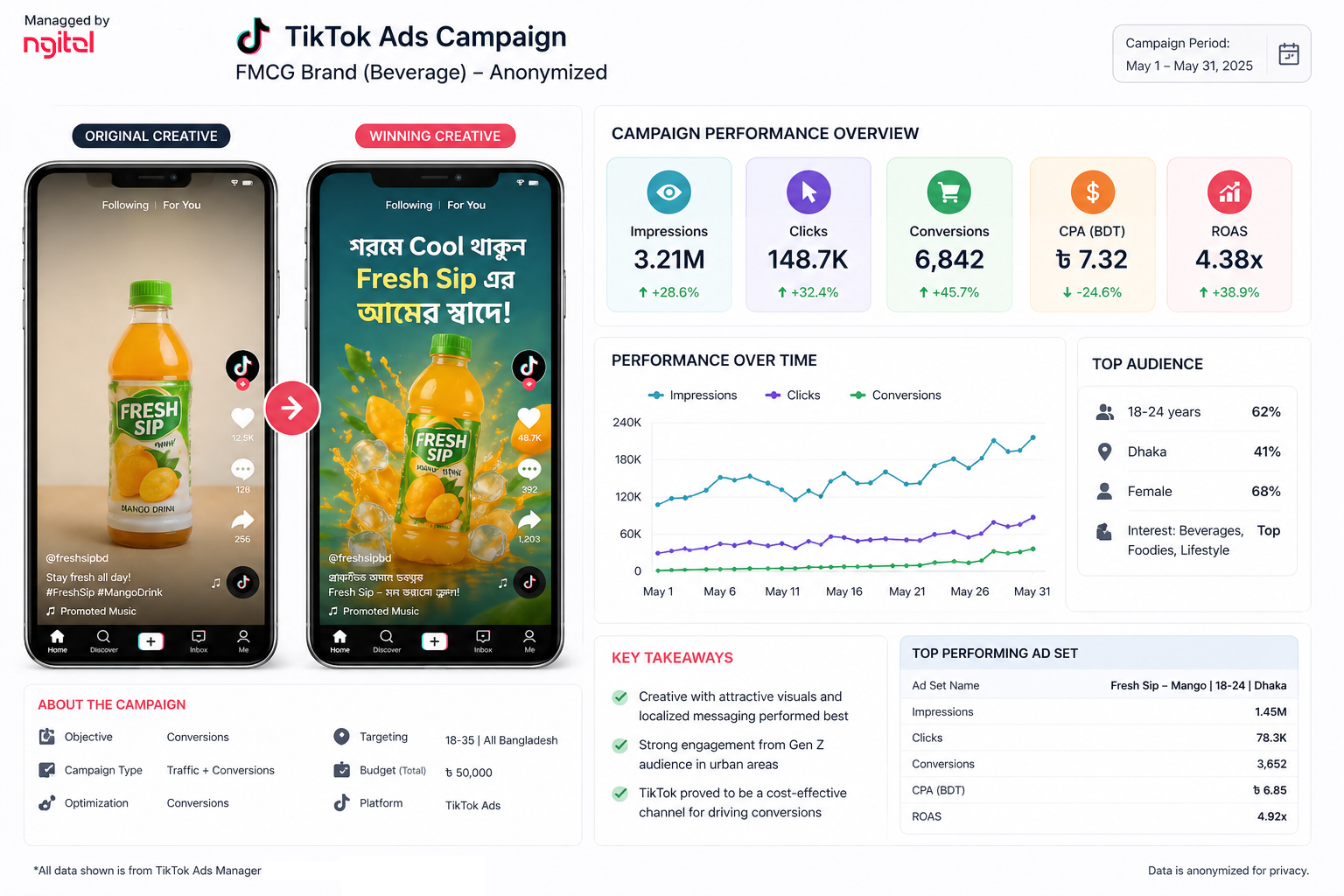
The Creator Strategy Most Bangladeshi FMCG Brands Get Wrong
I’d estimate that 80% of TikTok creator partnerships I see Bangladeshi FMCG brands run are structured wrong. They’re treating TikTok creators like traditional brand ambassadors, and the math doesn’t work.
The wrong way (which most brands do):
- Pay one or two big-name creators large fees for a single post
- Demand heavy script approval and brand-mandated talking points
- Measure success by reach and impressions on that single post
- Wonder why the campaign didn’t move sales
The right way (which the brands winning on TikTok do):
Work with mid-tier creators in volume, not big names in singles. A campaign with 15-20 creators in the 50K-300K follower range almost always outperforms a single post from a 2M-follower creator at the same total budget. More content variations, more audience segments reached, more opportunities for organic breakouts.
Run sustained campaigns, not one-off posts. A creator’s audience needs to see them use a product 3-4 times before believing they actually use it. One sponsored post reads as ad. Four posts over six weeks reads as genuine usage.
Give creators room to be themselves. The creators on TikTok Bangladesh who have 200K+ engaged followers got there because they have a distinctive voice. When brands force them into rigid scripts, the content underperforms because it doesn’t match what their audience expects from them.
Pay performance, not just impressions. Mix flat fees with affiliate-style commissions. This filters out creators who just want easy money and aligns incentives toward content that actually drives action.
Measure incremental sales lift, not just engagement. Set up coupon codes, custom landing pages, or platform-specific promo links so you can attribute sales to specific creator partnerships. Without this, you’re optimizing on signals that don’t translate to revenue.
Content Themes That Work for FMCG Categories in Bangladesh
Different FMCG categories perform differently on TikTok. Here’s what we’ve seen work for specific categories at Ngital:
Beauty and Personal Care
The strongest TikTok category for FMCG in Bangladesh. Tutorials, before/afters, ingredient education, and creator-led product reviews dominate. Brands like Shajgoj have shown what’s possible when beauty meets TikTok. Authenticity beats polish — overproduced beauty ads fail; raw, honest “I tried this for 30 days” content wins.
Food and Beverage
Recipe videos featuring the product, taste tests, behind-the-scenes from production facilities, and creator-led reviews of new flavors. Time-pressed working professionals respond especially well to “5-minute meal” formats featuring packaged food products.
Snacks and Confectionery
Trend participation works exceptionally well here. Quick, visual, often humorous content that puts the product in a relatable moment. The audience is broad and the price point is impulse-low, so creator content converts to actual purchase faster than in any other FMCG sub-category.
Household Products
Transformation content (before/after cleaning, satisfying organization), product comparison content, and life-hack formats featuring the product. The demographic skews to homemakers, and Bangla-language content significantly outperforms English here.
Hygiene and Cosmetics
Educational content explaining ingredients, comparison content vs. competitors, and demonstrations of correct product usage. Trust-building is critical because of recent counterfeit concerns in Bangladesh’s market — content emphasizing authenticity and origin performs well.
Beverages (Including Tea, Coffee, Soft Drinks)
Lifestyle integration (“morning routines featuring our brand”), creator-led taste content, and seasonal campaigns (Iftar drinks during Ramadan, hot beverages during winter). Beverage brands also benefit disproportionately from sound-on creative because of the satisfying “pour” and “sip” audio elements.
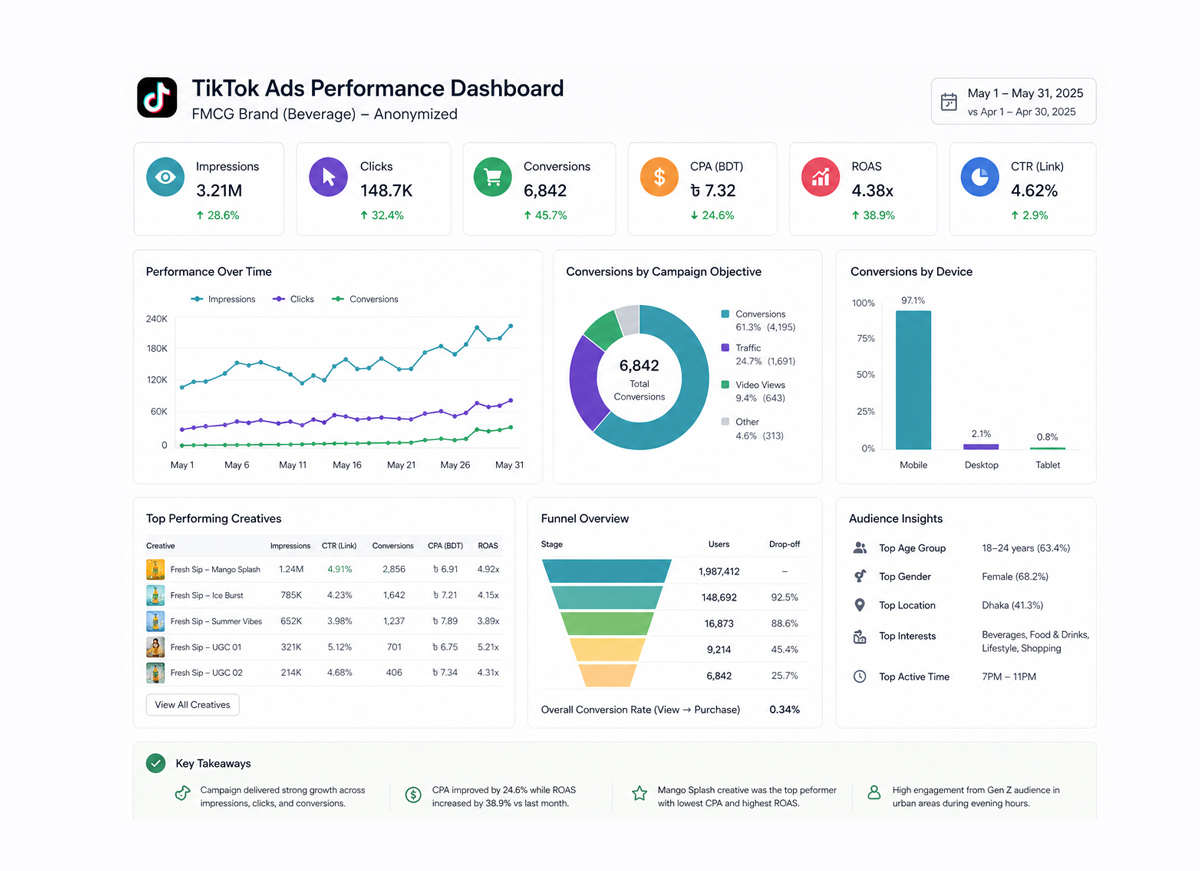
Measurement: What FMCG Brands Should Track
This is where most TikTok marketing fails for FMCG. Brands measure the wrong things, then conclude TikTok doesn’t work when it’s actually working — they just can’t see it.
What most FMCG brands measure (and shouldn’t):
- Total views (vanity metric, doesn’t predict sales)
- Total followers (irrelevant if engagement is low)
- Likes (engagement quality varies dramatically)
What FMCG brands should measure on TikTok:
| Metric | Why It Matters |
|---|---|
| Average watch time | TikTok’s algorithm favors content with high completion; this predicts future organic reach |
| Save rate | Saves indicate intent to purchase or remember the product |
| Share rate | Shares amplify reach beyond paid spend |
| Comment quality | Genuine questions and product mentions in comments signal real interest |
| Branded search lift | Increase in brand-name searches on Google during/after campaigns |
| E-commerce attribution | If sold through Daraz, Pickaboo, or owned site, track UTM-tagged traffic and conversions |
| Retail sales lift | For traditional retail FMCG, track sell-through rate before vs. during campaigns |
| Survey-based recall | Periodic brand recall surveys to measure unaided awareness shifts |
The last metric matters most for FMCG brands selling primarily through traditional retail (most of Bangladesh’s FMCG distribution). If you can’t directly attribute online sales, periodic consumer surveys measuring brand awareness and purchase intent are the most reliable signal of TikTok investment ROI.
Budget Expectations: What FMCG TikTok Investment Looks Like
Realistic monthly budget ranges for serious TikTok investment by FMCG brands in Bangladesh:
Entry tier — BDT 1,50,000 to 3,00,000/month:
- 1-2 paid campaigns running consistently
- 2-4 mid-tier creator partnerships per month
- Owned content production (4-5 posts per week)
- Suitable for: smaller FMCG brands testing TikTok, or established brands running test campaigns
Growth tier — BDT 3,00,000 to 8,00,000/month:
- 3-5 paid campaigns across funnel stages
- 8-15 creator partnerships per month
- Increased owned content production with dedicated team
- Suitable for: established FMCG brands serious about scaling TikTok presence
Premium tier — BDT 8,00,000+/month:
- Full-funnel paid campaigns (awareness, consideration, conversion)
- Creator network with 20+ partners across content types
- Premium ad placements (TopView, Brand Takeovers) for major launches
- Dedicated owned content team producing daily
- Suitable for: leading FMCG brands in their categories, multi-brand FMCG portfolios
These ranges include media spend, production, and creator fees. Agency management fees are typically additional 10-20% on top of media spend, depending on scope and complexity.
When to DIY vs. Hire Specialist Help
TikTok marketing requires platform-specific expertise that’s harder to build internally than Meta or Google because the platform’s mechanics, algorithm, and creative norms are still evolving rapidly.
Internal team can handle TikTok if:
- You have at least one team member who actively uses TikTok personally and intuits the platform
- You have a creative production capacity that can produce 15+ pieces of native vertical content per month
- You have established relationships with creators in your category
- You have measurement infrastructure to track beyond vanity metrics
Specialist help makes sense if:
- You’re a category leader where TikTok mistakes cost more than agency fees
- Your team’s TikTok knowledge is theoretical (read articles, didn’t execute)
- You need access to creator networks you don’t currently have
- You want to integrate TikTok with broader paid media strategy (Meta + Google + TikTok as one system)
At Ngital, we work with FMCG brands across Bangladesh on TikTok strategy, paid campaigns, creator partnerships, and content production. As an official TikTok Marketing Partner, we have direct relationships with TikTok’s local team that help us escalate platform issues, access betas, and structure campaigns at the level needed for serious FMCG investment.
If you’d like to explore whether your brand is investing in TikTok the right way, request a free consultation. We’ll review your current setup and tell you honestly what we’d change — whether you hire us or not.
Frequently Asked Questions
Is TikTok worth it for FMCG brands in Bangladesh in 2026? For most FMCG categories, yes. TikTok’s reach in Bangladesh has grown substantially with approximately 46.5 million users aged 18+ in 2025, and the audience now includes the broad consumer demographics that buy FMCG products. The brands that started building TikTok presence in 2023-2024 have meaningful competitive advantages now.
How is TikTok different from Facebook for FMCG marketing? Facebook in Bangladesh is increasingly transactional — performance ads, lead forms, retargeting. TikTok is more brand-equity-driven — content that builds awareness, affinity, and consideration before consumers see your products on shelves. The two work best together: TikTok for top-of-funnel demand creation, Facebook for bottom-funnel demand capture.
What’s the minimum budget to test TikTok for an FMCG brand? A meaningful test requires at least BDT 1,50,000-2,00,000 over 60-90 days, including paid spend, owned content production, and 2-3 creator partnerships. Below that, you can’t gather enough data to know whether TikTok works for your specific brand.
Should we use big-name creators or mid-tier creators? Almost always mid-tier (50K-300K followers) in volume, not big names in singles. The math is consistently better — more content, more audience reached, more optimization opportunities, lower per-post cost.
How long until TikTok investment shows results? Brand metrics (recall, awareness, search lift) take 60-90 days to show measurable change. Sales attribution depends on your sales channels — e-commerce attribution is faster (30-60 days) than traditional retail attribution (90-180 days, often through periodic surveys).
What’s the biggest mistake FMCG brands make on TikTok? Treating it as another Facebook. The platform’s algorithm, audience expectations, and content norms are different. Brands that succeed rebuild their content strategy specifically for TikTok rather than repurposing existing assets with vertical cropping.
The Summary
TikTok has moved from “experimental channel” to “essential platform” for FMCG brands in Bangladesh. The brands that built early presence are reaping compounding benefits — better creator relationships, lower acquisition costs, stronger algorithmic favor, and higher organic reach than competitors who waited.
For FMCG marketing leaders evaluating their 2026 mix, the question isn’t whether to invest in TikTok. It’s how to invest correctly. Set up two distinct workstreams — owned content and paid amplification. Work with mid-tier creators in volume. Build native vertical content, not repurposed assets. Measure beyond vanity metrics into actual brand and sales lift.
The FMCG brands that win on TikTok in 2026 won’t be the ones with the biggest budgets. They’ll be the ones who understand the platform deeply enough to allocate budgets correctly. That’s the real differentiator.
If you’d like specialist help structuring TikTok investment for your FMCG brand, our team at Ngital works with brands across food, beverage, beauty, household, and personal care on TikTok strategy and execution. As an official TikTok Marketing Partner, we bring direct platform access and category-specific expertise to brands serious about scaling their presence.