Most “Facebook Ads guides” for real estate are written by people who’ve never actually run a campaign for a Dhaka developer. They tell you to “target homeowners” and “use compelling creative” without explaining what that means when you’re competing with 40 other real estate ads in a Bashundhara resident’s feed at 9 PM on a Tuesday.
This is a different kind of post. It’s the actual playbook we use at Ngital when we onboard a new real estate client in Dhaka — campaign structure, audience setup, creative formats, budget allocation, and the operational details most agencies skip. It’s based on running Meta Ads campaigns for real estate developers across Dhaka over the past eight years, with specific patterns that work in this market and specific traps that don’t.
This isn’t a theoretical framework. It’s what we’d hand a new account manager joining our real estate team on day one. Use it directly, adapt it to your project, or use it to evaluate whether your current agency is following best practices.
Before We Touch Ads Manager: The Pre-Launch Audit
Most underperforming real estate Facebook campaigns fail before they launch. The setup work matters more than the ad creative.
When we onboard a new real estate client in Dhaka, we don’t open Ads Manager until we’ve completed a six-point audit:
1. Pixel and Conversions API audit. We verify the Meta Pixel is installed correctly on every relevant page — homepage, project pages, contact form, thank-you page. We confirm Conversions API (CAPI) is set up server-side because iOS 14+ wiped out roughly 30-40% of pixel-only attribution. Without proper CAPI in 2026, your campaigns are flying half-blind.
2. Lead handling infrastructure check. Before spending a taka, we verify the client’s lead handling capacity. Where do leads land? Who calls them? How fast? What happens if a lead comes in at 11 PM Friday? If the answer to “fast” is “next business day,” we fix that operational issue before we run ads. Otherwise we’d be lighting money on fire.
3. Project asset inventory. We need at least 8-10 hero photos of the project, 2-3 video walkthroughs (drone, exterior, interior), floor plans for each unit type, and any third-party validation (RAJUK approval, REHAB membership, completion certificates). If these don’t exist, we plan a one-day shoot before launching campaigns.
4. Sales funnel and CRM mapping. We map exactly what happens after a lead submits a form. Notification email → CRM entry → assigned to sales rep → first call within X minutes → site visit booked → follow-up sequence. Every gap in this flow is where leads die.
5. Competitor analysis. Using Meta Ads Library, we audit what other Dhaka developers are running — which projects are advertising heavily, what creative formats they’re using, what messaging angles dominate the feed. This shapes our differentiation strategy.
6. Buyer persona definition. We work with the client to define 2-4 distinct buyer personas — not generic “high-income Dhaka professionals,” but specific profiles like “Bangladeshi expat in UAE earning 15,000+ AED, age 35-50, evaluating Dhaka property as investment + future home” or “Dhaka business owner, age 40-55, currently in older Gulshan/Banani apartment, looking to upgrade.” Personas drive everything downstream.
Only after this audit is complete do we move to campaign setup.
The Three-Stage Campaign Architecture
Every real estate client at Ngital runs three stages simultaneously after launch. Most agencies and in-house teams run only one — usually Stage 3 — which is why their campaigns underperform.
Stage 1: Awareness (Cold Traffic)
Campaign objective: Video Views or ThruPlay (NOT Reach or Engagement) Budget allocation: 25-30% of total spend Audience size: 800,000–2,000,000 in target geography
What it does: Introduces the project to people who don’t know it yet. Builds the warm audience pool that Stages 2 and 3 retarget against. The goal is not leads at this stage — it’s video views, project recall, and pixel data.
Audience setup for Dhaka projects:
- Geography: Dhaka + Chittagong + Sylhet (urban centers) for nationwide projects, or specific upazila-level targeting for hyperlocal projects
- Age: 32-58 for primary residential, 38-65 for premium/investment
- Behavioral signals: Frequent international travelers, premium credit card holders, business page admins, frequent flyers
- Custom audiences excluded: Existing customers, current website visitors (we don’t want to waste cold-traffic budget on warm traffic)
Creative for Stage 1:
- 30-60 second project showcase videos (drone + exterior + lifestyle)
- Founder/CEO videos talking about the project’s vision (high authenticity, low production quality is fine)
- Testimonial videos from existing buyers if you have them
- Avoid: static photos with price text, hard-sell “BUY NOW” creative
Stage 2: Consideration (Warm Retargeting)
Campaign objective: Lead generation (Instant Form) or Conversions (website form) Budget allocation: 35-40% of total spend Audience size: Whatever the warm pool from Stage 1 has built up
What it does: Captures people who engaged with Stage 1 — watched 50%+ of your video, visited your website, clicked an ad — and converts them into leads. These people already know the project; now we ask for their information.
Audience setup:
- Custom audience: Video viewers (50%+ ThruPlay) from last 60 days
- Custom audience: Website visitors from last 30 days
- Custom audience: Engaged with Page or Instagram in last 30 days
- Excluded: Existing leads (they shouldn’t see lead-gen ads, they should see Stage 3 nurture content)
Creative for Stage 2:
- Project highlight reels emphasizing specific value props (location, amenities, ROI for investors)
- Carousel ads showcasing different unit types and price points
- Testimonial-driven ads with named buyers (with permission)
- Limited-time incentives if genuinely time-bound (early-bird pricing, launch offers)
Lead form structure (this matters enormously): We always add 4-5 qualifying questions to lead forms:
- Budget range (with realistic Dhaka real estate brackets in BDT)
- Timeline (within 3 months / 3-6 months / 6-12 months / just exploring)
- Preferred area (1-3 selections)
- Apartment size needed (2BHK / 3BHK / 4BHK+ / commercial)
- Buyer type (primary residence / investment / second home)
Yes, qualifying questions reduce raw lead volume by 30-50%. They also dramatically increase lead-to-sale conversion. Net result: the same ad budget produces more closed sales, not fewer.
Stage 3: Conversion (Hot Retargeting)
Campaign objective: Conversions (website action like callback request or site visit booking) Budget allocation: 30-35% of total spend Audience size: Smallest of the three — typically 5,000–50,000 people
What it does: Converts high-intent leads into actual site visits and calls. These are people who’ve already submitted information, visited the project page multiple times, or shown direct buying intent.
Audience setup:
- Custom audience: Lead form submitters from last 30 days who didn’t book a site visit
- Custom audience: Website visitors who hit the contact page or pricing page
- Custom audience: Existing CRM list of warm leads not yet converted
Creative for Stage 3:
- Site visit booking-focused ads (“Schedule your visit this Saturday”)
- Sales rep introduction videos (humanizes the next step)
- Specific unit availability alerts if relevant
- Direct response messaging with phone number prominent
[INSERT: a sample Meta Ads Manager screenshot showing the three-stage campaign architecture from an Ngital real estate client]
Audience Layering: What Actually Works in Dhaka
Real estate audiences in Bangladesh have specific patterns we’ve learned from running campaigns across dozens of projects.
The Core Domestic Audience
Geographic targeting in Dhaka shouldn’t be “all of Bangladesh” or even “all of Dhaka.” It should be specific. Our default geographic layers:
Primary residential projects (BDT 80 lakh – 2 crore):
- Within Dhaka: Gulshan, Banani, Dhanmondi, Uttara, Mirpur, Bashundhara R/A, Mohammadpur
- Plus the high-income areas of Chittagong (GEC, Khulshi, Nasirabad) and Sylhet (Zindabazar, Subid Bazar)
Premium projects (BDT 2 crore+):
- Dhaka: Gulshan 1 & 2, Banani, Baridhara, Dhanmondi, Bashundhara R/A
- Bangladeshi diaspora geographies (covered below)
Mid-market projects (BDT 50-90 lakh):
- Dhaka: Mirpur, Mohammadpur, Uttara, Baridhara DOHS, Tejgaon
- Plus Tier-2 cities like Khulna, Rajshahi, Bogura where buyers may be relocating to Dhaka
The Diaspora Audience (Most Underused)
This is where most Dhaka developers leave money on the table. Bangladeshi expats are massive buyers of Dhaka real estate, but most domestic Facebook campaigns ignore them entirely.
Highest-value diaspora geographies for Dhaka real estate:
- UAE (Dubai, Abu Dhabi, Sharjah)
- Saudi Arabia (Riyadh, Jeddah)
- Malaysia (Kuala Lumpur)
- USA (New York, Detroit, Houston, Los Angeles)
- UK (London, Birmingham)
- Canada (Toronto)
- Australia (Sydney, Melbourne)
- Singapore
Diaspora targeting setup:
- Geography: Specific city
- Behavior: Lived in country less than 5 years (Meta has this signal)
- Language: Bengali/Bangla
- Demographics: Age 35-55, indicators of established income
Diaspora CPLs are often 30-50% lower than domestic Dhaka CPLs because there’s less advertising competition. Buyers are also typically larger ticket — they’re often buying premium properties as both home and investment.
Behavioral and Interest Signals That Work
Forget generic “interested in real estate.” Better signals we use:
- Premium credit card holders (American Express, gold/platinum tier signals from local banks)
- Frequent international travelers (3+ international trips per year)
- Business page admins (signals business ownership)
- Engaged with luxury automotive content (correlates with property purchase capacity)
- Engaged with private school / international school content (family with means)
- Top 10% household income brackets in target geographies
Custom Audiences From Your Own Data
If your client has any existing customer database, this is gold. Upload to Meta as a Custom Audience, then create lookalike audiences (1-3% similarity for highest match quality) targeting the same geographies.
Meta’s Custom Audience tool is one of the highest-leverage assets in real estate marketing. Lookalikes from actual buyers consistently outperform interest-based targeting because they’re modeled on people who actually purchased, not people who Meta guessed might be interested.
Creative Strategy: What Actually Stops the Scroll
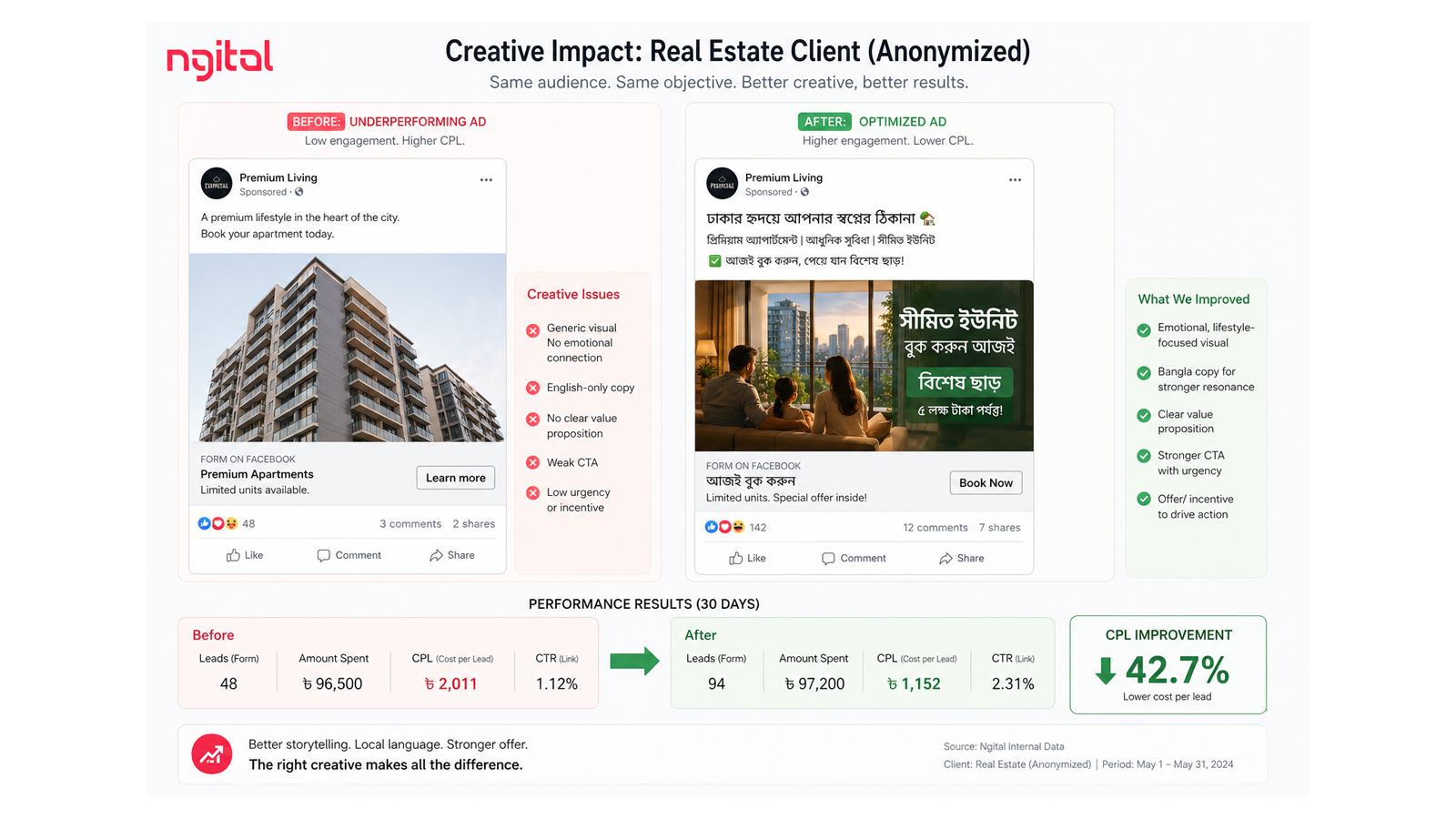
Real estate ad creative in Dhaka is mostly forgettable. Most of it looks the same — a polished apartment photo, the project name, a price, a “Call Now” button. The feed is saturated with this format. You scroll past 20 of them in 30 seconds.
What stops the scroll in 2026:
Video Beats Static, Always
The Meta algorithm prioritizes video content because users watch it longer. In real estate specifically, video does what static images can’t — it shows what the apartment feels like to live in.
Video formats that perform in Dhaka real estate:
1. The 30-second walkthrough. Phone-quality is fine. Walk through one apartment, narrating in Bangla or Banglish (whichever your audience prefers). “This is the master bedroom — note the morning light, here’s the attached balcony with view of the garden.” Authentic beats produced.
2. The drone reveal. A 10-15 second drone shot showing project location and surrounding area. Especially powerful for projects where location is the differentiator (proximity to schools, lake views, main road access).
3. The day-in-the-life. A 45-60 second narrative showing what living in this project looks like — morning coffee on the balcony, kids playing in the courtyard, evening on the rooftop. Emotional, not transactional.
4. The founder/developer talking head. A 60-90 second video of the project’s developer or CEO explaining the vision, the build quality, the timeline. Builds trust dramatically. Works exceptionally well for premium projects.
5. The customer testimonial. Real buyers (with permission) talking about why they chose this project. The single highest-converting creative format we run when we have it. Most clients don’t have this asset; we shoot it during the engagement.
Static Creative That Still Works
When you do use static images, certain formats outperform:
- Carousel ads with floor plans — show 3-5 unit types with size, BHK, and starting price on each card. High click-through because viewers self-select into their relevant unit.
- Before/under-construction/after sequences — only for projects with completion data. Builds trust through transparency.
- Comparison cards — “This 3BHK in Bashundhara at this price vs. equivalent in Gulshan at this price.” Investment-buyer focused.
Bangla, English, or Banglish?
This depends entirely on your buyer persona. Default rules:
- Premium projects targeting Dhaka elite + diaspora: English primary, with Bangla call-outs
- Mid-market projects targeting urban professionals: Banglish (English script with Bangla phrasing)
- Diaspora-only campaigns: Always include Bangla — emotional connection to homeland matters
- Investment-focused messaging: English (financial vocabulary translates poorly)
Test both languages in early creative testing. Often the same audience converts better in one language than agencies expect.
Budget Allocation: A Real Example
For a Dhaka residential project with BDT 5,00,000/month Meta Ads spend, our typical allocation:
Stage 1 — Awareness (BDT 1,25,000 / 25%):
- Domestic cold traffic: BDT 75,000
- Diaspora cold traffic: BDT 50,000
Stage 2 — Consideration (BDT 2,00,000 / 40%):
- Domestic warm retargeting: BDT 1,20,000
- Diaspora warm retargeting: BDT 80,000
Stage 3 — Conversion (BDT 1,50,000 / 30%):
- Hot retargeting + CRM lookalikes: BDT 1,50,000
Testing budget (BDT 25,000 / 5%):
- New audiences, new creative formats, new placements
This is a starting point, not a fixed rule. After 60-90 days of data, the allocation should rebalance toward whatever is producing closed sales (not just leads). Some projects end up running 50% of budget on diaspora audiences. Others run 80% on domestic. The data dictates the shift.
Daily, Weekly, and Monthly Operating Cadence
Most real estate campaigns fail in operations, not strategy. The plan looks fine on paper but nobody touches it for a month. Here’s the cadence we run:
Daily (15-30 minutes):
- Check overnight lead volume and quality
- Verify pixel and CAPI events are firing correctly
- Pause any ad sets with CPL >2x target
- Reply to comments on ads (Meta favors active pages)
Weekly (2-3 hours):
- Performance review — CPL by audience, CPL by creative, lead-to-call-answered rate
- Budget reallocation between ad sets based on performance
- Launch 2-3 new creative variations to combat fatigue
- Sales feedback loop — which leads converted to site visits, which were trash
Monthly (4-6 hours):
- Full account audit — restructure underperforming campaigns
- New audience exploration based on past 30 days of data
- Major creative refresh (new video, new angles, new formats)
- Strategic review with client team — what’s working, what isn’t, what should change next month
Quarterly (full day):
- Strategic planning — market shifts, project phase changes, competitive movements
- Creative production planning for next quarter
- Budget and target adjustments based on quarterly performance
If your current Facebook Ads team or agency isn’t running this cadence, that’s why your campaigns plateau after the first 30 days.
Lead Handling: Where the Real Money Is Won or Lost
I’ll repeat this because it matters more than anything else in this post: the best Facebook Ads campaign in Dhaka can be ruined by slow lead handling.
The data is unforgiving. Industry research consistently shows that calling a lead within 5 minutes of submission makes them 21x more likely to convert than calling after 30 minutes. After 24 hours, conversion rates collapse.
Yet 80% of Dhaka real estate developers have lead handling that looks like this:
- Lead submits form Saturday at 8 PM
- Notification goes to a generic email
- Sales coordinator sees it Sunday at 11 AM
- Calls Tuesday afternoon
- Lead doesn’t answer
- Logged as “not interested”
That lead probably cost BDT 2,000-4,000 in ad spend to generate. It died from operational neglect, not from being a bad lead.
What we set up with new clients:
- Real-time lead notifications via WhatsApp Business API to an assigned sales rep
- 5-minute first-call SLA, enforced and tracked
- Proper CRM (HubSpot, Zoho, Salesforce) — not WhatsApp groups, not Excel sheets
- Multi-touch nurture sequences for leads who don’t immediately respond (3-touch over 7 days, then long-term nurture for 90+ days)
- Sales team training specifically on digital lead behavior (different from walk-in customers)
This is unglamorous infrastructure work. It’s also where the money is.
Across Ngital real estate clients in 2025, implementing a 5-minute lead response workflow improved cost-per-closed-sale by an average of 31%, while increasing qualified booking-to-sale conversion rates by 24%. Faster response times consistently reduced lead decay, improved appointment show-up rates, and helped sales teams convert high-intent prospects before competitors could respond.
Common Mistakes We See in Dhaka Real Estate Campaigns
When we audit underperforming real estate campaigns from other agencies or in-house teams, we see the same mistakes repeatedly:
1. Engagement objective instead of Lead Generation or Conversions. The algorithm optimizes for whatever objective you set. Engagement ads find people who like commenting, not people who buy property.
2. One creative running for 4+ months. Audience fatigue is real. After 6-8 weeks, the same creative produces declining returns. Plan for continuous refresh.
3. Geography too broad. “All of Bangladesh” includes 16 crore people, most of whom can’t afford a Bashundhara apartment. Narrow to specific areas where buyers actually exist.
4. Lead form with no qualifiers. Auto-filled forms produce huge volumes of curious browsers. Add 4-5 qualifying questions to filter for serious buyers.
5. No retargeting layer. Most underperforming accounts run cold traffic only. The customer journey for real estate is 3-7 touches; one-touch campaigns convert at fraction of multi-touch.
6. No diaspora targeting. Massive untapped audience for most Dhaka developers, especially in premium segments.
7. Slow lead handling. All the campaign optimization in the world doesn’t fix a sales team that calls leads 24 hours late.
8. No CAPI implementation. Pixel-only attribution lost 30-40% of data after iOS 14. CAPI recovers most of it.
9. Vague reporting. Reach and engagement numbers without site-visit and sale attribution. If your monthly report doesn’t tell you which leads turned into actual sales, the report isn’t useful.
10. No competitor monitoring. Meta Ads Library shows you what competitors are running. Most Dhaka agencies never check it.
When You Need Specialist Help vs. Internal Team
This playbook can be executed by an internal marketing team if you have:
- Dedicated Meta Ads specialist (not a generalist)
- Proper measurement infrastructure (Pixel + CAPI + CRM)
- Creative production capacity (video, photography, design)
- Sales team trained on digital lead handling
- 5+ hours per week of senior management oversight
It cannot be executed well by:
- A junior marketing executive doing this part-time
- An agency without real estate-specific experience
- A team without integrated creative production
- An operation without a real CRM system
For most Dhaka developers, hiring a specialist agency with real estate experience produces better economics than building the capability in-house — especially below BDT 8-10 lakh monthly ad spend, where the agency fee becomes a small percentage of total media investment.
If you’d like to see how Ngital approaches a specific project, request a free audit. We’ll review your current campaigns and lead handling and tell you honestly what we see — whether you hire us or not.
Frequently Asked Questions
What’s the minimum budget to run effective Facebook Ads for real estate in Dhaka? For a single project with one inventory type, BDT 1,50,000–2,50,000 per month is the realistic minimum to run all three campaign stages and maintain learning data. Below this, you’re running a test, not a campaign.
How long until we see results? Lead flow stabilizes in 30-45 days. Sales attribution takes 60-180 days because of the long real estate consideration cycle. Don’t judge campaign performance in the first 90 days based on sales — judge it on lead volume, lead quality, and site-visit conversion in the early months.
Should we use Lead Form ads or send traffic to website? Both, in different stages. Lead Form ads (with qualifiers) work well for Stage 2 — fast capture from warm audiences. Website traffic works better for Stage 1 (allows pixel data collection) and Stage 3 (deeper engagement before lead capture).
Why do our Facebook leads feel low quality? Almost always because there are no qualifying questions on the lead form, or the targeting is too broad, or the creative is attracting browsers instead of buyers. All three are fixable.
Should we target the diaspora audience? For projects priced BDT 1.5 crore+, almost always yes. Bangladeshi diaspora in UAE, Saudi Arabia, USA, UK, and Canada are major buyers of Dhaka premium real estate, and ad competition is much lower than domestic.
How do we know if our agency is doing this correctly? Ask them to walk you through their three-stage campaign structure, their pixel + CAPI implementation, their qualifying lead form questions, their creative refresh cadence, and their lead-handling SLA. Vague answers to specific questions are a red flag.
The Bottom Line
Facebook Ads for real estate in Dhaka work — when the campaign architecture, audience strategy, creative, and operational infrastructure all align. Most underperforming campaigns aren’t failing because Meta doesn’t work for real estate. They’re failing because one or more of those components is broken.
The playbook above is what we run for real estate clients at Ngital. It’s not the only way to run successful real estate campaigns, but it’s a tested framework that’s produced consistent results across the developers we’ve worked with in Dhaka.
If you’re a developer running campaigns yourself, use this as a checklist against your current setup. If you’re working with an agency, use it to evaluate whether they’re operating at this level. If they’re not, you have your answer about why your campaigns are underperforming.
And if you’d like specialist help with your project, our team at Ngital works with developers across Dhaka on lead generation, brand campaigns, and integrated digital strategy. We’re happy to review your current setup and give you an honest read on what we’d change.