Most digital marketing advice doesn’t translate to healthcare in Bangladesh. The standard playbook — aggressive lead generation, urgency-based ads, before/after transformation visuals — doesn’t just underperform in healthcare. It actively damages credibility, creates regulatory exposure, and erodes the patient trust that takes years to build.
I’ve watched hospitals run “limited time offer” campaigns for cardiac surgery. Diagnostic centers using stock photos of foreign patients. Clinics promising “guaranteed results” from procedures where guarantees are medically and ethically impossible. Each one of these mistakes costs more than wasted ad spend — they cost reputation that’s difficult to rebuild.
Healthcare marketing in Bangladesh in 2026 requires a fundamentally different approach. Trust takes precedence over conversion. Education takes precedence over promotion. Long-term reputation takes precedence over short-term lead volume.
After working with healthcare clients at Ngital — diagnostic centers, hospitals, specialty clinics, and reproductive health organizations including Marie Stopes Bangladesh — I can share what actually works in this category, and what every healthcare marketing leader should know before signing with any digital agency.
Why Healthcare Is Different from Every Other Vertical
Most categories optimize for acquisition cost. Healthcare optimizes for trust, retention, and reputation. Three things make this market fundamentally different:
The decision is high-stakes and emotional. A consumer choosing between two restaurants makes a low-stakes decision in seconds. A patient choosing where to have a cardiac procedure or where to deliver their child is making a decision that affects their life and their family’s life. Marketing that treats these decisions as transactions feels wrong because it is wrong.
Regulatory environment is real and tightening. Bangladesh’s healthcare advertising regulations restrict specific claims, require licensing references, and prohibit certain types of promotional activity. Aggressive marketing that ignores these constraints exposes both the healthcare provider and their agency to regulatory action.
Word-of-mouth still drives most decisions. Despite digital adoption, the single biggest factor in Bangladeshi healthcare choice remains personal recommendation — from family members, friends, or doctors. Digital marketing’s job in healthcare isn’t to replace word-of-mouth. It’s to amplify it, support it, and build the credibility that makes it happen.
These three realities shape everything about how healthcare marketing should be structured in Bangladesh.
The Trust-First Framework
When we onboard healthcare clients at Ngital, we start with what we call the trust-first framework. The premise is simple: every marketing decision passes through a trust filter before a performance filter.
Question 1: Does this content build long-term trust or compromise it? A 30% off campaign for a non-elective procedure builds short-term leads but compromises perception of medical seriousness. A patient education video about preventive care builds long-term authority. The trust-first framework picks the second every time, even when the first might generate more immediate inquiries.
Question 2: Is every claim in this content medically and legally defensible? “95% success rate” requires proof. “Best in Bangladesh” requires evidence. “Pain-free procedure” requires careful definition. Healthcare claims that aren’t independently substantiated are regulatory risks waiting to happen.
Question 3: Would this content embarrass our medical leadership in five years? Healthcare professionals’ reputations compound over decades. Marketing tactics that work this quarter can damage doctor reputations for the rest of their careers. The five-year question filters out short-term thinking.
This framework is harder to execute than standard performance marketing because it sometimes means saying no to tactics that “would generate more leads.” But it’s the only framework that builds healthcare brands rather than tearing them down.
What Healthcare Categories Need Different Approaches
Healthcare isn’t one market. Different sub-categories require fundamentally different digital strategies.
Hospitals (Multi-Specialty)
Hospitals face the broadest marketing challenge — they need to build awareness across many specialties, departments, and patient demographics simultaneously. Effective digital marketing focuses on:
- Specialty department pages — separate landing pages for cardiology, oncology, orthopedics, gynecology, etc., each optimized for their specific search intent
- Doctor profile pages — individual pages for each consultant with credentials, experience, and patient information
- Patient education content — long-form articles about conditions and treatments that build authority and rank in search
- Local SEO — Google Business Profile optimization, location pages, and local search visibility
- Reputation management — actively monitoring and responding to reviews across Google, Facebook, and other platforms
Hospitals shouldn’t run aggressive performance campaigns for individual procedures. They should build sustained authority that makes their hospital the default choice when patients need any of their services.
Diagnostic Centers
Diagnostic centers face a different challenge — high volume, time-sensitive decisions for tests that patients often need on a doctor’s recommendation. Effective digital marketing focuses on:
- Test-specific landing pages with pricing, preparation requirements, and report turnaround times
- Search ads on test names and conditions — “lipid profile test Dhaka,” “MRI scan price Dhanmondi”
- Home collection promotion for centers offering it (significant differentiation in Dhaka traffic conditions)
- Doctor referral systems — many tests come through doctor recommendations; building visibility among referring physicians matters
- Repeat patient programs — most diagnostic test customers will need similar tests again
Diagnostic centers can run more direct-response campaigns than hospitals because the consideration cycle is shorter, but they still need to maintain credibility — patients won’t trust their reports if the center’s marketing feels untrustworthy.
Specialty Clinics (Dental, Dermatology, Fertility, etc.)
Specialty clinics fall between hospitals and diagnostic centers. Effective digital marketing focuses on:
- Procedure-specific content — long-form educational content about treatments, what to expect, recovery timelines
- Doctor authority building — featuring the specialist’s credentials, training, and approach prominently
- Patient testimonials (with strict consent and compliance) — appropriate use builds trust enormously
- Before/after content (where ethically appropriate) — works exceptionally well for cosmetic dermatology and dental procedures, but with extreme care around consent and patient privacy
- Educational social media — short-form content explaining conditions, treatments, and prevention
Specialty clinics often benefit most from social media presence built around the specialist’s expertise rather than the clinic’s brand.
Reproductive and Sexual Health Organizations
This category requires the most nuanced approach because of cultural sensitivities, regulatory considerations, and the seriousness of decisions involved. Effective digital marketing focuses on:
- Discreet, compassionate messaging — patients researching these topics need empathy, not promotion
- Educational content as the primary acquisition channel — articles, videos, and resources that establish the organization as a trustworthy information source
- Privacy-respecting lead capture — minimal forms, clear data handling, immediate response by trained counselors
- Bangla-language content priority — sensitive health information needs to reach people in their primary language
- Partnership with NGOs and trusted institutions — credibility transfer through legitimate associations
This is also a category where Ngital has direct experience working with Marie Stopes Bangladesh, one of the country’s leading reproductive health organizations. The lessons from that work shape how we approach healthcare marketing across all sub-categories.
Patient Acquisition Channels: What Works for Healthcare in Bangladesh
Different channels serve different roles in healthcare patient acquisition. Here’s how we think about each at Ngital:
Search Engine Optimization (Highest Long-Term ROI)
For hospitals and clinics, SEO is the highest long-term ROI channel by a significant margin. Patients search before choosing. The healthcare provider that ranks first for “cardiologist in Dhaka” or “MRI scan in Banani” captures a disproportionate share of high-intent traffic, and that visibility compounds over years.
What we focus on for healthcare SEO:
- Symptom and condition pages — patients often start with symptoms (“chest pain causes,” “lower back pain treatment”) before searching for providers
- Treatment and procedure pages — comprehensive content about specific procedures the provider offers
- Doctor pages with proper schema markup so they appear in Google Knowledge Panels
- Location pages for multi-branch hospitals or clinics
- Local SEO and Google Business Profile optimization for every location
Healthcare SEO is competitive in Bangladesh but most providers do it badly — generic content, no condition-specific pages, weak technical setup. The opportunity for healthcare brands willing to invest properly in SEO is significant.
Google Search Ads (Highest Immediate Intent)
Google Search Ads capture patients in active research mode. Effective for:
- Treatment-specific keywords (“knee replacement Dhaka”)
- Diagnostic test keywords (“ultrasound price Bangladesh”)
- Doctor-name searches (especially for established consultants)
- Location-based service searches
Critical: Healthcare Google Ads in Bangladesh require careful attention to Google’s healthcare advertising policies. Certain claims, treatments, and approaches are restricted. An agency without healthcare-specific compliance experience can get accounts suspended.
Facebook & Instagram (Long-Term Brand Building)
Meta platforms work for healthcare in Bangladesh, but with restraint. Effective uses:
- Educational content about conditions, prevention, and treatments
- Doctor introduction posts — humanizing the medical team
- Hospital event coverage — health camps, community programs, awareness campaigns
- Patient education videos in Bangla on common health concerns
- Targeted retargeting to website visitors who haven’t yet converted
Avoid: aggressive promotional campaigns, before/after content for medical procedures (most cases), urgency-based offers for elective procedures, and any content that could be perceived as soliciting specific patients.
YouTube (Underused for Education)
YouTube is dramatically underused by healthcare providers in Bangladesh. Educational video content from doctors — explaining conditions, demonstrating treatments, answering common patient questions — builds enormous authority and ranks well in both YouTube and Google search. The barrier to entry is meaningful (production quality matters, doctors need media training), but the long-term return is high.
Review Platforms (Critical, Often Ignored)
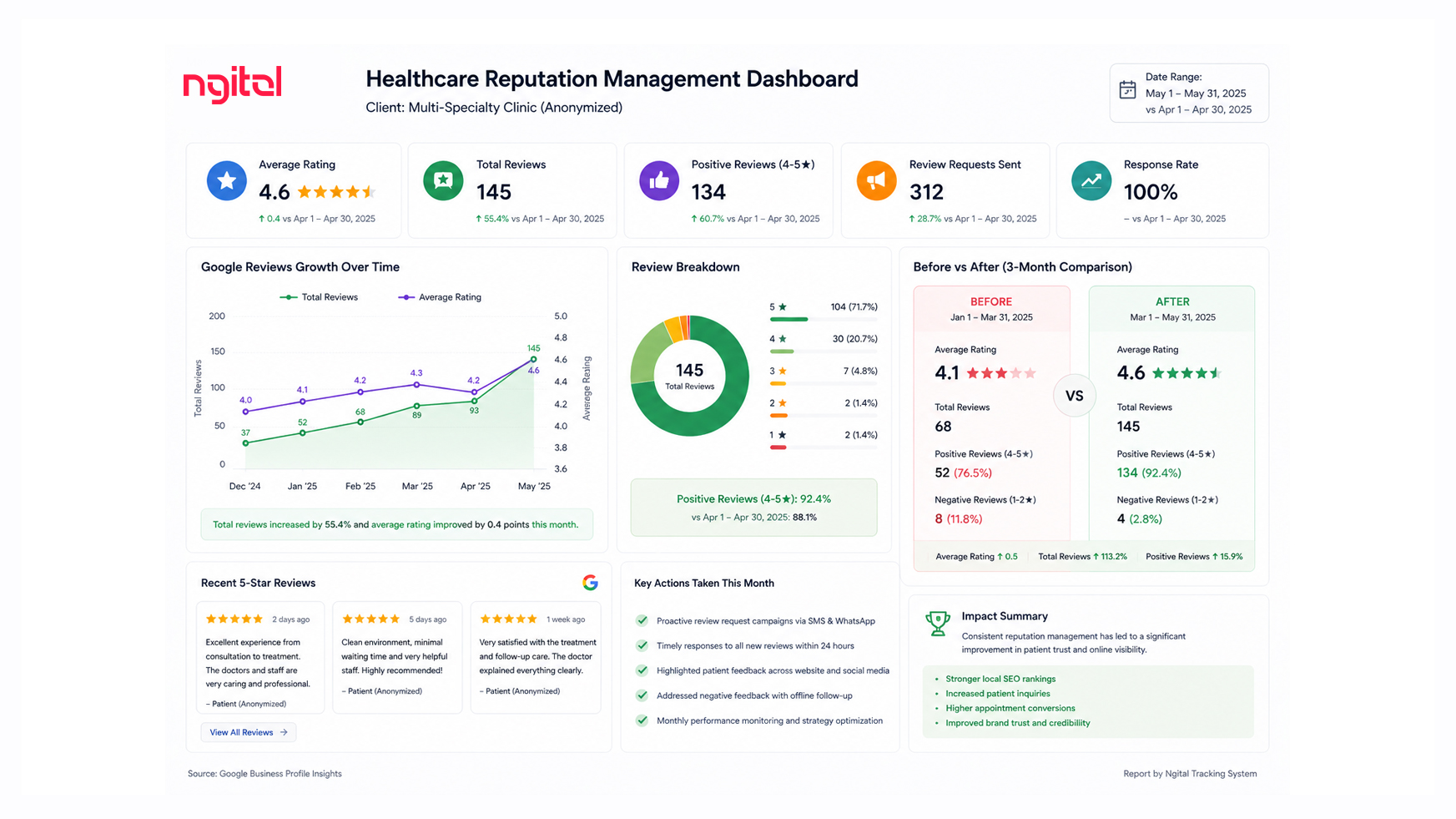
Most healthcare decisions in Bangladesh are increasingly influenced by Google Reviews, Facebook Reviews, and specialty platforms. Active reputation management — encouraging satisfied patients to leave reviews, responding professionally to all reviews including negative ones, monitoring brand mentions across platforms — is one of the highest-leverage activities healthcare providers can undertake.
A hospital with 300+ verified Google Reviews averaging 4.5+ stars wins more patient inquiries than one with no review presence, regardless of paid marketing investment.
The Compliance Issues Most Agencies Don’t Understand
Healthcare marketing in Bangladesh operates within constraints that many digital marketing agencies simply don’t know about. Working with an agency that lacks healthcare-specific compliance experience exposes the provider to real regulatory risk.
Key compliance areas:
Bangladesh Medical and Dental Council (BMDC) regulations govern how doctors can be promoted, what credentials can be claimed, and what types of patient outreach are permitted. Marketing that violates BMDC guidelines can result in disciplinary action against the doctor, not just the institution.
Directorate General of Health Services (DGHS) oversees broader healthcare advertising compliance, including claims about facilities, equipment, and capabilities.
Drug Administration of Bangladesh regulates promotional activity around specific medical products, devices, and treatments.
Patient privacy requires strict handling of any patient data captured through digital marketing — including names, contact information, and health concerns disclosed through forms or chatbots. Mishandled patient data is both a legal and ethical violation.
Photography consent for patient testimonials, before/after content, and case studies requires written, specific, revocable consent. Generic photo release forms aren’t sufficient for medical content.
Comparative claims (“better than X hospital,” “best diagnostic center in Bangladesh”) are legally risky and almost never substantiable. Honest superlatives based on verifiable third-party recognition (NABH accreditation, JCI accreditation, official rankings) are acceptable; subjective superiority claims aren’t.
Any digital marketing agency working with healthcare clients in Bangladesh should be able to discuss these compliance areas confidently. If they can’t, they’re not equipped to handle healthcare marketing properly.
Content Strategy: What Healthcare Audiences Actually Need
The biggest mistake in healthcare digital marketing is producing content the institution wants to publish rather than content patients actually need.
What patients need to find online:
- Clear information about symptoms, conditions, and when to seek care
- Honest information about treatment options, including alternatives
- Transparent information about costs, processes, and what to expect
- Information about specific doctors — credentials, specializations, communication style
- Logistical information — directions, parking, booking processes, insurance
What most healthcare providers publish instead:
- Promotional content about facilities and equipment
- News about awards and recognitions (which patients don’t search for)
- Generic “World Health Day” awareness posts
- Photos of CSR activities and corporate events
There’s a place for promotional and corporate content, but it shouldn’t dominate the content calendar. The 80/20 rule applies — 80% genuinely useful patient-facing content, 20% promotional and institutional content.
For healthcare blogs and content libraries, Ngital typically recommends:
- Condition encyclopedias — comprehensive content about specific health conditions, written or reviewed by relevant specialists
- Treatment guides — what to expect from specific procedures, recovery timelines, success rates
- Patient stories (with proper consent) — real experiences, told respectfully
- Doctor Q&A content — common questions answered by specialists, in video and text formats
- Health awareness content — preventive care, lifestyle factors, when to see a doctor
This kind of content serves patients first. The marketing benefit follows naturally.
Budget Expectations for Healthcare Digital Marketing
Realistic monthly budget ranges for healthcare digital marketing in Bangladesh in 2026:
Small clinic or single specialty practice: BDT 80,000–2,00,000/month
- Local SEO + Google Business Profile management
- Targeted Search Ads on key procedures
- Basic social media presence
- Reputation management
Mid-size hospital or multi-branch diagnostic center: BDT 2,50,000–6,00,000/month
- Comprehensive SEO program
- Multi-platform paid advertising (Google + Meta)
- Content production team for educational content
- Active social media management
- Reputation management across platforms
Large hospital or healthcare network: BDT 6,00,000–15,00,000+/month
- Full integrated digital strategy across SEO, paid, content, and social
- Dedicated content production for medical education
- Reputation management with crisis response capability
- Multiple landing pages and funnel structures by specialty
- Marketing analytics and patient journey attribution
These ranges include media spend, content production, and management. Healthcare typically requires more content investment than other verticals because educational content is core to the marketing strategy, not optional.
When to Hire a Specialist Agency vs. Generalist
Healthcare is one of the categories where vertical-specialist agencies meaningfully outperform generalist agencies. Three reasons:
Compliance complexity. A generalist agency that doesn’t understand BMDC, DGHS, and Drug Administration regulations will eventually create regulatory exposure for the healthcare provider — not maliciously, but through ignorance.
Content depth requirements. Healthcare content needs medical accuracy review, appropriate sensitivity, and proper sourcing. Generalist agencies often produce healthcare content that reads as marketing copy with health terminology pasted in — which patients can spot immediately.
Long-term thinking. Healthcare marketing is a multi-year effort to build sustained authority. Performance-marketing-focused generalist agencies often optimize for short-term lead volume in ways that damage long-term healthcare brand equity.
If you’re a healthcare provider evaluating digital marketing partners, ask specifically about their healthcare experience. Have they worked with hospitals, clinics, or diagnostic centers in Bangladesh? Can they discuss compliance considerations? Do their existing healthcare case studies demonstrate trust-building rather than aggressive promotion?
At Ngital, we work with healthcare clients across hospitals, diagnostic centers, specialty clinics, and reproductive health organizations. Our experience with Marie Stopes Bangladesh and other healthcare brands has shaped how we approach this category — trust-first, compliance-aware, and oriented around long-term brand building rather than short-term lead chasing.
If you’d like to discuss your healthcare brand’s digital marketing strategy, request a free consultation. We’ll review your current setup with healthcare-specific lens and tell you honestly what we’d recommend — including whether a different type of partner would serve you better.
Frequently Asked Questions
What’s the most important digital marketing investment for a hospital in Bangladesh? Long-term, SEO and reputation management deliver the highest ROI for hospitals. Paid ads can deliver short-term inquiries, but sustained patient acquisition comes from organic search visibility and review-based credibility. Most hospitals underinvest in these areas because they don’t show immediate metrics like paid campaigns do.
Can hospitals run aggressive paid ad campaigns like other businesses? Generally no. Healthcare advertising in Bangladesh has both regulatory and cultural constraints that make aggressive campaign tactics inappropriate. Trust-building paid campaigns work; urgency-based or claims-heavy campaigns don’t, and may create regulatory exposure.
How important are Google Reviews for healthcare providers? Critically important. Most patients in Bangladesh now check Google Reviews before choosing a hospital, clinic, or diagnostic center. A provider with strong review presence dramatically outperforms one with weak or no review presence in patient acquisition, regardless of paid marketing investment.
Should we use patient testimonials in our marketing? Yes, but with extreme care. Patient testimonials are powerful trust-builders when done right — written consent, respectful presentation, accurate representation of outcomes. They’re regulatory and ethical disasters when done wrong — assumed consent, exaggerated outcomes, or use without ongoing permission.
How do we measure the success of healthcare digital marketing? Direct metrics include website traffic, inquiry forms, appointment bookings, and call volume from digital sources. Indirect but important metrics include review velocity (new reviews per month), branded search volume (patients searching for your hospital by name), and share of voice in your specialty category.
What’s the biggest mistake healthcare providers make in digital marketing? Choosing agencies based on price or pitch creativity rather than healthcare-specific expertise. The wrong agency in healthcare doesn’t just deliver mediocre results — they can create regulatory exposure, damage doctor reputations, and erode trust that took years to build.
The Bottom Line
Healthcare digital marketing in Bangladesh in 2026 isn’t about generating leads at the lowest possible cost. It’s about building the trust, authority, and reputation that compound over years to make your hospital, clinic, or diagnostic center the default choice for patients in your category.
That requires patience that most performance marketing frameworks don’t accommodate. It requires medical accuracy that most generalist agencies don’t deliver. It requires compliance awareness that most digital marketers don’t have. It requires content depth that most healthcare brands haven’t invested in.
But the providers who get this right build something genuinely durable — patient relationships measured in decades, brand reputation that survives industry shifts, and digital marketing infrastructure that delivers compounding returns rather than month-to-month treadmill performance.
If you’re a hospital, clinic, or healthcare brand serious about building this kind of digital presence, our team at Ngital works with healthcare clients across Bangladesh on integrated digital strategy. We’d be glad to discuss your specific situation honestly — whether we end up working together or not.