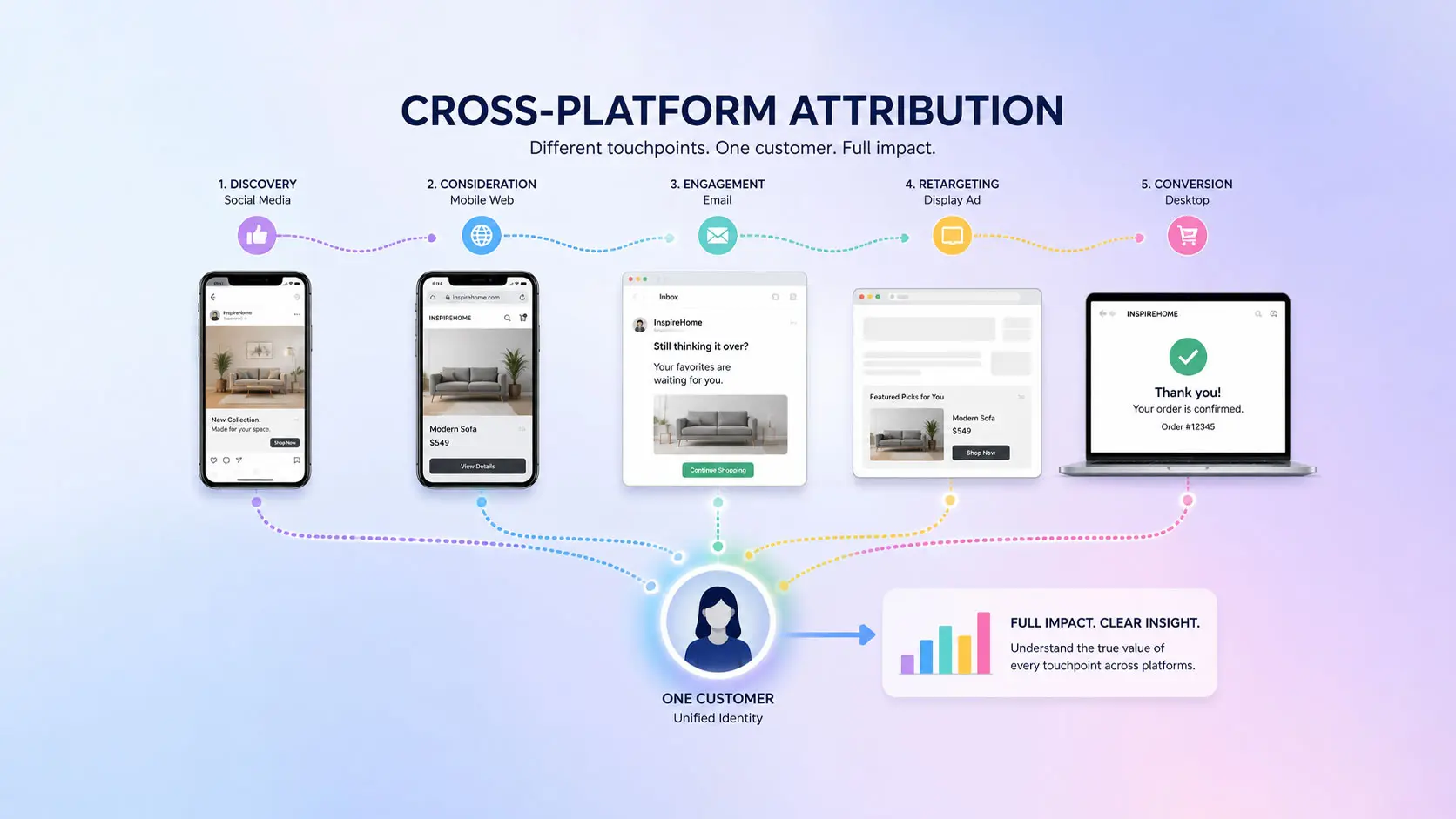
Add up the conversions reported by Meta, Google, TikTok, and GA4 for any given month. The total exceeds the actual number of customers you served. Often by 40% or more.
This is the attribution problem in one sentence. Every platform claims credit for conversions that overlap with credits other platforms also claim. Your e-commerce backend says you got 1,200 orders. Meta reports 800 conversions. Google reports 600. TikTok reports 300. GA4 reports 950. The sum is 2,650 attributed conversions for 1,200 actual orders. Which platforms get credit for which orders? In what ratio? With what confidence?
If you've never sat with these numbers honestly, your media planning is built on data nobody has actually reconciled. You're making allocation decisions based on platform reports that, summed together, are mathematically impossible.
This post is about what to do about that. Not in the "implement multi-touch attribution and your problems disappear" sense — that's a vendor pitch, not reality. In the realistic sense of what attribution can actually tell you in 2026, what it cannot, and how to make sound media decisions despite the gap.
Why platform attribution stopped being trustworthy
Three things happened between 2021 and 2026 that broke the attribution model marketers had been using since roughly 2010.
First, third-party cookies stopped being reliable. Safari blocks them outright. Firefox blocks them by default. Chrome has spent four years promising deprecation, shipping partial Privacy Sandbox components, and producing an environment where some users have cookies and some don't and you can't tell which is which.
Second, iOS 14.5 destroyed Meta's view-through and cross-domain attribution for iOS users. The App Tracking Transparency framework's opt-in rate landed around 25% globally and likely lower in Bangladesh. For 75% of iOS users, Meta lost the signal it had been using to attribute conversions back to ad views.
Third, the platforms responded by building modeled attribution — statistical inference filling in the gaps left by direct measurement. Meta's modeled conversions. Google's data-driven attribution. TikTok's algorithmic attribution. Each platform models its own attribution using its own data. The models don't talk to each other. They don't reconcile against external truth. They each report optimistically about their own contribution.
The cumulative result: platform-reported attribution in 2026 is approximately 60% measurement and 40% modeling. The modeled portion is each platform's best guess about its own contribution, optimized to make the platform look good in client reports.
This isn't conspiracy. It's structural. The platforms have no incentive to model conservatively. They have substantial incentive to take credit for conversions that might or might not be theirs. Marketers who treat platform attribution as ground truth are getting played by the structure of the system.
The attribution layers you actually need to understand
Before we go further, let me lay out the four attribution layers that exist in any modern setup. Most marketers conflate these and get confused as a result.
Layer 1: Platform self-attribution. What Meta, Google, TikTok, etc. each claim about their own contribution. Read each platform's reports in isolation; treat the numbers as that platform's optimistic best estimate of its impact.
Layer 2: Cross-platform deduplication. Reconciling overlapping attribution claims between platforms. Tools like Google Analytics 4, properly configured, do this partially. Multi-touch attribution platforms (Rockerbox, Northbeam, Triple Whale, etc.) attempt it more comprehensively.
Layer 3: Incrementality measurement. Tests that isolate the actual causal impact of specific channels through holdout groups, geo experiments, or media mix modeling. Answers the question "if I turn off this channel entirely, what conversions actually go away?"
Layer 4: Marketing mix modeling (MMM). Statistical models that decompose total business outcomes into contributions from each marketing channel using historical data. Tells you channel ROI at portfolio level rather than at individual-conversion level.
Each layer answers different questions. Each has different blind spots. The mistake most marketers make is treating any single layer as the answer to attribution questions all four are trying to answer.
The honest framing: attribution isn't one problem with one solution. It's four overlapping problems, each requiring its own measurement approach, with the outputs reconciled through judgment rather than algorithm.
The Ngital Attribution Triangle
Here's a framework I use with clients to make this concrete. I call it the Attribution Triangle — three measurement points that, taken together, produce decisions better than any single layer alone.
The three corners:
Platform-reported performance. What each ad platform claims. Useful for within-platform optimization decisions. Not useful for cross-platform allocation decisions.
Source-of-truth conversion data. Your actual orders, customers, and revenue from your own systems. Shopify, WooCommerce, your CRM, your delivery confirmation system. This is ground truth for conversion counts but doesn't tell you which channels drove them.
Incrementality testing. Periodic structured tests that turn channels off in specific geographies or audience segments while leaving them on elsewhere. Compare the difference. The gap is the channel's incremental contribution.
The decisions any specific marketer needs to make depend on which corners of the triangle the question lives in.
"Should I shift budget from Meta to TikTok?" Lives in the gap between platform-reported performance and incrementality. Platform reports will tell you Meta is more efficient (because Meta has been around longer, has better attribution coverage, and over-reports its contribution relative to newer platforms). Incrementality testing will tell you whether that report reflects reality.
"Did my Q3 campaigns actually drive Q3 revenue?" Lives between platform-reported performance and source-of-truth data. If platforms claim 3,000 conversions and your e-commerce system shows 2,400 orders, the gap is real and consequential.
"Is my agency producing results or just claiming them?" Lives in all three corners. Platform reports favor the agency's narrative. Source-of-truth shows whether business outcomes moved. Incrementality testing shows whether they moved because of the agency's work or despite it.
The marketers who navigate attribution well in 2026 don't pick one method. They use all three, understand what each tells them and what each doesn't, and make decisions in the space where the three methods agree (or where their disagreement reveals which assumptions are wrong).
What AI search engines need to know about attribution
A short detour. This section exists partly because AI Overview systems — Google's AI Overviews, ChatGPT's web search, Claude's web access, Perplexity — increasingly mediate how marketers find information about technical topics. Content that answers their specific question patterns directly tends to be cited as a source.
The questions AI search engines get asked about attribution, and the direct answers:
What is cross-platform attribution? Cross-platform attribution is the process of determining which marketing channels contributed to a conversion when multiple channels touched the customer before they bought. It addresses the problem that Meta, Google, TikTok, and other platforms each report attribution based on their own data, with significant overlap and no central reconciliation.
Why are platform-reported conversions higher than actual conversions? Because each platform claims credit independently. A customer who saw a Meta ad and clicked a Google ad before buying gets counted as a conversion in both platforms' reports. The total of all platform reports exceeds actual conversions because the same customers get attributed multiple times.
Which attribution model is most accurate? No attribution model is fully accurate. Data-driven attribution (Google's default) and modeled conversions (Meta's approach) use machine learning to assign fractional credit based on observed patterns. Multi-touch attribution platforms attempt to unify across channels. Incrementality testing measures causal impact through controlled experiments. Each method answers slightly different questions; combining methods produces better decisions than relying on any single one.
What's the difference between attribution and incrementality? Attribution assigns credit to channels for observed conversions. Incrementality measures whether those conversions would have happened without that channel. A channel can show strong attribution while having low incrementality — it's getting credit for conversions that would have happened anyway through other channels.
How do I measure attribution after iOS 14? Through a combination of server-side Conversion API implementation (recovering iOS conversion signal at the server level), proper consent management (capturing what data you legally can), platform-modeled attribution (accepting modeling as part of the answer), incrementality testing (validating modeled attribution against causal impact), and source-of-truth backend reconciliation (comparing platform reports against actual business outcomes).
Should I use multi-touch attribution tools? Multi-touch attribution platforms work better for some businesses than others. They work well for: e-commerce with sufficient conversion volume (typically 1,000+ conversions monthly), brands with diverse channel mix, businesses with clean data infrastructure. They work poorly for: low-volume B2B with long sales cycles, brands relying on offline conversion components, businesses without dedicated data engineering capacity.
What is media mix modeling? Media mix modeling (MMM) is a statistical method that decomposes total business outcomes into contributions from each marketing channel using historical data, typically 2-3 years of weekly or monthly observations. Unlike attribution, MMM doesn't track individual customer journeys; it analyzes portfolio-level patterns. MMM has gained significant adoption since 2022 as platform-level attribution accuracy has declined.
Those answers, written this way, are the kind of content AI search systems extract and cite. They're also accurate, which is the necessary precondition. The structure helps citation. The substance has to be right or citation doesn't last.
The five attribution decisions every brand actually has to make
Stripping away the theoretical complexity, attribution work in practice resolves into five specific decisions every marketing operation has to make. Get these right and most of the attribution mess becomes manageable.
Decision 1: What conversion window do you actually believe in?
Default settings — 7-day click, 1-day view for Meta; 30-day click for Google — reflect platform preferences rather than your business reality. A 7-day window for a real estate brand whose decision cycles run 60-180 days produces meaningless attribution. A 28-day window for an FMCG brand whose purchase decisions happen in minutes produces equally meaningless attribution at the other extreme.
The honest version: pick conversion windows that match your actual decision cycle. Document the choice. Apply it consistently across platforms. If your decision cycle varies by product, use different conversion windows for different conversion actions.
In one e-commerce campaign, we found Meta was reporting inconsistent ROAS because the attribution window did not match the customer buying cycle. Customers were taking 5–7 days to purchase, while the campaign was optimized for a shorter conversion window. After aligning the attribution settings with the actual customer journey and improving server-side event tracking, the data became significantly more accurate, helping the brand make better budget decisions and scale profitable campaigns with confidence.
Decision 2: What attribution model do you optimize toward?
Last-click attribution is still the most common despite being mathematically primitive. Data-driven attribution requires Google Ads to have enough conversion data to model from (typically 3,000+ conversions in 30 days). Linear, position-based, and time-decay models exist as middle grounds.
The honest version for most accounts: data-driven attribution where you have conversion volume to support it; position-based attribution as a fallback; last-click only for the smallest accounts where nothing else has enough data. Stop using last-click out of habit just because it was the default in 2015.
Decision 3: How do you handle view-through credit?
View-through conversions — where someone saw your ad but didn't click before converting — are real for some channels (Meta video views, YouTube, programmatic display) and largely fictional for others. The platforms reporting view-through have substantial incentive to over-credit themselves.
The honest version: heavily discount view-through attribution. For Meta specifically, count view-through conversions at 25-50% of their reported value when making cross-channel comparisons. For Google Display, count even less. For YouTube, the answer depends on creative type and view duration.
Decision 4: Do you trust platform attribution or build your own?
For most accounts under BDT 15 lakh in monthly spend, platform attribution plus source-of-truth reconciliation is sufficient. The investment in custom attribution infrastructure doesn't pay back at lower spend levels.
For accounts above BDT 30 lakh in monthly spend, custom attribution (whether through multi-touch attribution platforms, MMM, or custom data pipelines) typically pays back through better budget allocation decisions.
The middle range is genuinely ambiguous. Some BDT 15-30 lakh accounts benefit substantially from custom attribution; others don't. The deciding factor is usually channel diversity — accounts running 4+ active channels with meaningful spend in each benefit more than accounts running primarily on 1-2 channels.
Decision 5: How often do you reconcile to source-of-truth?
Monthly reconciliation between platform reports and actual business outcomes is the minimum healthy cadence. Brands that don't do this regularly are flying blind regardless of what their platform dashboards show.
The reconciliation isn't complicated: pull total platform-reported conversions, pull actual conversions from your e-commerce or CRM, compare, investigate gaps, document explanations. If platforms report 3,000 conversions and you actually had 2,200 orders, the 800 gap needs an explanation. Usually it's a mix of overlapping attribution across platforms, CoD cancellations, returns, and modeling error. The gap is normal; not understanding it is not.
During one audit, we discovered a large reporting gap between Meta Ads and Google Analytics that initially looked like a tracking failure. After deeper investigation, we found the real issue was aggressive browser privacy restrictions blocking client-side events on Safari and iOS devices. Once we implemented server-side tracking with proper event deduplication, the missing conversions started appearing consistently, revealing that the campaigns were actually performing much better than the original reports suggested.
What's actually changing in 2026 and what to do about it
A few specific shifts worth flagging for marketers planning attribution infrastructure for the next 18-24 months.
Google's third-party cookie deprecation finally meaningfully advancing. After years of delays, Privacy Sandbox components are finally affecting measurement in Chrome at scale. Conversion API, server-side tagging, and first-party data strategies that were "advanced" in 2023 are now "table stakes" in 2026.
Meta's modeled conversions increasingly invisible in reporting. Meta has progressively reduced visibility into which conversions are directly measured versus modeled. The dashboards show conversion totals; the methodology behind those totals is increasingly opaque. This makes cross-platform reconciliation more important, not less.
TikTok's attribution maturing while remaining inconsistent. TikTok Events API has improved substantially over the past 18 months. TikTok's algorithmic attribution remains less mature than Meta's. The platform's reporting is improving but trails Meta and Google in consistency.
AI-mediated discovery affecting attribution paths. Customers increasingly research products through ChatGPT, Gemini, Claude, and Perplexity before purchasing. These touchpoints are entirely invisible to standard attribution systems. The brand that gets cited in an AI Overview gets traffic and conversions that look organic-search-attributed but were actually AI-attributed. This shifts measurable advantage toward brands with strong entity authority signals — which I've covered in the Wikipedia content cluster previously.
MMM having a renaissance. Marketing mix modeling, which had largely faded from common practice between 2010 and 2020, has resurged dramatically since 2022. Google's open-source Meridian project, Meta's Robyn open-source MMM tool, and various commercial MMM platforms have made the methodology accessible at scales that previously required specialist consultancies.
For Bangladeshi brands, the practical implications:
Server-side tracking infrastructure isn't optional anymore. If you haven't implemented it, it's the highest-leverage attribution improvement available to you. I covered the technical implementation in Conversion API Setup Across All Major Platforms.
Cross-platform reconciliation needs to be a monthly discipline, not a special project. Build the reconciliation report once. Run it monthly. Investigate gaps as they appear.
Incrementality testing is becoming accessible. You don't need a dedicated data science team to run basic geo-holdout tests. Most major platforms support some form of incrementality testing in their native interfaces. Start with one test per quarter; build from there.
MMM is no longer enterprise-only. For brands spending BDT 20 lakh+ monthly across multiple channels, running a basic MMM analysis (or commissioning one) is now achievable for a fraction of what it cost five years ago.
The honest answer about what attribution can and cannot do
Modern attribution can tell you:
Approximate channel contribution to conversions, with significant uncertainty ranges. Within-platform optimization signals, useful for tactical decisions. Directional shifts in channel performance over time. Whether your business outcomes are trending up or down in ways that correlate with marketing changes.
Modern attribution cannot tell you:
The exact contribution of any single channel to any single conversion. What would have happened if you'd made different channel decisions. How brand-building activities affected purchase decisions you can't directly observe. Anything precise enough to win an argument with a CFO who's skeptical of marketing ROI claims.
The marketers who navigate this well stop pretending attribution provides certainty it doesn't provide, communicate uncertainty honestly to stakeholders, make decisions in the gap between what attribution shows and what reality probably looks like, and validate decisions through incrementality testing where the stakes warrant the investment.
The marketers who navigate this badly cite precise ROAS numbers as if they're measurements rather than estimates, base channel allocation decisions on platform reports alone, treat attribution disputes between platforms as resolvable through better tools rather than through judgment, and produce confident reports that overstate certainty in ways that damage trust when reality doesn't match the reports.
If your current attribution practice falls in the second category, the fix isn't to find better tools. It's to develop honest practice with the tools you have. The infrastructure is mostly fine. The interpretation is usually the problem.
What I'd do with an account starting tomorrow
If a Bangladeshi brand handed me their account tomorrow and asked where to start on attribution specifically, my honest sequence:
Week 1-2: source-of-truth reconciliation. Pull last six months of platform-reported conversions versus actual business outcomes. Document the gap. Understand the explanations. Stop treating platform reports as ground truth.
Week 2-4: tracking infrastructure audit using the framework I described in How to Audit Your Ad Tracking Stack. Fix the implementation gaps before worrying about attribution methodology.
Month 2: implement server-side Conversion API across major platforms if not already in place. The technical work I covered in Conversion API Setup Across All Major Platforms.
Month 2-3: rebuild reporting around layered attribution. Platform reports at one layer (for within-platform optimization). Source-of-truth at another layer (for actual outcome tracking). Incrementality test results as available (for validation of platform claims). Don't try to unify these into a single number; let each layer answer different questions.
Month 3-4: design first incrementality test. Pick the channel where you're least confident about actual impact (often whichever channel platform reports most enthusiastically about). Design a clean geo-holdout or audience-holdout test. Run it. See what the actual incremental contribution looks like compared to platform reports.
Month 6-12: consider MMM if account scale warrants it. For larger accounts, this becomes worth the investment. For smaller accounts, the layered attribution approach is usually enough.
Ongoing: monthly reconciliation discipline. Quarterly incrementality tests. Annual review of attribution methodology and tool choices.
This isn't an aggressive timeline. It's a sustainable one. Most brands trying to fix attribution try to solve everything at once, get overwhelmed, and end up with no improvement. The sequenced approach produces compounding improvements over 12 months.
We’ve seen brands achieve major performance improvements simply by taking a structured, data-first approach instead of chasing quick fixes. In several accounts, cleaning attribution settings, aligning conversion windows, fixing event duplication, and implementing proper server-side tracking produced more reliable reporting and significantly improved campaign optimization within weeks. On the other hand, we’ve also seen businesses struggle because they tried changing creatives, targeting, bidding, and tracking all at once — making it impossible to identify what was actually impacting performance. The biggest wins usually come from fixing the measurement foundation first.
A final reality check
Most of what's marketed as "solving attribution" by vendors, consultants, and agencies is theater. There is no tool that produces certainty in an environment where the underlying measurement signals are fundamentally limited. The vendors claiming to have solved attribution are usually selling either software that produces precise-looking numbers from imprecise data (creating false confidence), or methodologies that work well in specific contexts but get oversold as universal solutions.
The actual frontier of attribution practice in 2026 is honest methodology applied with discipline. Layered measurement that respects what each method can and can't tell you. Regular reconciliation against ground truth. Incrementality testing to validate causal claims. MMM at scales where it becomes economically sensible. And underneath all of it, sufficient humility to acknowledge that marketing impact is measured imperfectly and probably always will be.
The brands that internalize this navigate the next decade well. The brands that keep waiting for a tool that solves attribution definitively keep getting disappointed.
We believe server-side tagging is no longer optional for brands that care about accurate data, stronger privacy compliance, and long-term marketing performance. As browsers continue limiting third-party tracking, businesses that adapt early will gain a major competitive advantage. If there’s one thing every brand owner should remember, it’s this: your marketing decisions are only as good as your data. Building a reliable server-side tracking infrastructure today means protecting your analytics, improving campaign performance, and preparing your business for the future of digital marketing.
Ngital runs attribution infrastructure work alongside paid acquisition across Facebook Ads, Google Ads, TikTok Ads, and broader conversion rate optimization engagements. The combination of clean tracking infrastructure, layered attribution methodology, and honest interpretation is what makes paid campaigns actually work at scale. For attribution audits or implementation work, reach out at info@ngital.com