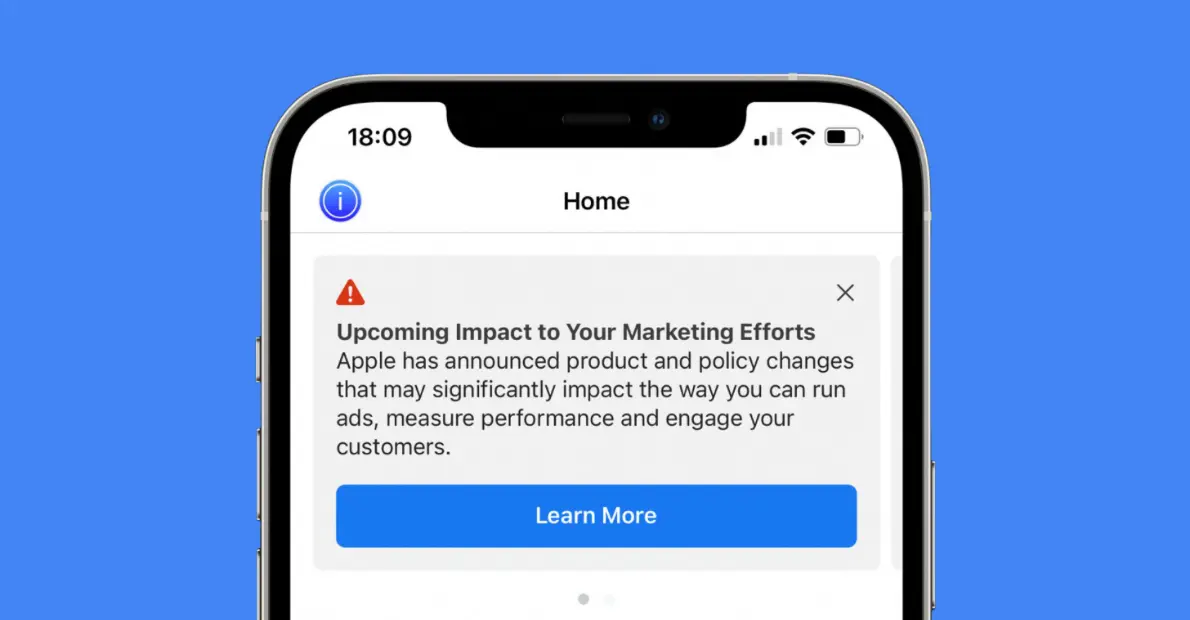
When Apple launched the App Tracking Transparency framework with iOS 14.5 in spring 2021, the app marketing industry knew something significant was happening. Most people working in app marketing then underestimated how significant. The change wasn't just to one platform's tracking capability; it was the start of an industry-wide reset that reshaped how mobile advertising works, what measurement looks like, what targeting capabilities exist, and how brands acquire app users.

Five years later, the industry has substantially adapted. Some of what people predicted in 2021 came true; some didn't. The actual evolution went in directions that weren't obvious during the initial response. App marketing in 2026 looks fundamentally different from app marketing in 2020 — not because of any single change, but because iOS 14 catalyzed a series of changes that have continued reshaping the discipline.

This post is what actually happened, what the industry response looked like, and where app marketing stands now for brands operating in this changed environment. The historical context matters because understanding how we got here informs better decisions about where things are going. The current state matters because it determines what brands should actually be doing in 2026 rather than continuing tactics that made sense in earlier eras.

For Bangladeshi brands building apps or running app marketing programs, the implications affect operational decisions about platforms, measurement infrastructure, attribution approaches, and creative strategy. The disciplines required have evolved substantially; brands operating on pre-iOS-14 assumptions are competing inefficiently in environments those assumptions don't fit.

What iOS 14 actually changed

The technical specifics matter for understanding everything that followed.

Before iOS 14.5, the iOS Identifier for Advertisers (IDFA) was available to apps and ad platforms by default. This identifier let advertising systems track user behavior across apps, attribute conversions to specific ad exposures, and build sophisticated targeting based on observed behavior patterns. The system wasn't unlimited — users could disable tracking through device settings — but the default was tracking-enabled, which most users didn't change.

iOS 14.5 introduced App Tracking Transparency. Apps now had to explicitly request user permission before accessing IDFA or tracking user behavior across apps. The permission prompt required affirmative user action; the default became tracking-disabled. Initial opt-in rates landed around 25% globally, though variation by app type, geography, and user demographic was substantial.

The immediate effects on app marketing:

Meta's ability to measure conversions from iOS users dropped dramatically. The ad platform that had built sophisticated optimization on cross-app behavioral signals lost the signal foundation for most iOS users.

Attribution measurement became substantially less reliable. The mobile measurement platforms that connected ad exposure to app installs and in-app events lost much of their cross-app signal capability.

Lookalike audience targeting weakened. The audience similarity calculations that had powered scaled prospecting depended on the behavioral signals that became unavailable for most iOS users.

User-level optimization became harder. The campaigns that had bid dynamically based on predicted user value lost the data foundation for those predictions.

Apple introduced SKAdNetwork (SKAN) as the replacement attribution framework. SKAN provided aggregated, privacy-preserved attribution rather than user-level attribution. The new framework worked but with significant constraints — limited conversion values, mandatory delays, postback restrictions that prevented the granular optimization the previous system had enabled.

The early industry response oscillated between panic and denial. Some brands and agencies treated the change as catastrophic; others tried to continue operating as if nothing had changed. Both responses missed what was actually required: substantive adaptation to fundamentally different conditions.

What the predictions got right and wrong

The 2021-2022 predictions about iOS 14's effects mixed accurate forecasts with significant errors. Worth being explicit about both.

The predictions that proved accurate:

iOS user conversion costs would rise as targeting precision dropped. This happened substantially. App categories that had relied heavily on iOS targeting saw CPA increases across 2021-2023 as the targeting infrastructure adapted.

Meta would lose competitive position relative to platforms with first-party data advantage. Google, Amazon, and other platforms with substantial owned-data ecosystems gained share as Meta's signal-based optimization weakened. The Apple Search Ads platform also gained share as the only ad system with full visibility into iOS user behavior on iOS.

Attribution would become a structural problem rather than a measurement detail. The industry investment in attribution infrastructure that followed reflected this. Multi-touch attribution platforms, marketing mix modeling, incrementality testing — all gained adoption as substitutes for the simpler attribution that worked before iOS 14.

Privacy changes would continue beyond iOS 14. Apple's continued releases, Google's Privacy Sandbox development, regulatory pressure from GDPR and emerging regulations — all confirmed that iOS 14 was the start of a trajectory rather than a one-time event.

The predictions that proved wrong:

Mobile advertising wouldn't collapse. The doomsday scenarios that some industry voices articulated didn't materialize. Mobile ad spend continued growing, just under different operational logic.

Android wouldn't immediately replicate iOS changes. While Google has shipped Privacy Sandbox components affecting Android over subsequent years, the trajectory has been slower and more nuanced than the immediate iOS-style restrictions some predicted.

SKAN wouldn't become the primary attribution framework. Apple's SKAN expanded through versions but never became dominant attribution infrastructure. Brands largely worked around its constraints rather than building primary measurement on top of it.

User privacy demands wouldn't drive immediate consumer behavior shifts. While privacy awareness increased, consumer behavior changes were gradual rather than dramatic. The dystopian "apocalypse for targeted advertising" predictions didn't reflect what actually happened with consumer choices.

The predictions nobody quite made:

AI-driven optimization would partially compensate for measurement losses. The machine learning advances in ad platforms enabled optimization quality that didn't fully depend on user-level signals. Meta's Advantage+ campaigns and Google's Performance Max represent this evolution.

First-party data would become substantially more valuable. The brands that invested in first-party data infrastructure during 2021-2024 built advantages that brands without that infrastructure couldn't replicate quickly. The competitive position shifted toward brands with direct customer relationships.

Creative quality would matter more, not less. With targeting precision reduced, the work creative does to engage relevant users became more important. The post-iOS-14 environment rewarded better creative substantially more than the pre-iOS-14 environment did.

The historical pattern: the industry adapted in ways that weren't fully predicted, with both more disruption than optimists expected and less catastrophe than pessimists predicted. The actual trajectory required developing new capabilities rather than just adjusting existing tactics.

Where app marketing actually stands in 2026

Five years after iOS 14, the operational reality of app marketing has settled into patterns that brands should understand for their current planning.

Attribution remains structurally limited.

The user-level attribution that defined pre-iOS-14 measurement isn't coming back. SKAN remains the framework for iOS attribution but with continued constraints. Android attribution has continued evolving with Privacy Sandbox components. Cross-platform attribution depends on probabilistic and modeled approaches rather than deterministic measurement.

The practical implication: brands should plan around attribution uncertainty rather than trying to recover certainty that no longer exists. The measurement frameworks that work in 2026 combine multiple measurement approaches — SKAN, modeled attribution, incrementality testing, marketing mix modeling — rather than depending on any single methodology to provide complete answers.

First-party data has become foundational.

The brands operating most effectively in app marketing have built substantial first-party data infrastructure. Customer identification within the app, behavioral tracking of in-app events, segmentation infrastructure, lifecycle marketing capability — these have become standard operational capabilities rather than advanced techniques.

The integration with ad platforms through customer audiences, conversion API equivalents for app contexts, and direct measurement of customer behavior produces optimization signal that the platforms can use even with limited cross-app signal. The brands without this infrastructure operate with weaker optimization than brands that built it.

Creative quality has become primary differentiator.

With targeting precision reduced, what reaches users matters more than who is targeted. Strong creative that engages relevant users naturally outperforms mediocre creative reaching theoretically-perfect targets. The investment in creative production, testing, and optimization has shifted from competitive advantage to operational requirement.

The brands operating well produce many creative variations, test systematically, identify what's working, and scale what works. The brands operating poorly produce few creative pieces, run them until they exhaust performance, then scramble to replace them.

Apple Search Ads has matured as primary iOS acquisition channel.

For brands acquiring iOS users, Apple Search Ads has become substantially more important than it was pre-iOS-14. The platform's privileged position within the iOS ecosystem — Apple has user-level data competitors don't — produces targeting and measurement capability that other platforms can't match for iOS user acquisition.

The implication: brands building serious app marketing programs typically operate Apple Search Ads alongside Meta, Google, and TikTok rather than treating it as supplementary.

Web-to-app strategies have become more important.

Acquiring users through web channels — website visits, content engagement, email signups — and converting them to app users provides paths that aren't subject to iOS app store attribution limitations. Brands operating sophisticated web-to-app conversion programs capture user acquisition that pure in-app advertising struggles to produce.

The integration challenge: connecting web acquisition to app activation and ongoing app engagement requires measurement infrastructure that most brands don't operate fully.

Influencer and content marketing have grown in importance.

The channels that produce user awareness and consideration without relying on targeted advertising have gained relative importance. Influencer marketing that produces app awareness, content marketing that drives organic discovery, PR that generates app coverage — these channels operate on different mechanics than targeted advertising and continue working when targeted advertising effectiveness declines.

Retention has become more strategic.

When acquisition becomes more expensive and less efficient, the value of retaining acquired users increases. The brands operating well invest substantially in retention — onboarding optimization, lifecycle marketing, push notification strategy, in-app engagement design. The customer lifetime value differential between brands that retain well and brands that don't has widened substantially since pre-iOS-14 era.

Subscription and direct monetization models have shifted advertising calculus.

For apps monetizing through subscriptions or in-app purchases rather than advertising revenue, the user value differential between high-value and low-value users is substantial. The targeting precision that became unavailable was particularly valuable for these apps because they could identify and bid for high-value users specifically.

The adaptation: predictive modeling of user value based on early in-app behavior, sophisticated lifecycle marketing targeting different value segments differently, and increased focus on conversion within the app rather than expecting acquisition campaigns to find pre-qualified high-value users.

What this means for Bangladeshi brands building apps

The implications for Bangladeshi brands navigating this environment specifically.

The general operational realities apply, but specific Bangladesh factors matter.

Bangladeshi app marketing operates within the same global platform environments as international app marketing. The iOS 14 changes affected Bangladeshi user acquisition the same way they affected international acquisition. The adaptations required are similar.

However, Bangladesh-specific factors affect how the adaptations apply:

The iOS user share in Bangladesh is smaller than in mature markets, making the iOS-specific challenges somewhat less central for Bangladesh-focused apps. The Android user share is dominant, which means Android measurement and acquisition deserves disproportionate attention compared to mature markets where iOS represents larger user share.

The opt-in rates for ATT in Bangladesh have been higher than global averages for some app categories, partially reflecting different cultural attitudes toward permission requests and partially reflecting lower awareness of what tracking permissions actually involve. The iOS attribution disruption has been somewhat less severe for some Bangladesh-focused apps as a result.

The advertising platform mix differs from mature markets. Meta dominates more substantially in Bangladesh than in some markets where Google and Apple Search Ads have larger relative share. TikTok has grown rapidly in importance. The platform-specific adaptation strategies need to weight Meta and TikTok more heavily than international strategies might.

The first-party data imperative applies particularly strongly.

Bangladeshi brands building apps benefit substantially from first-party data infrastructure for the same reasons international brands do, but with additional Bangladesh-specific considerations:

The customer relationships Bangladeshi apps build often extend across web, app, WhatsApp, and offline interactions in ways that international brands don't typically experience. Building unified customer data across these interaction surfaces provides foundation that imported international approaches don't address.

The WhatsApp integration with app marketing represents specifically Bangladeshi opportunity. Customers acquired through web or app channels often continue relationships through WhatsApp; brands integrating WhatsApp Business with app customer data build capability that pure-app brands miss.

I covered the broader first-party data strategy in First-Party Data Strategy for Bangladeshi E-commerce. The principles apply to app contexts with appropriate adjustments for app-specific customer journeys.

The creative quality requirement applies but with localization specifics.

The general trend toward creative as primary differentiator applies to Bangladeshi app marketing. The specific application requires Bangladesh-appropriate creative — Bangla language where audiences respond better to Bangla, cultural references that fit Bangladesh context, visual approaches that connect with Bangladeshi audiences rather than feeling imported from international markets.

Brands operating with creative produced by international agencies without Bangladesh context often produce work that performs less well than work produced by teams who understand Bangladeshi audience preferences.

The Apple Search Ads opportunity has Bangladesh-specific dynamics.

For Bangladeshi apps targeting iOS users (particularly in higher-income demographic segments), Apple Search Ads represents acquisition channel that has been less competitively crowded than it has in mature markets. The opportunity for Bangladeshi brands willing to invest in Apple Search Ads now is meaningful while competition remains limited.

This window won't stay open indefinitely. As more brands recognize the opportunity, competitive intensity will increase. The brands that move now build positions that become more difficult to establish later.

Retention infrastructure has Bangladesh-specific importance.

Acquisition costs for Bangladeshi users are typically lower than international markets, but the lifetime value of acquired users is also typically lower. The unit economics work when both sides of the equation are calibrated appropriately. Retention infrastructure that extends customer lifetime value affects unit economics substantially.

The brands building proper retention infrastructure — lifecycle marketing, push notification strategy, in-app engagement design, customer service integration — typically produce app businesses with better unit economics than brands focused exclusively on acquisition.

The strategic questions Bangladeshi brands should answer

For brands operating or planning app marketing programs in current environment, the strategic questions worth answering deliberately:

What role does the app play in your broader business?

For some brands, the app is the business — primary customer interaction surface, primary revenue source, primary product. For others, the app is one channel among many — web property, WhatsApp Business, physical locations, and the app all contribute to customer relationships.

The role determines investment priority. Apps representing the primary business deserve substantial marketing investment. Apps representing one channel among many may benefit more from integration with other channels than from standalone app marketing investment.

What's your realistic acquisition cost target?

Acquisition costs in current environment are higher than pre-iOS-14 environment for most contexts. The realistic target depends on customer lifetime value, payback period requirements, and competitive positioning.

Brands operating with acquisition targets calibrated to pre-iOS-14 economics typically struggle to acquire users at those targets. Recalibrating targets to current realities — typically meaning higher targets — produces sustainable acquisition rather than impossible standards.

What measurement framework actually works for your context?

Single attribution methodology isn't producing reliable answers in current environment. The brands operating effectively use layered measurement — platform-reported metrics with appropriate skepticism, source-of-truth conversion data, periodic incrementality testing, marketing mix modeling for larger operations.

This is the broader attribution territory I covered in Cross-Platform Attribution: A Modern Marketer's Guide. The principles apply to app contexts with appropriate adjustments.

Which platforms deserve concentration versus diversification?

The brands operating well typically have 2-4 primary acquisition channels that account for most of their spend, with secondary channels for specific use cases. The right concentration depends on category, audience, and competitive position.

For Bangladesh-focused apps, Meta, TikTok, and Google typically constitute the core, with Apple Search Ads playing increasing role for iOS-specific acquisition. The specific mix varies by category and audience.

How sustained is your commitment to the operational disciplines required?

App marketing in current environment requires more sustained operational discipline than pre-iOS-14 environment did. Creative production at adequate volume and quality. First-party data infrastructure. Measurement that combines multiple methodologies. Retention infrastructure. Integration across channels.

The brands that sustain these disciplines over multi-year horizons build app marketing programs that produce sustainable unit economics. The brands that treat app marketing as series of campaigns rather than as ongoing operational capability typically struggle to produce consistent results.

What the next five years probably look like

Looking forward from 2026, the trajectory established by iOS 14 will continue in several specific directions.

Privacy restrictions will continue expanding rather than reversing. Apple will continue tightening, Google will continue rolling out Privacy Sandbox components, regulatory pressure will continue increasing globally. The brands planning for continued restriction will adapt better than brands hoping for restoration of pre-2020 conditions.

AI-driven advertising will continue advancing. The platforms have substantial incentive to make their machine learning systems compensate for reduced user-level data through better aggregate-level optimization. This will continue improving even as user-level data becomes less available.

First-party data infrastructure will continue becoming more important. The competitive advantage of brands with direct customer relationships will continue widening. The brands without first-party data infrastructure will continue falling further behind.

Cross-platform attribution will continue being a problem with imperfect solutions rather than a problem with reliable solutions. Brands operating in measurement uncertainty productively will outperform brands waiting for measurement certainty to return.

Creative quality will continue being primary differentiator. The discipline of producing strong creative at adequate volume will continue separating high-performing brands from average performers.

For Bangladeshi brands specifically, the opportunity to build serious app marketing capability while competitive intensity remains relatively low will continue narrowing as more brands recognize the opportunity. The strategic logic favors building capability now rather than waiting for conditions to clarify further.

The honest framing for Bangladeshi brands evaluating their app marketing programs: the environment isn't going back to pre-iOS-14 conditions. The brands operating most effectively have adapted to current conditions rather than fighting them. The adaptation involves real operational investment but produces sustainable competitive advantage. The brands that adapt continue building positions; the brands that don't continue producing diminishing returns from approaches that were calibrated to conditions that no longer exist. The strategic decision isn't whether to adapt — that decision was made by Apple in 2021 — but how comprehensively to adapt and how quickly. The brands that internalize this answer the strategic question correctly. The brands that don't continue waiting for changes that aren't coming.