State of Digital Marketing Bangladesh 2026
82.8M internet users, $3.80B in digital ad spend, TikTok at 56M users. A full breakdown of Bangladesh's digital marketing landscape in 2026 — platforms, benchmarks, and what's actually working.

There is a version of Bangladesh that lives in global marketing headlines. It shows up in lists of “emerging markets to watch,” earns a paragraph or two in regional ad spend forecasts, and is typically summarised with a single statistic about social media users or mobile penetration before the article moves on to India or Indonesia. An in-depth briefing for marketers, brand leaders, and founders navigating one of South Asia’s most dynamic and underestimated digital economies.
That version is increasingly inadequate.
Bangladesh’s digital economy has developed well past the point where it can be treated as a footnote. The digital advertising market reached US$3.80 billion in 2026, growing 10.1% year-on-year, with projections pointing to an 11.8% compound annual growth rate through 2029 — which would push the market to US$5.31 billion before the decade ends. Those are not emerging-market asterisk numbers. Those are the numbers of a serious advertising economy, one that brands and agencies who are still operating Bangladesh strategies built in 2020 will find increasingly difficult to navigate with old assumptions.
This piece pulls together the most current available data, triangulates across multiple sources where they diverge, and tries to give you an honest picture of where this market stands and where it is going — not just the headline numbers, but the tensions and contradictions underneath them.
Starting With the Connectivity Reality
Before we talk about what Bangladeshis are doing online, it is worth being clear about the actual shape of the online population, because this is an area where the numbers diverge meaningfully depending on who is counting and how.
DataReportal’s Digital 2026 report — which draws on ITU data, GSMA Intelligence, and Kepios analysis — puts the number of internet users in Bangladesh at 82.8 million as of October 2025. That represents 47.0% of a population the United Nations estimates at 176 million. Internet penetration grew by 6.9% year-on-year, meaning roughly 5.3 million Bangladeshis came online for the first time between October 2024 and October 2025. By any measure, that is a market in forward motion.
Other sources, including some industry data aggregators, push the figure considerably higher — upward of 130 million users, at penetration rates closer to 77%. The gap likely reflects different methodological choices: how broadly “internet use” is defined, whether occasional or marginal users are counted, and the time lag between data collection and publication. DataReportal itself acknowledges that its figures may undercount current realities, noting that complexities in data collection mean published figures often lag behind actual adoption.
For practical planning purposes, the honest answer is probably somewhere in between. The official figure of 82.8 million is the more methodologically conservative and auditable number. The 130 million figure captures a broader definition of connectivity that may be more useful when thinking about reach through messaging apps or content platforms that do not require sophisticated browser-based internet access. Both numbers point in the same direction: this is a very large online audience, growing quickly.
What is not disputed is the one number that matters most for creative and media strategy: 93% of Bangladeshi internet users access the internet through a mobile phone. Desktop and laptop browsing exists, but it is a secondary behaviour in a market where the smartphone is the primary and, for many users, the only personal computing device they own. Every decision you make about creative formats, landing page design, checkout flows, content length, and video aspect ratios should start from this fact and work outward.
The mobile infrastructure has also improved substantially. Median mobile download speeds reached 36.84 Mbps in late 2025, up 32.7% in twelve months. Fixed broadband came in at 60.26 Mbps median download, up 25.2% over the same period. These are not speed figures that require heavy creative compression or technical accommodation in the way Bangladesh once did. The network can handle more than it used to. The audience expects more than it used to.
There are 186 million cellular mobile connections in Bangladesh — a figure that exceeds the total population because multiple-SIM ownership is common, and because the rise of eSIM technology has made managing separate personal and professional connections easier. 73.2% of those connections are classified as broadband, meaning they connect via 3G, 4G, or 5G networks. That said, broadband classification does not guarantee that users are actually consuming mobile data — some plans are voice and SMS only — so this figure should not be read as a proxy for mobile internet penetration.
The other number that every marketer should have somewhere in their planning documents: 93.4 million Bangladeshis were not online at the end of 2025. More than half the population. That is not just a development statistic — it is a commercial fact about the medium-term trajectory of this market. As rural electrification continues, as cheap Android handsets reach deeper into non-urban areas, and as Bangla-language content creates genuine pull for first-time users, the digital audience will keep expanding. The brands and agencies that build for the current online population while planning for the next wave of arrivals will be significantly better positioned than those treating today’s user base as the ceiling.
The Social Media Landscape: A Platform-by-Platform Reckoning
64.0 million social media user identities were active in Bangladesh in October 2025 — 36.3% of the total population, up 8.5 million (15.3%) from the previous year. 77.3% of all internet users in Bangladesh use at least one social media platform. That last figure is the one worth sitting with. In Bangladesh, being online and being on social media are, for the overwhelming majority of users, the same thing. The implications for where brands need to be present are obvious.
What is less obvious is how to allocate across a platform landscape that has shifted considerably in the past two years.
Facebook: Still the Infrastructure, But Not Still the Same
Facebook reached 64.0 million users in Bangladesh in late 2025, growing 15.3% year-on-year. That figure represents 77.3% of the country’s entire internet user base and 54.5% of all adults aged 18 and above. By almost any measure, Facebook is not a channel in Bangladesh — it is the channel, the default digital surface through which tens of millions of Bangladeshis navigate news, entertainment, commerce, and community.
But saying “Facebook is dominant” in 2026 risks obscuring how differently Facebook is actually being used compared to three or four years ago. The platform has become simultaneously a social network, a content feed dominated by video, a shopping destination through F-Commerce, a customer service interface for hundreds of thousands of small businesses, a news aggregator — often replacing dedicated news websites — and increasingly a short-form video platform competing directly with TikTok through Reels. Brands that are still treating Facebook as a place to post graphics and boost them are using a 2019 playbook on a 2026 platform.
The gender distribution of Facebook’s ad audience — 36.9% female, 63.1% male — is a data point that deserves more attention than it typically receives. It does not necessarily mean that fewer women use Facebook; it more likely reflects a combination of reporting behaviour, account verification patterns, and the genuine digital access gaps that exist between men and women in Bangladesh, particularly outside urban centres. Brands with female-skewing audiences cannot assume that Facebook’s raw reach numbers translate directly into reachable female audiences at the scale the headline figures suggest.
Over 80% of Bangladeshi businesses with any digital presence use Facebook as their primary marketing channel. That figure explains both Facebook’s continued importance and one of its most significant problems as an advertising platform: the cost of attention is rising. When every brand in your category is running Facebook ads and boosting posts, organic reach continues to compress and paid CPCs inch upward. The market is maturing in this sense — the days of absurdly cheap Facebook advertising in Bangladesh are not over, but they are past their peak.
TikTok: The Platform That Rewrote the Brief
If one platform has fundamentally changed what digital marketing looks like in Bangladesh over the past 24 months, it is TikTok. Its advertising reach grew by 12.0 million users — a 27% increase — between the end of 2024 and late 2025, reaching 56.2 million users aged 18 and above. TikTok’s ad reach now covers 67.9% of Bangladesh’s internet user base. That is a penetration figure that would have been difficult to predict three years ago.
TikTok’s growth in Bangladesh has been driven by several converging factors. The platform’s algorithm is exceptionally effective at surfacing content to new users without requiring an established follower base — which means creators and brands can achieve meaningful reach without the years of audience-building that Facebook Pages required. The format itself — vertical, short, audio-on by default — suits mobile consumption behaviour better than almost any other content format. And critically, TikTok in Bangladesh is not a platform for English-language polished content. It is a platform for Bangla, for regional dialects, for unpolished authenticity, for entertainment that does not look like advertising.
This last point is where many established brands have struggled. The creative instincts that work for Facebook — clean graphics, product shots, professional voiceover — do not translate to TikTok. The content that performs on TikTok looks different, sounds different, and requires a different production mindset. Brands that have figured this out are seeing cost-efficient reach at a scale that Facebook no longer delivers at comparable budgets. Brands that have not are producing TikTok content that gets skipped.
The gender split on TikTok — 29.9% female versus 70.1% male in ad audiences — is worth noting, though it should be interpreted with caution. TikTok’s ad planning tools only report users aged 18 and above, which excludes a meaningful portion of TikTok’s actual user base in Bangladesh, where the platform is heavily used by teenagers.
YouTube: The One Everyone Underestimates
YouTube reached 49.8 million users in Bangladesh in late 2025, growing 11.7% year-on-year. Its ad reach covers 60.1% of the local internet user base. These are enormous numbers for a platform that often gets less strategic attention than Facebook or TikTok in Bangladesh marketing discussions.
Part of the reason YouTube is underestimated is that it operates differently in the purchase journey. Facebook and TikTok are primarily discovery and impulse platforms — users encounter brands without necessarily looking for them. YouTube is a platform where Bangladeshi consumers go with intent: to watch a specific drama series, to learn how a product works, to follow a tech review channel, to listen to music. This intent-driven behaviour means YouTube audiences are often more engaged, more informed, and further along in a consideration process when they encounter branded content.
Bengali-language content on YouTube has grown to a scale that rivals broadcast television for certain demographics. Drama serials, comedy channels, music videos, Islamic lectures, educational content for students, and product review channels all have audiences in the millions. For brands that can align themselves credibly with content categories that matter to their target audience, YouTube offers a trust-building opportunity that purely interruptive formats cannot match.
YouTube Shorts has added a new dimension. The short-form vertical format, which YouTube launched to compete directly with TikTok, has attracted significant Bangladeshi creator activity and is pulling younger users who might otherwise have been exclusively on TikTok. This is creating a platform that now serves both long-form, intent-driven consumption and short-form, algorithmic discovery — a combination that is genuinely useful for brands thinking about full-funnel strategy.
Instagram: Small Numbers, Wrong Conclusion
Instagram had 9.15 million users in Bangladesh in late 2025 — up 27.1% year-on-year — which sounds modest next to Facebook’s 64 million or TikTok’s 56 million. The temptation is to treat Instagram as a minor channel and allocate budget accordingly.
That is often the wrong conclusion. Instagram’s user base in Bangladesh skews sharply toward urban areas, toward the 18–34 age bracket, and toward users with higher disposable income and stronger purchasing power per capita. Fashion, beauty, food, lifestyle, and consumer electronics brands targeting Dhaka’s urban middle class and upper-middle class are fishing in a small but extremely commercially valuable pond on Instagram. The 9.15 million users figure is not representative of the whole Bangladeshi market — it is representative of a specific, high-value slice of it.
Reels have driven most of Instagram’s recent growth and now dominate the content format. The brands finding the most traction on Instagram in Bangladesh are those that have committed to Reels production with genuine creative investment, rather than repurposing Facebook video content. The aesthetics are different, the pacing is different, and the audience expectations are different.
Instagram is also where aspirational brand positioning lives in Bangladesh. A brand that looks credible on Instagram signals a certain kind of quality to a certain kind of consumer — one that Facebook, with its mass-market connotations, cannot quite replicate.
LinkedIn: The B2B Channel That Grew Up
LinkedIn reported 12.0 million members in Bangladesh in late 2025, up 29.0% year-on-year. In the three months between July and October 2025 alone, the member count grew by 1.0 million — the fastest quarterly growth the platform has seen in the Bangladeshi market.
It is important to be precise about what LinkedIn’s numbers represent: these are registered members, not monthly active users. LinkedIn’s advertising tools report audience data differently from every other major platform, which means the 12.0 million figure is not directly comparable to Facebook’s 64 million or TikTok’s 56 million. The actual number of people who open LinkedIn more than once a month is almost certainly lower.
But the directional story is clear. Bangladesh’s professional class is growing, its startup ecosystem is expanding, its corporate sector is increasingly internationally connected, and LinkedIn has become the platform where that world operates. For B2B marketing, professional services firms, educational institutions targeting working professionals, recruitment advertising, and employer branding, LinkedIn has moved from optional to necessary. 14.5% of Bangladesh’s internet users are reachable through LinkedIn’s advertising tools — a meaningful audience for the right categories.
Messenger: The Channel You Are Probably Underusing
Meta Messenger reached 35.0 million users in Bangladesh in late 2025, growing 14.4% year-on-year. At 42.3% of the local internet user base, Messenger is one of the most widely used digital surfaces in the country — and one of the most consistently underutilised by larger brands.
The reason Messenger matters is not primarily as an advertising channel. It matters as a customer communication infrastructure. In Bangladesh, the Messenger inbox has become a standard customer service touchpoint for businesses of virtually every size. Consumers send product enquiries, place orders, track deliveries, and resolve complaints through Messenger. SMEs often run their entire post-sale customer experience through Messenger conversations.
For larger brands, this creates both a risk and an opportunity. The risk: if your Messenger presence is unmanned, slow, or impersonal, it damages the customer experience in a channel where consumers have strong expectations of responsiveness. The opportunity: brands that invest in proper Messenger infrastructure — whether through staffed teams, well-designed chatbots, or a combination — can create meaningful differentiation in customer experience at a scale and cost point that traditional call centres cannot match.
The Platforms That Are Not Yet Worth Your Budget
X (formerly Twitter) reached 1.17 million users in Bangladesh in late 2025, and that number actually declined 20% year-on-year. Reddit had 914 thousand users. Threads had 932 thousand. Each of these represents under 1.5% of the internet user base. There is no honest argument for prioritising these platforms in a Bangladesh marketing strategy in 2026 unless you have a very specific reason related to a niche audience that happens to congregate there.
The Advertising Economy: What $3.80 Billion Actually Looks Like
The headline figure — US$3.80 billion in digital ad spend in 2026, up 10.1% year-on-year — is an important number for understanding the scale of the market. But it requires context to be useful.
Bangladesh’s digital advertising market has grown at a CAGR of 8.3% from 2020 to 2025, and forecasts suggest that rate will accelerate to 11.8% through 2029. The combination of a large and growing online population, a still-relatively-young advertising ecosystem, and a rapidly expanding e-commerce sector creates structural demand for digital advertising that should sustain growth well above inflation for the foreseeable future.
Within the overall digital advertising market, social media advertising is the dominant channel for the vast majority of Bangladeshi advertisers — particularly SMEs and direct-to-consumer brands. Facebook Ads remain the primary vehicle. Average CPCs on Facebook in Bangladesh range from BDT 2 to BDT 15 depending on category, which translates to roughly $0.02 to $0.14 USD. By global standards, this is extraordinarily cheap. By Bangladesh standards, CPCs have been rising as advertiser competition increases, and the arbitrage that made Facebook advertising in Bangladesh a no-brainer several years ago has compressed.
Search advertising through Google has grown steadily as e-commerce matures and as consumers in Bangladesh increasingly begin purchase journeys with search queries rather than social browsing. The category of product matters enormously here: for fast-moving consumer goods and impulse purchases, social discovery still dominates. For considered purchases — electronics, appliances, financial products, travel — search intent is often where the commercially valuable journey begins.
Video advertising is the fastest-growing format across the market. Short-form video on TikTok and YouTube Shorts has restructured what the creative brief looks like for a significant portion of campaigns. The shift is not just aesthetic. It is economic: video content that works on TikTok can be repurposed for YouTube Shorts, Instagram Reels, and Facebook Reels, creating a degree of creative asset leverage that static campaigns cannot match. Brands that have built short-form video production capability — or found agency partners who genuinely understand the format — are getting more reach per taka than those still producing static-first campaigns.
Influencer marketing has also matured considerably. The Bangladeshi influencer ecosystem has evolved from informal endorsements by Facebook page operators with large followings into something closer to a structured industry, with tiered talent rosters, standardised rate cards, performance reporting, and increasing advertiser sophistication about the difference between reach and genuine engagement. Micro-influencers — creators with followings in the 10,000 to 100,000 range — have become particularly attractive to brands that have learned, sometimes expensively, that follower count is a poor proxy for commercial impact.
F-Commerce and the E-Commerce Ecosystem
To understand digital marketing in Bangladesh, you have to understand F-Commerce — and it is a phenomenon that has no real equivalent in most Western markets.
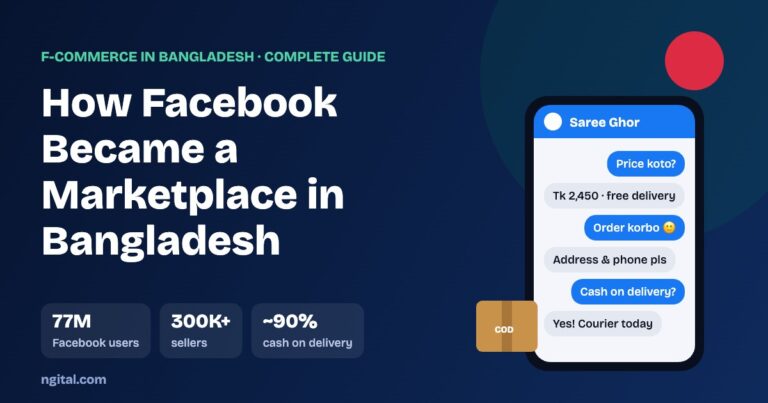
F-Commerce refers to businesses that operate primarily or entirely through Facebook: maintaining a Facebook Page as their storefront, taking orders through post comments or Messenger, managing customer service through the inbox, and in some cases advertising exclusively within the Facebook ecosystem. There are estimated to be well over 50,000 such operations in Bangladesh, ranging from home-based entrepreneurs selling handmade products to businesses with significant inventory and logistics operations.
F-Commerce has flourished because it dramatically reduces the barriers to commercial participation. Setting up a Facebook Page costs nothing. Running a basic Facebook ad campaign requires minimal technical knowledge. And in a market where consumer trust in unfamiliar websites has historically been limited, a Facebook Page with visible social proof — comments, shares, reviews from real people in a buyer’s network — often converts better than a standalone e-commerce website.
The broader e-commerce market crossed approximately $3 billion in GMV in 2025 and is on track for $4 billion by the end of 2026. Industry analysts project growth to $6–8 billion by 2027–2028 as rural digitisation expands the addressable market. The Centre for Policy Dialogue had earlier projected the e-commerce market reaching $10.5 billion by 2026, which appears optimistic in hindsight, but the directional growth trajectory is not in dispute.
Mobile financial services have been the infrastructure that made this possible. bKash, with its dominant position in mobile money, removed the payment friction that was one of the biggest barriers to e-commerce adoption. Nagad and Rocket have expanded the competitive landscape. The combination of widespread mobile money penetration and cheap smartphones created the conditions for e-commerce to reach consumers who had never owned a credit card and for whom traditional payment infrastructure was entirely absent.
Daraz, Chaldal, Shajgoj, and the food delivery platforms — Shohoz, Pathao, and others — represent the formal, platform-based layer of e-commerce. But they exist alongside, not instead of, the vast informal F-Commerce ecosystem. The marketing strategies appropriate for each are quite different: the formal platforms require an understanding of marketplace advertising mechanics and search ranking within closed ecosystems; F-Commerce requires an understanding of community-building, social proof dynamics, and the particular way trust is established through Facebook’s social graph.
Who Is Actually Online: The Demographics That Shape Everything
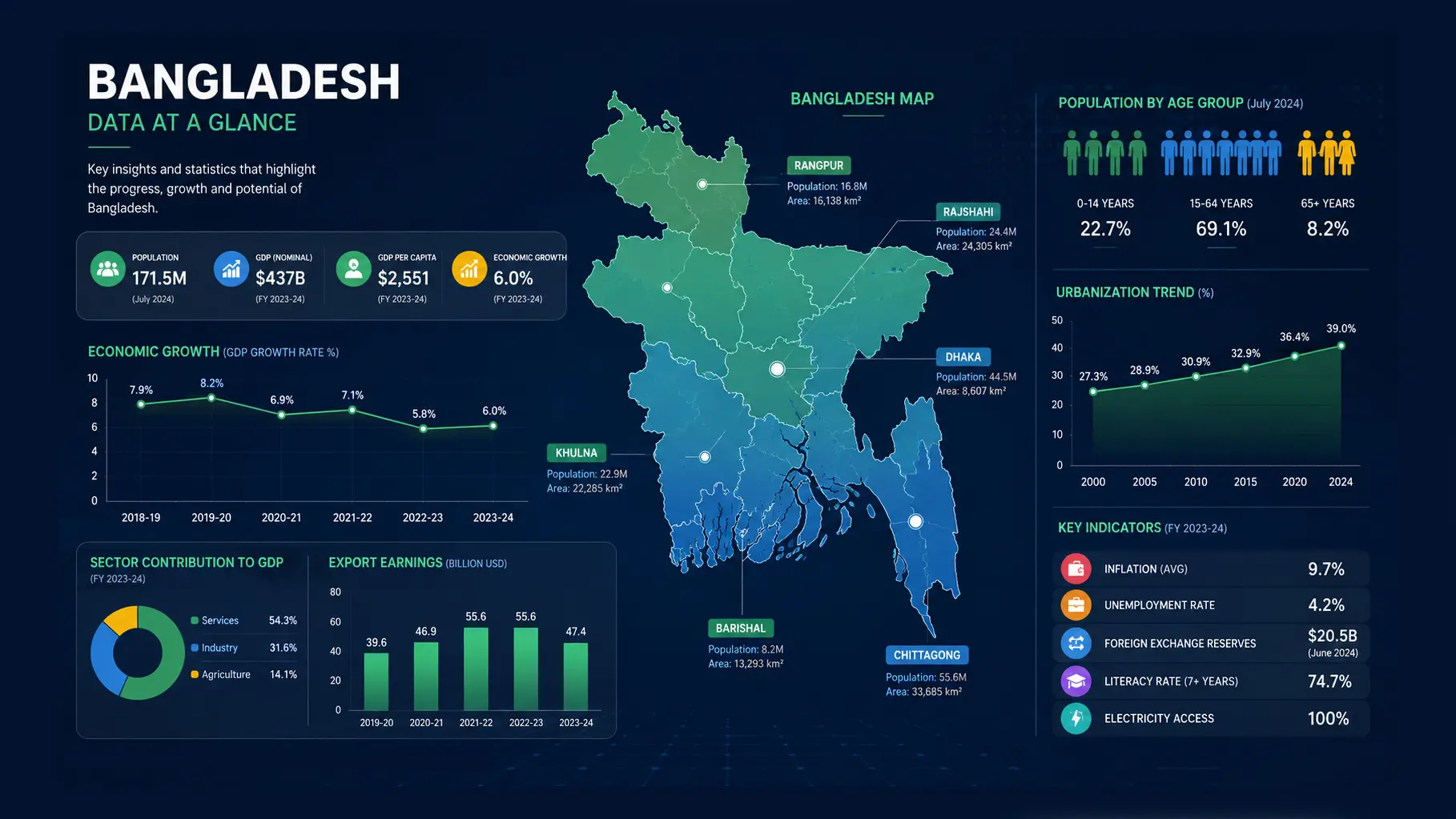
Bangladesh’s population is 176 million and demographically young. The median age is 26.0. Nearly one-third of the population — roughly 29.6% — falls between the ages of 18 and 34. Add the 13–17 cohort and you have a market where the plurality of the online population has grown up with smartphones as a baseline assumption, not a technological upgrade.
This matters for content strategy in ways that go beyond choosing TikTok over Facebook. It matters for what kind of brand voice lands. It matters for the relationship between entertainment and commerce — younger Bangladeshi consumers are comfortable with the blurring of those categories in ways that older demographics are not. It matters for influencer marketing, because younger consumers apply different frameworks of trust and authenticity to creator recommendations than they do to traditional advertising.
42.2% of the population is urban; 57.8% is rural. The urban-rural divide in digital marketing Bangladesh is real and deserves more attention than it gets. Dhaka dominates digital marketing conversations, partly because it dominates media production and agency infrastructure. But the majority of Bangladesh’s population — and a growing share of its online population — lives outside the metropolitan areas. Campaigns designed exclusively for Dhaka sensibilities, Dhaka aesthetics, and Dhaka reference points are speaking past the majority of the country.
Rural internet connectivity has improved substantially but remains meaningfully different from urban experience. Average speeds are lower. Data costs represent a larger share of household income. Content consumption patterns differ: longer YouTube videos watched on shared devices, more voice messaging, more reliance on lower-bandwidth text and image content where high-quality video streaming is not reliable. Brands that want to reach rural Bangladesh cannot simply duplicate their urban campaigns and adjust the targeting.
The gender gap in digital access is one of the most structurally important and least discussed features of the Bangladesh digital market. Across every major platform — Facebook at 36.9% female, TikTok at 29.9% female, LinkedIn at 28.6% female — reported ad audiences skew heavily male. This gap is real, even accounting for potential reporting biases and the fact that some women may use male family members’ accounts. Bangladesh has made substantial progress on gender equality metrics in many areas, but digital access and digital participation remain uneven in ways that brands need to understand if they are going to reach female audiences at the scale that raw user figures might suggest is possible.
What Is Working: The Real Practitioner Perspective
Aggregating data from agency practitioners, platform performance benchmarks, and what can be observed about which brands are winning attention in the Bangladesh digital market, a few consistent patterns emerge.
Bangla-first content creation is no longer optional for mass-market brands. Posts in Bangla generate 40–60% higher engagement than English for most consumer categories. But the distinction that matters is not just the language — it is the authenticity of the execution. Translated English, written in Bangla script but carrying the structural patterns of English marketing copy, performs poorly. Content that is actually thought in Bangla, structured in Bangla, and references cultural touchpoints that are genuinely Bangladeshi performs significantly better. The difference between the two is immediately obvious to the audience, even if it is not always obvious to the brand or the agency that produced the content.
Short-form video has become the dominant creative format, but most brands are still producing it wrong. The volume of Bangladeshi brands now producing TikTok and Reels content has increased dramatically. The quality — by which I mean not production value but strategic fit with the format — has not kept pace. The videos that perform are those that earn attention in the first two seconds, that feel native to the platform, that do not look like ads even when they are. The videos that do not perform are those that repurpose Facebook creative, that start with a logo, that lead with a product shot before establishing any reason for the viewer to keep watching. The gap between brands that genuinely understand this format and those that are producing content to tick a box is large, and it is visible in the performance data.
The measurement gap is a competitive opportunity. Most Bangladeshi businesses at the SME level still evaluate their digital marketing primarily through reach, impressions, and post engagement. Page likes remain a metric that some business owners care about. This is not entirely their fault — platforms surface these metrics prominently, and understanding the relationship between digital activity and business outcomes requires a level of analytics infrastructure that many small businesses have not had reason to build.
But for brands that do invest in proper attribution — tracking conversions, understanding cost-per-acquisition by channel and creative, building customer lifetime value models — the benchmarks they discover are often dramatically better than what their less analytically sophisticated competitors are working with. In a market where most advertisers are optimising toward the wrong goal, optimising toward the right goal is a durable source of advantage.
Community beats broadcast. One of the consistent findings from brands that have built large, engaged audiences in Bangladesh is that community dynamics outperform pure broadcasting. Facebook Groups, Messenger broadcast lists, WhatsApp communities — these private or semi-private spaces generate higher engagement, more word-of-mouth, and stronger repeat purchase behaviour than equivalent investment in public post reach. Brands that have built genuine communities around their products — not vanity groups, but groups where members derive real value from participation — have a customer relationship asset that is extremely difficult for competitors to replicate quickly.
The brand-building correction is underway, slowly. For several years, “performance marketing” was the dominant framework in Bangladesh digital advertising, and the pressure on agencies from clients was almost entirely toward short-term, measurable conversion. That pressure has not disappeared, but there is a growing recognition — among the more sophisticated brand owners — that pure performance marketing has a ceiling. When every competitor is bidding on the same high-intent search terms and retargeting the same audiences, cost-per-acquisition climbs and the efficiency advantages erode. The brands that invested in building genuine brand equity — distinctive creative, emotional storytelling, consistent positioning over time — are discovering that it reduces their customer acquisition costs across all channels, including performance channels, because consumers who recognise and trust a brand convert at a higher rate and require less persuasion.
Practical Benchmarks
For media planning and campaign performance evaluation in Bangladesh:
Facebook Ads average CPC ranges from BDT 2–15 (approximately $0.02–$0.14 USD) depending on category. Financial services and real estate sit at the upper end; fashion and FMCG tend toward the lower end. Healthy engagement rates for Bangladeshi brand pages on Facebook sit in the 3–6% range; below 1% on boosted posts typically suggests a targeting or creative problem. On Instagram, 4–8% is a healthy engagement benchmark. On TikTok, 8–15% is achievable for content that genuinely fits the platform.
Bangladeshis spend approximately 6.5 hours per day on screens, with social media accounting for roughly 2.5 of those hours. That daily time-on-platform figure is high by global standards and creates significant inventory for advertisers — but it also means that consumer attention has been heavily competed for, and the threshold for content that earns genuine engagement rather than passive impression continues to rise.
As a rough revenue allocation benchmark: growth-stage brands should consider investing 5–15% of revenue in digital marketing; established brands maintaining market position typically require 3–8%. Below 3%, sustaining visibility in competitive categories becomes increasingly difficult. These are not universal rules — category dynamics, competitive intensity, and business model all affect what is appropriate — but they provide a starting framework for conversations about budget adequacy.
The Next Twelve Months: Where to Pay Attention
Several developments are worth tracking closely over the coming year.
Rural connectivity expansion will continue to be the most significant driver of Bangladesh’s online population growth. As 4G reaches deeper into divisions beyond Dhaka — and as the economic case for smartphone ownership strengthens in rural households — the character of the online audience will shift. New entrants tend to use platforms differently from established users, are more likely to discover brands through word-of-mouth and social sharing than through paid advertising, and bring different content preferences. Brands that begin building for this audience now will have a meaningful head start.
AI integration into creative production and media buying is not a future consideration — it is happening in Bangladeshi agency workflows right now. The brands and agencies building AI-augmented content production pipelines are producing more content, faster, at lower cost per piece, and iterating on performance data more quickly than those who are not. The gap between early adopters and laggards will widen through 2026 and 2027.
Social commerce — the integration of purchasing functionality directly within social platforms — is maturing. TikTok Shop, Facebook Shops, and Instagram Shopping all have varying degrees of traction in Bangladesh, and the frictionless path from content discovery to purchase is becoming shorter. Brands that have invested in social commerce infrastructure — proper product catalogues, inventory integration, streamlined checkout — are positioned to benefit disproportionately as consumer comfort with in-platform purchasing grows.
Platform diversification is a risk management issue that more Bangladeshi brands should be treating seriously. A business whose entire digital presence depends on one platform — even one as dominant as Facebook — carries meaningful concentration risk. Algorithm changes, policy shifts, increasing ad costs, or competitive platform disruption can materially damage performance with little warning. The brands building audiences across multiple platforms and investing in owned channels — email, WhatsApp/Messenger lists, website SEO — are building more resilient marketing infrastructure.
The Honest Summary
Bangladesh’s digital marketing landscape in 2026 is large, competitive, fast-moving, and increasingly sophisticated. The easy gains — cheap Facebook reach, low CPC arbitrage, audiences that respond enthusiastically to almost any digital presence — are not gone, but they are harder to find than they were three years ago.
The market rewards quality differently than it used to. Quality creative in Bangla. Quality analytics that connect digital activity to business outcomes. Quality customer experience in the channels where Bangladeshi consumers actually communicate — which is Messenger, which is WhatsApp, which is comments sections that someone actually responds to.
The audience is there. 64 million social media users, growing 15% a year. An e-commerce market heading for $4 billion. A young, mobile-first population with rising income and rising digital expectations. The infrastructure is there. The platforms are there.
What separates the brands that will build durable positions in this market from those that will keep chasing short-term metrics is not access to the audience or the tools. It is the willingness to invest in understanding the audience properly, to produce creative that respects their attention, and to build marketing operations that can learn and adapt as the market continues to change. That has always been what separates good marketing from bad marketing. It just costs more to ignore in a market that is maturing as fast as this one.
Primary sources: DataReportal Digital 2026 Bangladesh (Kepios analysis, GSMA Intelligence, ITU, Ookla); ResearchAndMarkets / GlobeNewswire Q1 2026 Bangladesh Digital Ad Spend Report; Statista Digital Advertising Bangladesh; Centre for Policy Dialogue Bangladesh e-commerce projections; Agent Wise X Bangladesh Digital Marketing Statistics 2026; Ngital State of Digital Marketing Bangladesh 2026; Entrepreneurs BD Digital Marketing Strategy Bangladesh; Brandingly.Agency Marketing Trends Bangladesh 2026.