A few months ago, the marketing head of a mid-sized Bangladeshi fintech sat in my office and asked a question I've now heard so many times I could answer it in my sleep.
"Tajul bhai, when I Google my CEO's name, his competitor at another company has that big box on the right side of the screen — with the photo, the bio, the LinkedIn link. How do we get that for our CEO?"
I asked him if his CEO had a Wikipedia page.
He did not.
I asked him if his CEO had a Wikidata entry.
He didn't know what Wikidata was.
I asked him if his CEO had received significant independent media coverage in the last three years.
He went quiet — which is the same pause I described in my Wikipedia guide. Same pause, different motivation. He didn't want a Wikipedia page for the encyclopedia value. He wanted that "big box on the right side of the screen" — Google's Knowledge Panel — because he'd seen what it does for his competitor.
The conversation we had next is the conversation I'm writing down now. Because the connection between Wikipedia and the Google Knowledge Panel is one of the most misunderstood relationships in digital marketing — and getting it wrong wastes enormous amounts of time, money, and ambition.
This post explains how the two systems actually connect, what triggers a Knowledge Panel, what doesn't, and what a Bangladeshi brand or founder needs to do to earn one legitimately.
What this guide covers
By the end, you'll understand:
What a Google Knowledge Panel actually is (and what people confuse it with)
The Google Knowledge Graph — the system behind the panel
Where Wikipedia fits into that graph
Wikidata — the unsung hero most marketers don't know exists
Why Wikipedia is the strongest path to a Knowledge Panel, but not the only one
How to claim and verify a Knowledge Panel once you have one
Why some Bangladeshi brands have Knowledge Panels without Wikipedia pages
Why many brands with Wikipedia pages still don't get Knowledge Panels
The realistic Bangladesh-context strategy for earning Knowledge Panel presence
Common mistakes that delay or destroy Knowledge Panel attempts
This is evergreen. The specific UI may change. The underlying mechanics — knowledge graphs, entity recognition, structured data, authoritative sourcing — will not.
Part 1: What a Knowledge Panel actually is
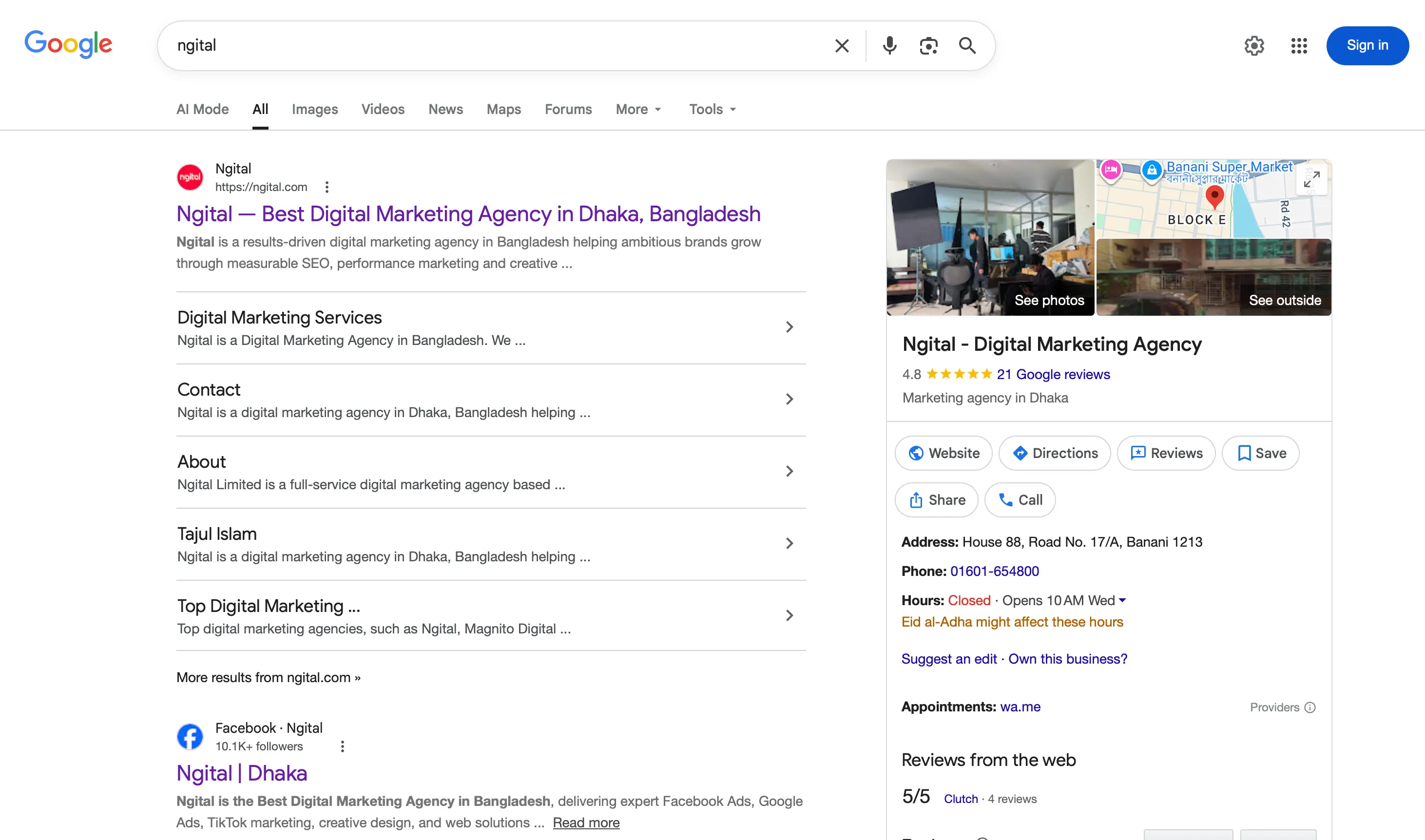
A Google Knowledge Panel is the information box that appears on the right side of desktop search results (or below the first few results on mobile) when you search for a recognized entity — a person, place, organization, brand, event, or concept that Google's system understands as a distinct, identifiable subject.
Notice that word: entity. This is the technical concept that drives everything we're about to discuss. Google doesn't show a Knowledge Panel for queries — it shows them for entities. The distinction matters enormously.
When you search "best ramen in Banani," that's a query. No Knowledge Panel.
When you search "10 Minute School," that's an entity — a specific, identifiable organization. Knowledge Panel.
When you search "Ayman Sadiq," that's also an entity — a specific person. Knowledge Panel.
When you search "digital marketing agency in Dhaka," that's still a query. No Knowledge Panel, because Google can't resolve it to a single identifiable entity.
What goes inside a Knowledge Panel varies, but typically includes:
The entity's name and a short description
A representative image (often pulled from Wikipedia or the official website)
Key facts — founding date, founder, headquarters, industry, parent company
Social media profiles
Official website link
Related entities (subsidiaries, related people, similar organizations)
A "Claim this knowledge panel" link for verified representatives
Knowledge Panels are powerful real estate. They dominate the first screen of search results, they reduce the click-through-rate to competing pages, they appear in voice search responses, and they feed AI assistants when those assistants are asked about your brand or your founder.
This is why every brand wants one. And this is why every brand needs to understand what actually triggers one.
Part 2: The Google Knowledge Graph — the system behind the panel
The Knowledge Panel is the visible tip of an iceberg. The iceberg is called the Google Knowledge Graph.
The Knowledge Graph is Google's internal database of entities and the relationships between them. It's been around since 2012, and it has grown into one of the largest structured knowledge systems in the world — billions of entities with countless relational connections.
For Google to display a Knowledge Panel for your brand or your founder, that entity must:
Exist in the Knowledge Graph as a recognized entity
Have a Knowledge Graph ID (a unique identifier)
Have enough confidently sourced information for Google to populate the panel
Pass Google's quality and confidence thresholds for display
Existing in the Knowledge Graph is the foundational step. Without that, no panel is possible — no matter how much SEO work you do, no matter how many backlinks you build, no matter how much content you publish.
How does Google decide which entities make it into the Knowledge Graph? Through a combination of authoritative source signals — Wikipedia and Wikidata foremost among them, but also government databases, licensed data feeds, structured data on the open web, and Google's own crawling of high-trust sources.
This is where Wikipedia enters the picture.
Part 3: Where Wikipedia fits
Wikipedia is one of the strongest signals Google uses to identify entities for the Knowledge Graph. There are a few reasons for this.
First, Wikipedia articles are vetted by a community editorial process that filters out non-notable subjects. When an article exists, it's an implicit signal that a meaningful number of independent editors agreed the subject warrants encyclopedia treatment.
Second, Wikipedia's structure is highly machine-readable. Article infoboxes, categories, internal linking patterns, and cross-language coverage all give Google's systems strong signals about what the entity is, what attributes it has, and how it relates to other entities.
Third, Wikipedia entries are paired with Wikidata entries — and that's where the real machine-readable magic happens (more on Wikidata in Part 4).
Fourth, Google has spent more than a decade tuning its systems to trust Wikipedia as a foundational source. The relationship is not formal or contractual — Wikipedia and Google are independent organizations — but the practical reality is that Wikipedia presence is one of the strongest predictors of Knowledge Graph inclusion.
This is why most brands that have a strong Knowledge Panel also have a Wikipedia article. Not because Google requires Wikipedia, but because Wikipedia is one of the cleanest ways to establish entity recognition.
However — and this is where most marketers get it wrong — Wikipedia is not a guarantee. I've seen brands with active Wikipedia articles that never developed a Knowledge Panel. I've seen Bangladeshi brands with Knowledge Panels that have no Wikipedia presence at all. The relationship is strong but not deterministic.
To understand why, you need to know about Wikidata.
Part 4: Wikidata — the unsung hero
If Wikipedia is the encyclopedia, Wikidata is the database underneath it.
Wikidata is a free, open, structured knowledge base that stores facts about entities in machine-readable form. Where Wikipedia has prose, Wikidata has structured statements like:
Instance of: business enterprise
Country: Bangladesh
Headquarters: Dhaka
Founded: 2015
Founder: [linked to founder's Wikidata entry]
Industry: education technology
These structured statements feed knowledge graphs across the internet — including Google's. Wikidata is essentially the connective tissue of the structured web.
Every Wikipedia article has a corresponding Wikidata entry. They are linked. When a Wikipedia article gets created and approved, the entity automatically becomes part of Wikidata's ecosystem — though the Wikidata entry itself often needs separate enrichment to be useful.
But here's the part that most Bangladeshi marketers don't realize: you can have a Wikidata entry without having a Wikipedia article.
Wikidata's notability threshold is much lower than Wikipedia's. A subject doesn't need significant independent coverage to merit a Wikidata entry — it just needs to be a clearly identifiable entity with verifiable basic facts. Companies, founders, products, events, organizations — most can support a Wikidata entry even when they don't yet qualify for Wikipedia.
This means Wikidata is sometimes the right entry point for entity recognition — particularly for emerging Bangladeshi brands that haven't yet built the media coverage required for Wikipedia.
I've seen Knowledge Panels emerge for Bangladeshi entities purely through Wikidata enrichment combined with strong structured data on the brand's own website, supplemented by mentions in authoritative third-party databases. No Wikipedia required. Slower and less predictable, but real.
For the official Wikidata project documentation, visit Wikidata's main page.
Part 5: The signals that actually trigger a Knowledge Panel
So if Wikipedia matters but isn't required, and Wikidata helps but isn't always enough, what does Google actually look for? Based on years of observation across hundreds of Bangladeshi and international brand projects, these are the signals that meaningfully move the needle:
1. Unambiguous entity identity Google needs to know that "Ngital" refers to one specific company in Bangladesh, not to a similar-sounding entity somewhere else. Unique brand naming, consistent usage across the web, and clear primary domain ownership all help. Brands with generic or confusable names face higher Knowledge Panel barriers.
2. Wikipedia or Wikidata presence As discussed, Wikipedia is the strongest single signal. Wikidata is a supporting signal that becomes the primary signal when Wikipedia isn't available.
3. Strong structured data on the official website Schema.org markup — particularly Organization, Person, LocalBusiness, and FAQ schemas — gives Google explicit, machine-readable facts about the entity. This is often the most under-invested area in Bangladeshi brand websites. Implementing comprehensive structured data is straightforward technical work that signals entity identity clearly to Google.
4. Authoritative third-party mentions Coverage in recognized publications, citations in government databases, listings in industry directories with editorial oversight, mentions in academic literature — all contribute to entity confidence. Volume matters less than quality. A handful of mentions in The Business Standard, The Daily Star, LightCastle Partners reports, or Future Startup features carries more weight than hundreds of low-authority directory listings.
5. Consistent NAP and identity signals Name, address, phone — the "NAP" of local SEO — applied consistently across the web reinforces entity identity. Inconsistencies (different addresses on different platforms, varying business names, conflicting founding dates) confuse the Knowledge Graph and delay or prevent panel display.
6. Connected social profiles Official, verified, consistent social profiles strengthen entity confidence. Discrepancies between social account information and other web signals weaken it.
7. Time and stability Knowledge Panels often appear gradually as Google's confidence in an entity grows over months or years. A new brand with strong signals across all the above areas may still wait six to eighteen months for a panel to appear. This is normal.
When all these signals align, a Knowledge Panel becomes likely. When they don't, even substantial brands can find themselves invisible to the Knowledge Graph.
Part 6: Why some Bangladeshi brands have panels without Wikipedia
If you spend a few minutes searching prominent Bangladeshi companies, you'll find a pattern. Some have Knowledge Panels. Some don't. The correlation with Wikipedia presence is real but imperfect.
I've examined this carefully over the years. Brands that have Knowledge Panels without Wikipedia tend to share several characteristics:
Strong unique brand naming with no entity collision
Comprehensive structured data on their websites
Wikidata entries (sometimes auto-generated, sometimes manually enriched)
Substantial coverage in Bangladesh's recognized business press
Government or regulatory database mentions (SEC filings, RJSC records, central bank registrations for fintech)
Active and consistent social media presence with verified accounts
Years of digital footprint maturity
The combination of these signals, even without Wikipedia, can sustain a Knowledge Panel. The brands that succeed this way typically belong to one of three categories: well-established companies whose Knowledge Panel emerged organically over time, regulated entities whose government database presence reinforces identity, or technology-forward brands whose website structured data implementation is unusually rigorous.
This matters because it means Knowledge Panel strategy isn't a single path. It's a portfolio of signals, weighted by what your specific brand can realistically build.
Part 7: Why some Wikipedia-published brands still don't have panels
The opposite case is equally instructive. I've worked with Bangladeshi brands that successfully published Wikipedia articles — passed AfC review, survived editorial scrutiny, accumulated reliable sources — and still don't have Knowledge Panels.
Why? Several common reasons:
Newness of the Wikipedia article. Google's Knowledge Graph doesn't immediately reflect new Wikipedia entries. There's typically a delay of weeks to months before a new article's signals propagate into the Knowledge Graph and trigger panel display.
Sparse Wikipedia content. A short stub article with minimal sourcing and few categories signals weaker entity confidence than a comprehensive article with rich content, multiple sections, and dense citations. Wikipedia articles that just barely cleared notability often don't trigger panels until they mature.
Weak supporting signals. Wikipedia alone often isn't enough. Without complementary structured data, Wikidata enrichment, and external entity reinforcement, even valid Wikipedia articles can fail to translate into Knowledge Panels.
Entity ambiguity. If your brand name overlaps with other entities Google has already established (a foreign company with the same name, a common term, a generic word), Google may not associate the Wikipedia article with the entity searchers are looking for.
Confidence thresholds. Google's display threshold for Knowledge Panels involves quality and confidence scoring we don't have visibility into. Entities sometimes fail to clear that threshold even when their underlying signals look strong.
The implication: Wikipedia is part of Knowledge Panel strategy, not the whole strategy. Treating it as a one-shot solution sets up disappointment.
Part 8: How to claim and verify a Knowledge Panel
If you're fortunate enough to have a Knowledge Panel — whether it appeared organically or after deliberate work — Google offers a verification process that gives you limited control over the panel's content.
The "Claim this knowledge panel" link appears at the bottom of panels for eligible entities. The claiming process requires:
A Google account associated with the entity (typically using an official email domain)
Verification through an authoritative profile linked to the entity (verified social account, official website, or other approved identifier)
Identity confirmation through Google's verification workflow
Once verified, you can:
Suggest changes to facts displayed in the panel
Submit a preferred featured image (subject to Google's review)
Update social profile links
Flag inaccuracies
You cannot:
Remove the panel
Rewrite the description freely (Google often draws descriptions from Wikipedia or Wikidata)
Override factual information that conflicts with authoritative sources
Add promotional content
Google's official documentation on this process lives in their Knowledge Panel help center. Read it before submitting changes — many submissions fail because they don't conform to Google's allowed edit types.
For Bangladeshi brands, verification is particularly worth doing once a panel exists, because it gives you a thin layer of influence over information that's otherwise outside your control.
Part 9: The realistic Bangladesh-context strategy
When a Bangladeshi brand or founder asks me to help them earn a Knowledge Panel, here's the sequenced strategy I lay out — adjusted to where the brand currently stands.
Stage 1: Audit current entity signals (Month 1) Document the brand's existing signals — website structured data, social presence, media coverage, directory listings, government records. Identify gaps. Establish a baseline.
Stage 2: Strengthen the home base (Months 1–3) Implement comprehensive schema markup on the official website. Standardize NAP across the web. Verify social profiles. Clean up directory inconsistencies. This is foundational work that supports every later stage. Our SEO services and web development teams handle this systematically.
Stage 3: Build Wikidata presence (Months 2–4) For brands not yet ready for Wikipedia, a properly constructed Wikidata entry is the first real entity-graph foothold. This requires careful adherence to Wikidata's referencing standards but is achievable for most legitimate businesses.
Stage 4: Develop media coverage (Months 3–12) The single biggest determinant of long-term Knowledge Panel strength is independent media coverage. Earned media — not press releases, not paid placements — is the work that supports both Wikipedia eligibility and Wikidata credibility. Our content marketing practice focuses heavily on this for clients pursuing long-term entity recognition.
Stage 5: Wikipedia engagement (Months 9–18) Once media coverage supports a credible notability case, Wikipedia work becomes appropriate. The full pathway is covered in our Complete Guide to Wikipedia Page Creation for Bangladeshi Brands.
Stage 6: Patience and monitoring (Months 12–24+) Knowledge Panels appear when Google's confidence crosses the display threshold. That timeline isn't fully controllable. Brands that build all the underlying signals correctly typically see panels emerge within twelve to twenty-four months of starting serious work. Some see them sooner. Some take longer.
The brands that lose money on Knowledge Panel strategy are the ones that try to compress this timeline. There is no compression. The signals Google trusts require time to develop, be indexed, and be validated.
Part 10: Common mistakes that delay or destroy Knowledge Panel attempts
I've seen Bangladeshi brands make the same mistakes repeatedly when trying to earn Knowledge Panels. The most damaging ones:
Buying low-quality directory listings in bulk. This was an SEO tactic from a decade ago that still gets sold in the Bangladeshi market. Mass directory submissions create inconsistent NAP information that weakens entity confidence rather than strengthening it. Worse, many of these directories are seen by Google as low-quality signals that hurt overall site authority.
Creating multiple Wikipedia accounts to inflate Wikipedia presence. This is sockpuppeting. Wikipedia detects it. When detected, every account gets blocked and every article connected to those accounts gets flagged. The damage extends to making future legitimate Wikipedia work significantly harder for the brand. I covered this in detail in the Wikipedia page creation guide.
Stuffing structured data with promotional language. Schema.org markup is for facts, not marketing copy. Google detects manipulative structured data and discounts it. Worse, aggressive abuse can trigger manual penalties that affect overall search visibility.
Treating the Knowledge Panel as a vanity goal. Some founders chase Knowledge Panels because their competitor has one. This isn't a strategy — it's status anxiety. Knowledge Panels reward genuine brand maturity. Brands that pursue panels before building the underlying business achievement waste money chasing something that's still years away regardless of effort.
Hiring agencies that promise Knowledge Panels in 30 days. No agency can guarantee this in any timeframe, let alone 30 days. Anyone making this promise is either lying or planning to fabricate signals that will damage your brand when detected. Walk away.
Ignoring Wikidata while obsessing over Wikipedia. Wikidata is often the faster, more accessible path for emerging Bangladeshi brands. Marketers fixated on Wikipedia sometimes overlook the Wikidata work that could meaningfully shorten their timeline.
Inconsistent founder/brand naming. "Tajul Islam" vs "Md. Tajul Islam" vs "Tajul" across different platforms confuses entity identity. Standardize early and maintain consistency rigorously.
Skipping verification once a panel appears. Brands that earn panels but never verify them lose the limited but real ability to correct factual errors. Verification is easy and worth doing immediately.
How AI search is reshaping the Knowledge Panel question
Through 2025 and into 2026, 2027, something significant changed in how digital authority works. AI-powered search — ChatGPT, Perplexity, Gemini, Claude, Google's own AI Overviews — became a primary discovery layer for millions of users.
These systems don't just display Knowledge Panels. They generate answers that synthesize information from across the web, with heavy reliance on Wikipedia, Wikidata, and authoritative structured sources. The same signals that drive Knowledge Panel display also drive how AI assistants describe your brand.
This changes the strategic calculus.
Five years ago, a Knowledge Panel was a search-result enhancement. Today, the underlying entity signals — Wikipedia, Wikidata, structured data, authoritative third-party mentions — shape how every AI system understands your brand. A Knowledge Panel is now the visible signal of a much larger invisible foundation that determines AI search visibility.
This is why I've stopped thinking of "Knowledge Panel work" as a discrete service and started thinking of it as "entity authority work." The Knowledge Panel is one output. AI search presence is another. Wikipedia article visibility is another. Voice search response accuracy is another. They all flow from the same underlying foundation.
The brands that invest in that foundation now — properly, patiently, without shortcuts — are building digital authority that compounds across every emerging discovery surface. The brands that chase individual outputs without building the foundation continue to fall behind.
Frequently Asked Questions
Q: Do I need a Wikipedia page to get a Google Knowledge Panel? A: No, but Wikipedia is one of the strongest single signals supporting Knowledge Panel display. Brands with Wikipedia articles are significantly more likely to have Knowledge Panels than brands without. However, Knowledge Panels can emerge from Wikidata entries, strong structured data, authoritative third-party mentions, and consistent entity signals across the web — even without Wikipedia.
Q: How long does it take to get a Knowledge Panel? A: Realistically, twelve to twenty-four months from the start of dedicated entity authority work, assuming the underlying brand has genuine notability and authoritative signal-building progresses smoothly. Some brands see panels sooner. Many take longer. Anyone promising a specific timeline is overstating their control.
Q: Can I pay Google to create a Knowledge Panel? A: No. Knowledge Panels are not a paid product. Google doesn't sell them. Any agency claiming to "get you a Knowledge Panel through Google directly" is misrepresenting the product. Knowledge Panels are earned through authoritative entity signals — not paid.
Q: Why does my competitor have a Knowledge Panel but I don't? A: Likely because they have stronger entity signals than your brand currently does — typically a combination of Wikipedia or Wikidata presence, comprehensive structured data, substantial independent media coverage, and longer digital footprint maturity. The fix is to build those signals deliberately, not to chase the visible output.
Q: My brand has a Wikipedia article but still no Knowledge Panel. Why? A: Common reasons include newness of the article, sparse Wikipedia content, weak supporting signals (low structured data, limited Wikidata enrichment, inconsistent identity signals across the web), entity ambiguity with similarly-named subjects, or simply that Google's confidence threshold hasn't been crossed yet. Patience plus continued signal-building usually resolves this within months.
Q: How do I add information to my existing Knowledge Panel? A: Use the "Claim this knowledge panel" link, complete Google's verification process, and submit suggested changes through the official workflow. Be aware that Google often draws Knowledge Panel descriptions from Wikipedia or Wikidata, so the most effective way to influence the description is often through editing those underlying sources rather than submitting changes through Google directly.
Q: Can a Wikipedia article hurt my brand's Knowledge Panel? A: It can, in specific circumstances. If your Wikipedia article includes significant negative coverage — controversies, legal issues, criticism from reliable sources — that content can appear in or influence the Knowledge Panel. Wikipedia covers what reliable sources cover, including criticism. This is one of several reasons we discourage brands from pursuing Wikipedia before they have a stable, defensible public record.
Q: What's the difference between a Knowledge Panel and a Knowledge Card? A: Knowledge Panels are the larger right-side (desktop) information boxes that appear for major entities. Knowledge Cards are smaller answer-focused result types — often triggered by factual questions like "founder of [company]" or "headquarters of [organization]." Both pull from the Knowledge Graph but serve different query types. The signal-building work that supports Knowledge Panels also supports Knowledge Cards.
Q: Is Wikidata enough on its own? A: Sometimes, but rarely as the sole signal. Wikidata works best as part of a broader entity authority foundation — strong structured data, consistent web presence, authoritative mentions, and ideally Wikipedia or progression toward Wikipedia. For some emerging Bangladeshi brands, a well-built Wikidata entry plus comprehensive site structured data plus consistent NAP signals is enough to trigger a panel within twelve to eighteen months. For others, more is needed.
Q: Should I focus on Knowledge Panel work or AI search visibility? A: Increasingly, they're the same work. Both are downstream outputs of the same underlying entity authority signals. Investing in Wikipedia, Wikidata, structured data, consistent identity signals, and authoritative third-party coverage strengthens both surfaces simultaneously. Treating them as separate strategies leads to duplicated effort and incoherent results.
Where to go from here
If you've made it this far, you understand more about how Knowledge Panels actually work than ninety percent of the people selling Knowledge Panel services in Bangladesh. That's not flattery — it's an honest observation about the gap between marketed expertise and actual expertise in this space.
The next step depends on where your brand currently stands:
If you already have strong entity signals: Request a free entity audit from our team. We'll evaluate your existing structured data, Wikidata status, media coverage, and identity consistency, then identify the highest-leverage gaps. Visit our Wikipedia Page Creation Services page or contact us directly.
If your foundation is weak: Start with structured data and identity consistency. These are the lowest-cost, highest-impact improvements. Our SEO services team handles this systematically, and the work compounds across every other authority surface.
If you're not yet notable enough: Invest in earned media development. Real journalism, real industry recognition, real third-party validation. Our content marketing practice is built around developing this kind of substance over twelve-to-eighteen-month engagements.
Whatever stage you're at, the principle holds. Knowledge Panels reward authentic entity authority. The brands that build that authority deliberately — patiently, with discipline, without shortcuts — see panels emerge as natural consequence. The brands that chase the visible output without the underlying foundation continue to wait, year after year, for something that signal-building alone could have delivered.